Review of Summer of Sam (1999) by Michelle K — 31 May 2011
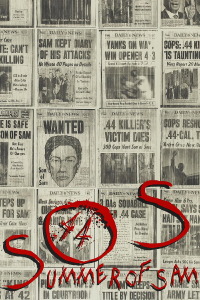
Spike Leeâ(TM)s harrowing exploration of New York during the Summer of 1977, the summer leading up to the David Berkowitzâ(TM)s (the Son of Samâ(TM)s) capture, is a breathtaking cinematic tour de force that represents a departure from Leeâ(TM)s previous films (Do the Right Thing, Jungle Fever, Malcom X, etc.
). Lee had made a name for himself making cinema that concerned the African-American experience in the past and present. Summer of Sam still explores issues of prejudice and urban life, but it features almost no major black charactersâ"the only significant black character is the reporter played by Lee himself who shows up at various points to examine the reaction of people on the streets to the series of murders.
The main characters in Summer of Sam are all Italian-American, andâ"as he had already done in other films like Do the Right Thingâ"Lee demonstrates his intimate, first-hand knowledge of Italian-American New Yorkers.
And the film is really about the prejudice that exists among themselves, particularly against those that are perceived as different, perverse, or weird. This weirdness is epitomized in the neighborhood of the film by Ritchie (Adrien Brody), who left the neighborhood and has returned as a punk complete with trashy clothes, spiky hair, dog collars, etc.
Plus, Ritchie earns extra money by performing S&M style strip shows at a local gay strip club. His entire personality and behavior runs against the traditions and expectations of the Italian-American community, and Ritchie soon becomes a suspect character in the neighborhood.
Also starring John Leguizamo, the beautiful and talented Mira Sorvino, Jennifer Esposito, and Ben Gazarra from John Cassavetesâ(TM)s The Killing of a Chinese Bookie, Summer of Sam represents Lee moving on to explore other kinds of prejudice than those that are based on the racial dichotomy of black/white; instead, Lee explores disco/punk, tradition/counterculture, religious morals/contemporary morals, homophobia, etc.
But Summer of Sam is not just a departure within in the Spike Lee canon; it is also a brilliant variation on the serial killer genre. Instead of focusing mostly on the killings, the serial killer, or the police hunting the killer, Summer of Sam focuses on normal people coping with the nightmarish atmosphere that the killings foster in the neighborhood.
Featuring glimpses into such famous New York clubs as Studio 54 (Disco) and CBGB (Punk, Post Punk, and New Wave), Summer of Sam also depicts the divide between different schools of popular culture. Finally, Summer of Sam also explores how culture develops conflicted, neurotic, and even violent forms of subjectivity.
In particularly, John Leguizamo's character remains conflicted between his repressed, Catholic ideas about sexuality and his modern, permiscuous desires. In the final analysis, Summer of Sam uses the figure of the Son of Sam serial killer to explore the tensions within our culture and within ourselves--the psychotic divide within the serial killer's mind becomes symbolic of cultural paradoxes that lead to violence, destruction, and neurotic guilt.
An excoriating critique of how culture, religion, and the media shape our personalities, Summer of Sam remains a classic of the Spike Lee canon as well as a highly original innovation in serial killer cinema.
This review of Summer of Sam (1999) was written by Michelle K on 31 May 2011.
Summer of Sam has generally received mixed reviews.
Was this review helpful?