Review of Strangers on a Train (1951) by Hatem A — 16 Aug 2011
4.0/4.0.
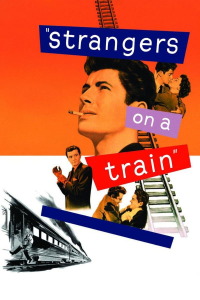
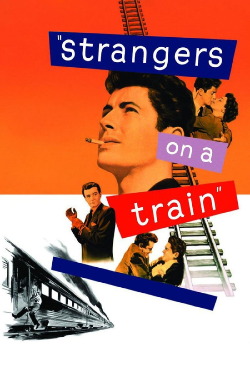
"Strangers on a Train" is undoubtedly one of Hitchcock's best movies. A great piece of film noir, the movie is filled with endless memorable, flawless scenes from the movie's opening sequence where we watch two feet as they board a train leading to a chance meeting between two men that changes their lives forever.
The two men are amateur tennis player Guy Haines (Farley Granger) and spoiled rich kid Bruno Anthony (Robert Walker who died shortly after this movie). Bruno knows everything about Haines from the fact that he is dating senator's daughter Anne Morton (Ruth Roman) to that he wants to divorce his unfaithful wife Miriam (Laura Elliott). As the conversation ensues, Bruno shares with him the idea of perfect murder given that Guy is obviously resentful of his wife and Bruno hates his father. The idea is exchanging murders (or "crisscross" as Bruno calls it). Guy leaves the compartment in a rush and acts as if he played along with the conversation. Bruno, believing Guy actually agreed to the deal, goes to his hometown of Metcalf and follows Miriam as she heads to an amusement park with two men. The perfectly constructed sequence starts off as Miriam and Bruno seemingly flirt with each other and ends with Miriam's strangulation that we see through her broken fallen eyeglasses (possibly cinema's most memorable set of eyeglasses; from the moment we see Miriam the eyeglasses catch our attention perfectly building up for that scene and for a later one in the movie).
From that point on, the movie diverts into a (possibly one of cinema's first and best) stalker movie with Bruno following Guy's every move as he expects him to repay him by murdering his father. In one of the movie's more memorable and famous shots, we see Bruno seated in tennis aisles with his eyes fixated on Guy as all other watchers move their eyes with the tennis ball. Another scene shows Bruno's shadowed face (it is only evident it is him from his hat) as he is standing on the staircases of one of Washington's monuments. There is also the famous Hitchcockian wrongfully accused theme as Guy emerges as the prime suspect (especially after his alibi fails him) and is placed under police surveillance.
There is a subtle homoerotic tension between the two leads that really makes their relationship and encounters more memorable and tension mounting, although the theme not as obvious as in Hitchcock's 1948 movie "Rope" that also starred Granger (This comes as no surprise given that the movie based on the 1950 first novel by Patricia Highsmith of Tom Ripley fame).
Granger is great in his portrayal of Guy, a somewhat soft character who is plagued with guilt despite the fact that he did nothing wrong other than wishing Miriam dead. But the real powerhouse performance here is Walker who plays this diabolical and sick yet sometimes amusing and funny character to the perfect note. The movie also stands out as one of Hitchcock's movies that have a relatively big array of solid supporting characters. Elliott in a brief memorable role is both seductive and memorable and there's also Leo G. Carroll as Morton's senator father. Hitchock's daughter Patricia plays Anne's younger sister Barbra - she is a good comic relief here playing a character that says out loud what everyone else is probably scared to say. She also sports very memorable glasses, which lead to another great scene where Bruno goes into a state of trance (recalling Miriam) while amusingly demonstrating the art of strangulation to an old woman at a party at the Senator's place. My favorite supporting role here is Marion Lorne as Bruno's mother who in a brief role sheds light on Bruno's psyche and where he got his insanity from.
The movie has a perfect finale. In a long sequence with a perfect buildup, we get Guy playing and trying to quickly wrap up a tennis match (that is a very well filmed one I must say) to quickly stop Bruno who is heading back to Metcalf to plant evidence that could potentially incriminate Guy. Then there is the famous merry-go-round sequence (that was really filmed with no special effects) that remains an edge-of-your-seat experience till today. The closing scene is appropriately set on a train (actually there are many other train scenes throughout the movie, with Hitchcock setting them up as a motif).
This review of Strangers on a Train (1951) was written by Hatem A on 16 Aug 2011.
Strangers on a Train has generally received very positive reviews.
Was this review helpful?