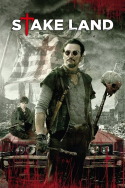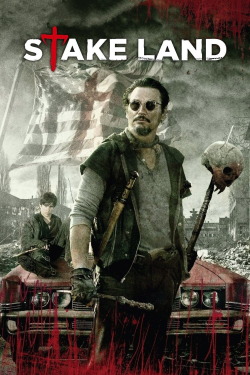
Review of Stake Land (2010) by Sally A — 11 Jul 2012
Has the whole vampire/zombie metaphor been stretched too far now with the explosion of releases in the last few years, far surpassing even the genre fan's appetite for them. Well this film gives you the answer - that if the director has a broad enough palette of influences and some convincing relationships, then it is possible to make a unique film in the post '28 days later' mould. Another question must also be asked though: Is a film usually improved by utilising classic conventions, such as those of the Western or the Horror, or can a directors imagination be unnecessarily constrained by this desire to satisfy genre expectations?
I should start by owning up to the fact that I am not generally a fan of modern zombie/vamp flicks simply because there were some excellent films in this area in the last century and I hate the way in which Romero's zombies or Coppola's vampyres have been diluted or substituted for something more fetishistic or pointless e.g. Twighlight's reinvention of vampires as chivalric, sub-Jane-Austin heart-throbs. On the other hand, '30 days of night' had most of the meaning, tension, cinematography and relationships that I would look for in a good horror flick - it may have been an influence on this film in fact, with the evil Jebidia Loven character reminding us of the lead vampire Marlow.
In Stake Land, the political allegory can be a little heavy handed at times, but the developing relationship between Mister and his protà (C)gà (C) Martin (an awkward young man who has been bereft of contact with women for some time - a homage to Romero's 'Martin') and the growing understanding that Martin and the audience have of the brutality which is closing in on the protagonist, largely compensates for this and reminds us of classic Western partnerships or reimagined Westerns like Clint Eastwood's Gran Torino.
If you really want to talk about recent influences on Director Jim Mickle, the one that stood out most throughout the film was actually 'Cold Mountain', the civil war epic, because of the visuals and the sense that ordinary Americans have been betrayed by their own. Another type of civil war has broken out here between mysoginist religious zealots (The Brotherhood) and multi-cultural, tolerant, world-weary survivor communities, singing ominous Meat Puppets songs from way back in the 1980's to accoustic guitar, in a run down old community speakeasy - two ideas of what America should be. The nature of this battle is one of the most enjoyable surprises as the story unfolds, with the zombies sidelined to the woods, like a pack of wild animals, used by the Brotherhood as a sort of biological weapon to hold America randsom with - which persoanlly made me wonder why the scriptwriter didn't just use wild animals instead of a laboured zombie metaphor? In a way, this Brotherhood are everything that Fox News would have you believe 'Al Queda' are - turned around on its head and cast as the most un-christian Christians you've ever met, inflicting a Vietnam-style rain of terror on their own people.
These terror cells thrive in a nation enveloped in a continental apocalypse of sorts: An infectuous disease has driven the majority of the population to brain-dead, flesh-eating madness. The fact that at no point in the film do we see livestock or other animals in the baron, rural, prairie landscape and the title of the film, implying Steak as well as Stake, suggests that the disease has been carried rapidly through the foodchain. One of the wonderful things about the film is that nothing is spelled out. There is very little annoying plot exposition, despite the fact that a voice-over is utilised (generally not a favourite technique of mine in a modern film and probably a 'Martin' homage again), which did seem slightly out of place at times, conflicting with our empathy for the world-weary Mister and tending to state the obvious.
The actors are not overburdened with dialogue or private conversations, making it difficult to say whether the cast is particularly talented or not, but there is certainly no problems which stand out and plenty of Eastwood/Bronson/Tommy Lee charisma when needed. While the director uses silences well to build tension, at certain moments the script can be a weakness because it reminds you that the film is essentially a road-trip western which is driven by a somewhat predictable course of events. Attempts at brief chats between minor characters, such as a clumsily introduced ex-soldier who fills us in on the extent of the national crisis and the poor political response, remind us that this is a movie which seems happy to be confined to horror festivals, unlike the comparable 'The Road'. As soon as the marine steps into the car the whole audience knows he is the 'Derek' and will soon meet his untimely end before we have got to know him.
The film could easily have taken more of an interlude from the trip north to Canada (The New Eden) to explore a particular character more and there are hints towards the end that the director wanted to do this but was limited by timing and genre. The film works best with two or three people awkwardly trying to figure each other out and figure out who they can trust - as at the beginning of the film with the two travellers and an abandoned middle-aged housewife.
The soundtrack and rustic music helps to add tension and a sense that the film is about more than ripping of throats, although there is some of that too and the zombie make-up job is one of the most brutal I have seen. The director manages to use low lighting (the zombies only become active at night like vampires), cuts, angles and speed to create a horrible dread in the audience when a pack of flesh-eaters are closing in. There is an excellent use of the Jacques Tourneur less-is-more approach, making the audience try to guess where the next threat will emerge from and when the violent confrontations occur, they are usually uncoreographed and scrappy, adding a greater sense of risk and unpredictability.
So overall the film is a little bit of a beautiful anti-climax. It gives the impression of being a paired back horror film, focusing on the most essential ingredients, but gradually it reintroduces the superfluous conventions of modern horror and overcomplicates the underlying plot. The director cleverly sets up various scenarios which seem to have very interesting dramatic potential, but the conclusion to each developement is either a predictable horror 'pay-off' or a sort of condensed, bite-size relationship. If he had added less of these developements and concentrated on say three or four characters indepthly, more akin to the approach taken in 'The Road', then the film might have achieved its own objectives better and in the process, given the audience some memorable characters to go along with the beautiful scenery, score, action and thrills (in particular a fast-paced zombie chase sequence through iconic rural scenery, transformed by darkness into the perfect horror setting). The well executed and subtle ending, tries to remind us that it is a film of politics, ideas and allegory, but in reality the logic of the film is fairly simple and most of the time it is the dramatic potential which had the audience hooked, and ultimately a little disappointed.
There is so much promise in this film, but I can't ignore the fact that there are some real wasted oppertunities here where one of the most aesthetically beautiful horror films you will see occasionally slides into a made for TV culdisac. Well worth seeing when compared to other recent horror releases in this area.
This review of Stake Land (2010) was written by Sally A on 11 Jul 2012.
Stake Land has generally received positive reviews.
Was this review helpful?