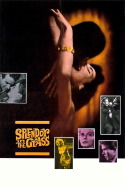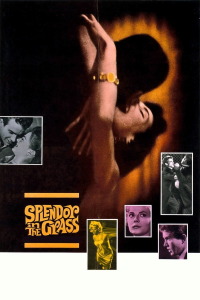
Review of Splendor in the Grass (1961) by Tanya P — 17 Jun 2010
Grade: B+.
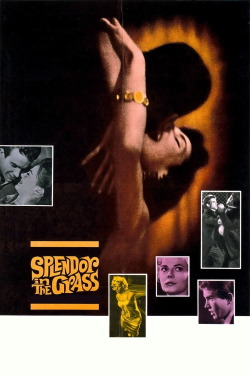
Director Elia Kazan made this film about two teenagers in late 1920s rural Kansas that fall in love, only to be forbidden their sexual desires because of their parents separate wishes and the status quo beliefs of their mainly puritanical society.
The late, great Natalie Wood gives a terrific performance as Deanie Loomis, the teenage girl that has fallen completely and hopelessly in love with the most popular kid in school. He is Bud (Warren Beatty, in his first film), the son of a rich oil tycoon played by Pat Hingle as a mad and greedy capitalist that is as much in control of son's life as his son is; he wants his son to go to Yale for four years before marrying Deanie, the woman he loves. To simplify Bud's thought processes; he's basically thinking "Four year waiting to have sex? Am I going to be able to wait that long? Hmmm..." Hingle plays the oil man as a monster that tries his best to hide his evil with money. He attempts to make his son forget about Deanie by conniving him to think about other women, and Bud also has to contend with all the other women in the world as he's forced to keep it in his pants with Deanie. Hingle and Beatty also manages to give a handful of hilarious scenes as well; ironically hilarious scenes that may ultimately be heartbreaking as well.
The film is a teenage drama, a very serious one that harks back to a time when adults still attempted with vigour to maintain a stranglehold on their children. Bud is just a boy though, and boys just want to have sex, right?; therefore the struggle he exhibits does have comedic undertones to it, at least to me. Beatty portrays this mental struggle between loyalty and desire in Bud in a very intriguing, serious, and sometimes funny way. Bud, a teenage boy with teenaged desires, can hardly keep his pants on around Deanie, and he loves her, but he can't do anything about it because of all of the forces telling him not to. His utter confusion is depicted in a hilarious way in one scene in particular that takes place on a football field. This could be taken as straight drama as well, but I found it to be rather funny.
Deanie's mother is a strict woman of the old world ideal, and she cannot handle the idea that her daughter would have sex before getting married, lest she be "ruined" as she and others used to put it (some who still do). Such is the pressure that she puts on her daughter not to have sex that it, as well as Bud's parent's multiple demand, puts strain on their relationship. Her mother's sermonizing and moralising is as tactless as it is annoying and ultimately incorrect and wrongheaded; she is also part of the cause for Deanie's mental woes, even if she can't realise the damage she's causing. Deanie's has several difficult struggles to consciously decide and work toward pleasing all of the people around her and going insane over it. Her situation is juxtaposed with Bud's sister Ginny, who is the definition of a 1920's floozy in that couldn't care less what anyone thought about her actions. She is a drunken sexpot with what is seemingly an emotionally scarred background that has to do with her control hungry and powerful father; Deanie and Ginny are like two sides of a coin, or opposites in a mirror, or as David Lynch writes in INLAND EMPIRE "....as he passed through the door, he saw a reflection. Evil was born.".
A similar struggle goes on with Bud, except in his case it's more for sexual satisfaction or dissatisfaction; but will he ever love a person as much as he loved Deanie? This is a question he carries with him as the social forces create distance between them. I don't want to tell you how everything turns out, because the films ideas and themes are inextricably connected to the direct outcome of the plot and how it unfolds. Something does happen near the end that I knew was going to happen right when the film started though, which sort of blunted some of the impact of it for me. So I'll just end my review with the poem Splendour in the Grass, which is really a summation of what this films message is all about:
.......................................................................................................................................................................................................................................
Splendour in the Grass, a poem by William Wordsworth.
What though the radiance was once so bright.
But now forever taken from my sight.
Though nothing can bring back the hour.
Of splendour in the grass, of glory in the flower.
We will not grieve, rather find.
Strength in what remains behind;.
In the primal sympathy.
Which having been must ever be;.
In the soothing thoughts that spring.
Out of human suffering;.
In the faith that looks through death,.
In years that bring the philosophic mind.
........................................................................................................................................................................................................................................
This review of Splendor in the Grass (1961) was written by Tanya P on 17 Jun 2010.
Splendor in the Grass has generally received very positive reviews.
Was this review helpful?