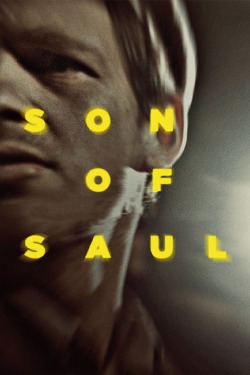
Review of Son of Saul (2015) by Dave M — 22 Feb 2016
Sometimes life presents us with impossible choices. These are decisions we have to make even though all the options are horrible to contemplate. What do you do in a situation like that? What CAN you do? You choose the option with which you can most easily live, hoping that a better option will soon present itself. It's that kind of situation in which many European Jews found themselves during World War II. Upon arrival at a Nazi concentration camp or extermination camp, some physically fit adult males were separated from the pack and forced to help with the killing of their fellow Jews. The Nazi guards had the task of actually running the gas chambers, while the Jewish "Sonderkommando" (German for "special unit") gathered the belongings of the Jews who had just been forced into the gas chamber (made to look like showers). Then, when the horrible screaming and pounding on the locked doors stopped, the Sonderkommando had to transport the bodies to the crematorium. The word horrible barely begins to describe the job of the Sonderkommando - or the impossible choice they had to make. That "choice", however, was merely one of obedience versus suicide, with disobedience being equivalent to the latter. Some Sonderkommando chose that latter option, but most fulfilled their gruesome responsibilities and hoped that they would somehow survive. That is the world of the Hungarian film "Son of Saul" (R, 1:47).
Saul Ausländer (Géza Röhrig) is a Hungarian Jew who works as a Sonderkommando at Auschwitz. One day as he is clearing corpses out of the gas chamber, he finds a teenage boy who is still breathing, but coughing and obviously near death. A Nazi doctor plugs the boy's nose and covers his mouth to finish the job the gas had not, as Saul watches from another room. Because the boy's initial survival is such a rare occurrence, rather than sending the boy's body to the crematorium, the doctor orders an autopsy. Saul enlists help from the doctor's assistant, who happens to be one of the prisoners, to set the body aside instead. Saul wants to give the boy a proper Jewish burial. Saul believes that this boy is his son.
Saul spends the remaining twenty-four hours covered by the film making sure the boy's body remains hidden and desperately searching among his fellow prisoners for a rabbi to perform the proper funeral rites. Saul takes dangerous chances as he moves around the camp, surrounded by various stages in the murderous routine at Auschwitz, such as receiving new arrivals, operating the gas chamber and crematorium, burning bodies outside when the crematorium becomes overwhelmed and shoveling mounds of ash into a river. Further complicating Saul's quest, his fellow Sonderkommandos are plotting an uprising and they insist that he help, in spite of his conflicting priorities.
With every step, "Son of Saul" solidifies its place among the world's great Holocaust films. It's powerful like Steven Spielberg's 1993 masterpiece "Schindler's List", personal like Claude Lanzmann's 1985 epic "Shoah", intimate like 1997's "Life is Beautiful" and heartbreaking like 2008's "The Boy in the Striped Pajamas". Co-writer and director László Nemes places his camera almost literally on the back of his lead actor, with nearly every image being a shot of Saul or a scene viewed from Saul's perspective. Nemes also uses a camera lens with a very short focal length, giving his shots a very shallow depth of field, meaning that the main character is often the only image in focus. These cinematography techniques have the effects of blurring the most graphic details of what Saul is seeing and doing, as well as drawing the viewer into the action in a way that feels like voyeurism, but is actually profoundly intimate.
"Son of Saul" effectively shines a light on one of the lesser-known and more horrifying aspects of the Holocaust. Röhrig brings an appropriate understated intensity to the role of Saul, a man being forced to the do the unthinkable. He has become emotionally numb, but struggles to maintain a small shred of his humanity, even as he knows he isn't likely to have much time left. We also see the sober acceptance of fate in the eyes, words and manner of all the supporting players. Those performances, combined with the realistic look of every frame of film and the creatively intimate camera work, wake us feel that we are right there with these people every step of the way as they march toward their nearly certain doom.
However, as an open-minded reviewer who considers all aspects of the films I see, I feel compelled to note just a few problems with the film which, unfortunately, slightly lessened its overall impact for me. Although it's understandable on an emotional level, it's still difficult to believe Saul would go to such great lengths to bury this boy, not just because he was risking his own life, but also considering he was increasingly endangering the lives of those around him. I also found the anticlimactic and open-ended resolution to the boy's story to be unsatisfying and frustrating (same thing with the movie's ending). As a whole, however, the film's dramatic, original and eye-opening nature helps it rise above those issues.
When Sonderkommandos have been portrayed in other films, it has often been through the lens of negative judgment. In the 70+ years since World War II ended, public opinion on this issue has come to see the Sonderkommando as victims, just as much as those who went straight to the gas chambers upon their arrival in the camps. This film presents the Sonderkommandos without judgment and subtly asks the question: What would you do? By telling a little-known story from within the Holocaust and presenting that still virtually unfathomable human rights tragedy in a fresh and unusually personal way, by showing us an unimaginable dilemma, then getting us to identify with it, even with its few flaws, "Son of Saul" has become one of the most powerful foreign films of the decade. "A-".
This review of Son of Saul (2015) was written by Dave M on 22 Feb 2016.
Son of Saul has generally received very positive reviews.
Was this review helpful?