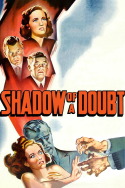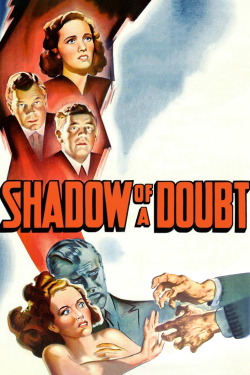
Review of Shadow of a Doubt (1943) by Mike N — 11 Mar 2014
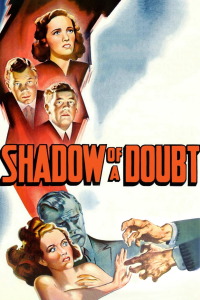
In 1941, Alfred Hitchcock just had "Suspicion", but now there isn't... or is a "Shadow of a Doubt". Yeah, without the "Beyond", it's kind of hard to guess the full level of urgency to this mystery thriller, regarding the possibility of an evil deed being done. Hey, Hitchcock is the Master of Suspense, so either his titles are even supposed to drive you mad with wonderment... or I'm just making up nonsense as I go along because there really is so much ambiguity to this film that it's hard to figure out what to talk about. I mean, it's Hitchcock, and by 1943, alone, he had a pretty firm formula down as a thriller storyteller, and yet, this was one of the first ones that people really remembered. Well, that's probably because, for 1943, it actually was kind of thrilling, at least more so than "Suspicion", which was alright and all, but not particularly eventful. Granted, there's only so much momentum to this thriller, seeing as how there's apparently still a shadow of doubt keeping things from really hitting the fan. Still, the point is that this film is not simply a little more exciting than "Suspicion", but actually pretty darn decent, despite the flaws.
With all my ramblings about rambling thrillers like Alfred Hitchcock's "Suspicion", a film held back largely by natural shortcomings, this film itself has its conceptual limitations, of which there aren't enough to prevent compellingness from consistently standing firm, yet nevertheless enough to limit potential that is further shaken by familiarity. On top of being kind of thin, the path followed by this film is too familiar for its own good, or at least seems to, because among its tropes are Hollywood histrionics that are rarely all that carried away, and are ultimately pretty limited in quantity, but still recurring enough, as well as severe enough, to deliver on some questionably dated dialogue and melodramatics. Quite frankly, the big issue behind the histrionics is their betrayal of subtlety, for although this suspense thriller has enough sober intensity to thoroughly intrigue time and again, those lapses in subtlety all but aggravate in their shaking the thriller's genuineness, in addition to the dramatic momentum. Of course, the drama's momentum is not the only loose element to storytelling here, as structural momentum is itself questionable, as the generally solid, though arguably overblown scripting team of Thornton Wilder, Sally Benson and Alma Reville have their moments in which they leave certain segments to feel tight, and leave others to feel draggy, resulting in an inconsistency in pacing that is all but outdone by an inconsistency in tone. Not unlike something like "Suspicion", this film gets too lighthearted with its dramatic build-ups, so much so that when tensions begin to rise, they go rather undercut by tonal unevenness, which isn't to say that the dramatic heights are all that soaring, not so much because of storytelling hiccups, but by the natural shortcomings. Hitchcock's direction, at the very least, is actually inspired enough to transcend natural shortcomings and make a mighty compelling and ultimately rewarding dramatic thriller, but it all comes back to the natural shortcomings, which limit dramatic depth, further limited by all of the inconsistencies in tone, pacing and subtlety. Speaking of subtlety, the film runs a risk of subtly, but surely, collapsing into underwhelmingness, yet when it's all said and done, the thriller doesn't simply compel adequately, but proves to be worthy as Hitchcock's first true triumph as a thriller filmmaker, with impact, and even good looks.
Limited by technical limitations of the time, Joseph Valentine's cinematography actually used the shortcomings of the time pretty effectively, carrying a certain fitting black-and-white palette whose bleakness goes reinforced by dapper plays on shadows that draw you into the near-claustrophobically intense environment that this thriller thrives on. Even more essential in the driving of this type of tight thriller is, of course, the characters, who are brought to life about as effectively as the visual style is, in this case by then-solid and still-impressive performances whose subtle dramatic layering is sometimes ahead of the time, and consistently effective. Joseph Cotten proves to be particularly impressive in his slickly charismatic and atmospherically intense portrayal of a seemingly caring man with deep, dark secrets that he can filter out only so much, so much so that Cotten, especially when working with an emotionally roughed Teresa Wright, drives much of this thriller whose bite relies on the minimal, perhaps too much so. Again, in addition to being formulaic, the story concept is kind of thin in scope, having an intentional tightness that threatens compellingness, but also establishes a potential for it through human intensity that screenwriters Sally Benson, Alma Reville and Thornton Wilder sell through well-rounded characterization, and an attention to light bite that was refreshing at the time, and has aged well. Well, maybe the compellingness hasn't aged especially gracefully, but make no mistake, it is ultimately secured, because if there is meat to this idea, its juiced and drawn upon about as much as it can be by highlights in the acting, script and, above all, direction. What can make or break this potentially underwhelming minimalist thriller is, of course, Alfred Hitchcock, who, through this film, surely had to be revelatory as a thriller filmmaker, because where the film's steadiness could have devolved into dullness, Hitchcock's thoughtful storytelling is realized enough in its celebration of bleak style and audacious material to immerse you into the narrative, whose gradual build in intensity is sold every step of the way enough for the film to grow more and more compelling as the plot thickens. I don't suppose the plot ever thickens all that substantially, yet meat never thins all that substantially either, and between thickness and thinness, Hitchcock cuts far enough to the bone to keep you attached, until the shortcomings are, if you will, over"shadowed" by thorough intrigue.
Once the shadows lift, reward value finds itself all but obscured by conventions, subtlety lapses, and pacing and tonal inconsistencies to the telling of an almost thin narrative, yet pronounced enough through fine cinematography, solid performances, - especially by Joseph Cotten - well-characterized writing, and biting direction to make Alfred Hitchcock's "Shadow of a Doubt" rewarding as one of the Master of Suspense's first triumphs in suspenseful cinema.
3/5 - Good.
This review of Shadow of a Doubt (1943) was written by Mike N on 11 Mar 2014.
Shadow of a Doubt has generally received very positive reviews.
Was this review helpful?