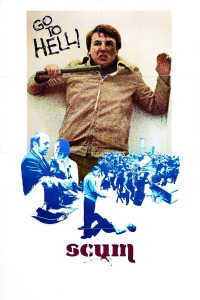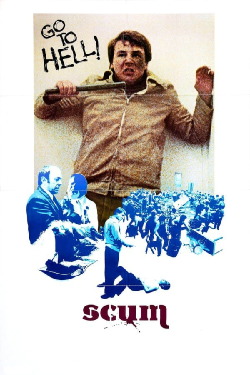
Review of Scum (1979) by Aileen M — 31 Dec 2011
Watching â~Scumâ(TM) for the first time aged 24 in 2011, I cannot help but compare this portrayal of the apparent brutality of the youth justice system in the 1970â(TM)s with the current rehabilitative approach. We have certainly now shifted to a more welfare oriented system of implementing youth justice, thought to benefit both the victim and offender, compared with a system that emphasised punishment and retribution in years gone by. The real questions that are elicited from this film are whether it was truly indicative of life for these boys in youth custody at this time, and if so, what are the repercussions of such a punitive system on both the offender and society, compared to the restorative justice philosophy of today?
The idea of custody for young offenders is not a new concept, and was certainly already in place when the first Borstal opened in 1902. Ironically, the Borstal system was devised as a method of protecting the youth from influence and association with adult criminals in prisons. The purpose of these detention centres was to provide a place where wayward young males could learn to be personally responsible, active, members of the community. Although there was much emphasis on religion, hard work, and education in the legislation surrounding these detention centres, the reality was somewhat different. It has been suggested that there was a widespread belief amongst Borstal staff that punishment, especially corporal punishment, could suppress antisocial behaviour in young people. It has been suggested that this, combined with the elasticity of the rules in Borstals related to discipline, led staff members to be allowed to exercise their control as they saw fit. This is supported in the film, where wardens used both violence and the traineeâ(TM)s indeterminate sentences as a means of inducing compliance. Further, it has been suggested that there are voluminous files in the Home Office regarding physical and sexual abuse in these Borstals, perpetrated by both juniors and staff. Considering this evidence, â~Scumâ(TM) seems to paint a true picture of existence in Borstals, where young boys were subject to a system which appeared to value retribution and revenge for wrongdoing, despite government policy dictating rehabilitation.
The effect of not just the incarceration of these young men, but the punitive system which they were subject to during incarceration, cannot possibly be positive. Of course, the imprisonment of undesirables does have the effect of incapacitation, and the threat of such deters the completion of crimes, but in fact there is little evidence that punitive custodial sentences have a positive effect on future offending behaviour. In fact, it has been shown that though incarceration and physical punishment may produce compliance in the short term, it actually increases the risk of deviance and reoffending over time. This is shown in â~Scumâ(TM), where initial obedience was observed by the lead character, followed by uprising caused by the unnoticed suicide of a young victim of sexual assault. Considering this, and taking into account the negative psychological consequences, such as depression, anxiety and anger, all depicted in the film, related to the abuse that was experienced in these Borstals, one can from hindsight see the serious negative ramifications of past youth justice policy.
The current youth justice ideals arise from the notion that compensation is the foundation of repair of harm, which has been long established in tort liability. It intends to keep the majority of young persons from a custodial sentence. It advocates use of restorative justice for rehabilitating the young offender. This involves the voluntary meeting of all people involved in the offence, for the discussion and hopeful agreement of what can be done to achieve reparation of the harm caused. It is a process which is thought to be beneficial to the offender, enabling them to be responsible for their actions outside of a custodial environment, despite its being initially developed to benefit to the victims healing. Although there is some belief that such practices are too lenient in the tackling youth crime, it has been shown that these current procedures produce offender and victim satisfaction, giving increased empathy in both parties. Combining this with the use of incarceration as a last resort, eliminates the negative effects of imprisonment and reduces the chances of possible abuse to the young person whilst in the care of the government, therefore giving a more humanitarian approach to dealing with juvenile delinquency.
Whilst consideration must be given to the positive or negative consequences of both punitive and rehabilitative approaches to youth crime, the principle aim of Youth Justice Policy is to reduce levels of reoffending within the youth population. Evidence suggests that restorative justice practices do lead to reduced recidivism compared to traditional court settings, while the little research that has been completed with young persons in Borstals indicates reoffending rates as being very high.
Taking this into account, it seems we have learnt our lesson from the days of â~Scumâ(TM). The current policy allows more young offenders to be kept from custodial sentences whilst taking responsibility for their actions and shows reduced levels of reoffending by young people who are involved in the system. More importantly, a more civilised approach is now being taken to juvenile reform, reducing the risk of abuse of the system, and showing continuity nationwide. Looking deeper into â~Scumâ(TM), the borstals, and the ideology behind them, I think one can safely say that mere good intention in implementing policy is not good enough. It was not that the government officials behind the introduction of specialised youth custody were sadistic in their establishment of such, but it was the application of the law that led to subjectivity in its enforcement. Therefore, politicians can learn much from â~Scumâ(TM) and the history of youth justice in the UK, and realise that strategies and guidelines in abundance cannot change the fact that their policies affect real people, not just numbers, and impetuousness or complacency cannot be allowed to exist when human lives are concerned, because incidences like â~Scumâ(TM) are the result.
This review of Scum (1979) was written by Aileen M on 31 Dec 2011.
Scum has generally received very positive reviews.
Was this review helpful?