Review of Saving Mr. Banks (2013) by Jack F — 27 Jan 2015
Like so many of Walt Disney's feature films, animated or live-action, his musical adaptation of "Mary Poppins" is a classic. It's the very definition of "timeless," the type of movie that is as appealing to audiences nowadays as it was in 1964. It has a magical, whimsical feel to go along with an iconic performance by Julie Andrews and some insanely--and dare I say, possibly even gratingly?--catchy musical numbers. It seems hard to imagine the Disney universe (or the cinema universe, for that matter) without it, but apparently that was almost the case.
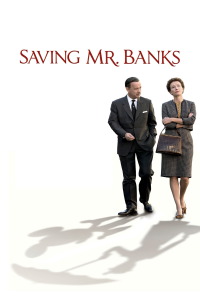
"Saving Mr. Banks" tells the story of Walt Disney's (Tom Hanks) desire to bring the character of Mary Poppins to the silver screen. Apparently the book was a favorite of his young daughters, and he promised them that one day he would make it into a feature film. It's taken quite some time, 20 years to be exact, but now it appears that it may finally come to fruition. This is because P.L. Travers (Emma Thompson), the author of the book, who has been refusing to sell the rights to her characters to Disney for years, is suddenly faced with declining royalties and dwindling finances, so she needs to at least consider the notion.
This does not sit very well with the stuffy, uptight Travers, who abhors the very thought of her beloved book being transformed into a garish, big-screen musical. But Disney has also offered her a large amount of creative control for the project in hopes of swaying her decision. Thusly, he flies her from London to Los Angeles, where she can oversee the development with screenwriter Don DaGradi (Bradley Whitford) and composers Robert and Richard Sherman (B.J. Novak and Jason Schwartzman). As the filmmakers discover though, Travers has a lot of demands, ranging from unreasonable to absolutely insane.
In a parallel story, we see flashbacks to Travers' childhood in Australia, and piece by piece, we come to realize just why she is so reluctant to relinquish the rights to her book. On numerous occasions, she explains that Mary Poppins and the Banks family are more than just characters to her; they're her family, and she loves them dearly. The inspiration for the book is right there in her experiences, particularly her relationship with her deeply caring but alcoholic father (a superb Colin Farrell).
The two plotlines play well off each other; I liked seeing the parallels between Travers' real life and that of the Banks family in her novel, and this also helps to explain why she's so uptight and standoffish. Thompson is very good here, portraying Travers as rather cold and bitter, but not without a sense of vulnerability. One of the best scenes in the movie occurs when DaGradi and the Sherman brothers finally crack her icy exterior by playing the song that will become "Let's Go Fly a Kite" for her. The song strikes a chord with her, and she finally begins to see that there may be some potential in a movie based on her book.
Actually, all the scenes involving Travers and the increasingly exasperated filmmakers are good. It's quite humorous to watch her nitpick over the little things, and then watch the men react to her suggestions. They realize they're more or less stuck here; Disney wants this film to be made, and it can't happen without Travers' say-so. But that doesn't stop them from getting truly frustrated (as any reasonable person would), sometimes to very humorous effect.
To the surprise of probably no one, Hanks is also great as Disney, playing him as jovial and friendly, but also tenacious, which is about how I'd imagine he would've been. Here's a man who really goes after what he wants; for all the childlike wonder that must've been prevalent in Walt Disney, it's important to remember that he must've also been a hell of a businessman too. Clearly wooing someone like P.L. Travers was no easy task, but as we know by now, he was ultimately successful.
I was surprised at how simultaneously entertaining and touching this movie turned out to be. There's a quiet scene near the end of the movie in which Disney and Travers discuss their personal "Mr. Banks" in their own lives, and it's here that Walt realizes the true purpose of the curious nanny's visit in the author's book. It's a pivotal scene to the proceedings, and it's handled masterfully by the pros Thompson and Hanks.
I can't say for certain how faithful to real life "Saving Mr. Banks" is, and I've no doubt there are more than a few Hollywood embellishments. Some of Travers' protests seem a bit forced or melodramatic, even for a story such as this. However, on the whole, this is a wonderful film in its own right, and it serves as a fine companion piece to Disney's "Mary Poppins." One might even say it's supercalifragilisticexpialidocious.
This review of Saving Mr. Banks (2013) was written by Jack F on 27 Jan 2015.
Saving Mr. Banks has generally received positive reviews.
Was this review helpful?