Review of Ray (2004) by Silabhakta L — 11 May 2010
"I walk out alone in the dark and do something no one's done in music and business.".
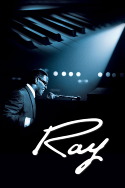
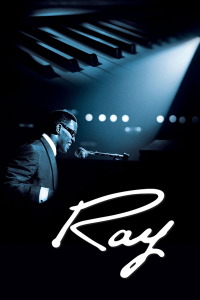
Those are the words of Ray Charles Robinson. What he says may sound arrogant, but the fact is: it's true. He was blind and an extraordinary man. How could you now make a movie about him? The thing is that he never had a 'stylish' exit by dying at his peak. He lived on. No one after watching Taylor Hackford's "Ray" would not think of him as a legend.
Ray's life wasn't a walk in the park. The movie brings out a rather conventional film that contains an incredible true story, irresistible music and a charismatic lead that makes us not only like how normal the outline is but actually fall in love with it.
And with Jamie Foxx. With an uncanny and heartfelt performance, he IS Ray. We don't think of comparing him with the real Charles, we are convinced from the first few seconds of seeing Foxx that that's the real Ray we're seeing. It's his physical self that captures how unconstrained Ray was. Just because Ray was blind, it didn't mean he was this self-contained and afraid man. He filled whatever room he was in, whether that in life, or the movie. His spirit and abundance, and how he intertwines with other people. Foxx captures all of this. And not over-doing it by suggesting that Ray was a manic character. Even by choreographing Ray's piano-playing on-stage. It's spot-on.
Foxx did everything right. He deserved his Oscar. Heck, he was born to play Ray. He did not sing though, because the film makers had the soundtrack of all of Ray's songs. No one could sing like Ray right? So they just used that. But I'm pretty sure Foxx played the piano for he is also a gifted piano player.
The movie centers on a postwar Charles starting in 1948. He's just took a bus from his native Georgia to Seattle. Why Seattle? The movie never tells but this was because New York and Los Angeles were too big. I guess Seattle was a right start. In here he would meet a teenage Quincy Jones (Larenz Tate), one of the many crucial people in his life. He then quickly gained popularity in a local club where he's taken advantage of by his first manager.
The movie creates many flashbacks from Ray's birth until 1966. These were the roughest years of his life. Starting off from on scene where Ray witnesses his younger brother, George drown in a bath basin. He was just 7. How could he not have thought that George was playing an absurd joke at him? He was new to the new skills and props life gives you. He was still just a dumb 7-year-old.
This would prove a lifelong guilt for Ray. Not if he was already blind when this happened. He became blind two years after, at the age of 9. The movie argues that this was the cause of Ray's eventual drug addiction and perhaps his life as a polished artist. This is interesting. If this is the case, in what role does his blindness have in his life? The answer is his music. It made him an exceptional musician. Being blind is one thing, but he did not use it for pity. His mum, Aretha Robinson (Sharon Warren) told him:
"If you wanna do something to make Mama proud, promise me you'll never let nobody turn you into no cripple... You won't become no charity case. And? You will always stand on your own two feet. ".
This proved a lifelong message for him. He used his blindness as an asset. When he turned blind, his mum told him that she could pick him back up one, twice, but not the third. Life comes in at three. He learned to open his ears, listen instead of see. And to memorize every step he takes, so he knows his way. His mum plays a big role in shaping his life.
The movie then follows his way after his mum sent him away to get a proper education. He would master the piano and find his real sound in music. From a sound-a-like of Nat King Cole, to his own combination of Gospel and R&B. This would ultimately result in the invention of soul, in early songs like "I Got a Woman." He would also venture to country music and crossover to pop. It was absolutely phenomenal what he did.
Ray also took clever charge of his music. In the middle of exploited musicians, he took the front seat of his career. From leaving his longtime backers Atlantic Records to sign a deal with ABC Paramount, he knew what he wanted to do with his career. (It should be noted that Atlantic owners Ahmet Ertegun played by Curtis Armstrong, and Jerry Wexler played by Richard Schiff reacted quite positively to this. They were Ray's friends. They were happy for him.) He was also one of the first African-American to gain full artistic control by a mainstream label.
Through his life, Ray had two addictions: drugs and women. He was heavily addicted to heroine after being introduced while touring with Lowell Fulson. This would last until the mid-'60's when his wife convinced him he would lose his music if he didn't get rid of his addiction.
And it's also his wife who provided a solid supporter of his life. Della Bea Robinson, played by Kerry Washington provided wisdom, acceptance and understanding for Ray. It was her who told him to find his own sound. It was her back he could always rely on. But she wasn't the only woman for him. He fathered more children from many different women than the movie had time for.
He had two main affairs, with Ann Fisher (Aunjanue Ellis), a blues singer, and Margie Hendricks (Regina King), a member of his backup group, the Raelettes. The movie made Charles seem like this true and honest person. He still obviously loves Bea most, but he womanized, and all these women accepted and cared for him. He sort of needed a proper, loving housewife and another for him to take on the road. He got rid of the drugs, but not of his women.
The movie provides an excellent balance between Ray's personal and professional life. We see what it suggests in both, and understand the connection between the two. Like when he refused to play in front of a racially divided crowd in Georgia in 1961. Georgia banned him from performing ever again in their state. Before getting an apology in 1979 and making his song, "Georgia on My Mind" the official state song. Why did Ray abruptly decide not to play in front of divided crowds again? Why did Ray do a lot of things he did? Because of his experiences. Not all of them are the right ones, but he learns, and we learn to understand him.
The movie is long. Two and a half hours long. Long enough for the story it tells. The complexity and joys of Ray's life is told superbly by first-time screenwriter James White and director Taylor Hackford. But, this is way less time than the two would have settled for. When we leave Ray, he's beaten heroine and is to go on living his glory years.
Hackford also worked for years with Ray Charles himself to make this movie. Foxx even met Charles. He was meant to attend the premiere of the movie in 2004, but died several months before. Great timing right? But maybe that's why the movie is so great. It may look like a normal biopic, but there's more to it. The spectacular music and Foxx's performance may be enough to watch it. But the movie reaches a deeper level. Everyone knows Ray Charles. But "Ray" understands him. Because of his involvement? Possibly. Either way, Hackford and Foxx brings quick and deep sympathy and admiration to Ray Charles.
4 out of 4 stars.
This review of Ray (2004) was written by Silabhakta L on 11 May 2010.
Ray has generally received very positive reviews.
Was this review helpful?