Review of Rashomon (1950) by Sam C — 10 Sep 2009
"It's human to lie.".
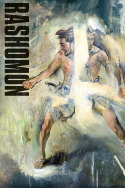
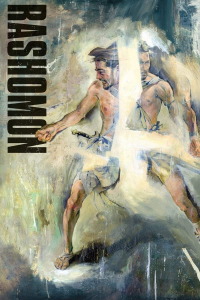
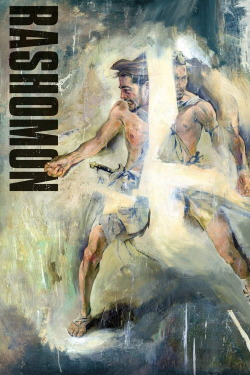
This quote stands out amongst the dialogue in Akira Kurosawa's first international hit, Rashomon. The premise behind this film is one most Western audiences are already familiar with: an incident happens and multiple witnesses tell their version of the story. The only problem is that the audience is not quite sure who to trust . . .
Kurosawa helps to build this uneasiness through many ways. For instance, whenever the characters explain their tale to the court, they are positioned in front of the camera and look directly into it, as if they are trying to convince the viewer the circumstances of what happened. And that's not all, as there are many tracking shots in this film that follow the characters as they walk, passing through tree branches and shrubbery, as if we, the viewer, are also tagging along, trying to see the story through their eyes.
The present setting of the story takes place under the ramshackle Rashomon gate, a gate that, according to myth, used to be controlled by a demon until he fled from the ferocity of man. It is raining out as our three characters explain the unfortunate events that led to the death of a noble (?) samurai, and the dilapidated gate serves as a metaphor for their fragmented stories. The three characters consist of a woodcutter, a priest and a commoner who could possibly be a bandit (they hinted at it once in the film). After the commoner says the line quoted in the first paragraph, he follows it up with, "I don't care if it's a lie, as long as it is entertaining." No wonder the demon fled from mankind.
Godard is known for messing around with the conventions of cinema. With his film Rashomon, Kurosawa toys with the idea of the narrative. If you can't trust any of the characters, then can you trust the film itself? One could watch a film, say Empire Strikes Back. The events in that film all happen in real time in that galaxy far, far away and we know for a fact that Luke Skywalker had his hand chopped off. When people watch a film, they assume that what they are seeing is true in the little universe that contains the film. Since all of the stories here blur together (minus the scenes at the Rashomon gate) and could be all false, Kurosawa has created something along the lines of the anti-film. A film that gradually pulls the viewer in, but ultimately tricks them.
Every character has their own story to tell, and even the characters who are supposed to morality are contradicted by their own personal beings. Kurosawa paints us a portrait of lies and deceit, but by the end of the film the rain has stopped and the woodcutter and the priest are left with the child, thinking of what to do. It is, however, ultimately up to the viewer to decide the fate of these characters.
This review of Rashomon (1950) was written by Sam C on 10 Sep 2009.
Rashomon has generally received very positive reviews.
Was this review helpful?