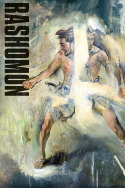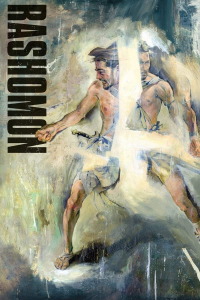
Review of Rashomon (1950) by Paul Z — 15 Mar 2009
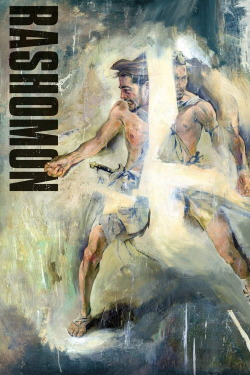
From this material most filmmakers might have made a murder mystery or a courtroom drama, which is what it can fundamentally be considered to be. But Akira Kurosawa, rather, directed this universal tale made all the way across the world, set a thousand years ago, made 60 years ago, which has actually given root to philosophical movements and fields, transfiguring the account of a foul rape and murder into a contemplation on certainty and human nature. The film is about the real animal showing through the most coercive social doctrines.
Beginning with a very powerful opening master shot of the Rashomon gate, two mingling time filaments construct the contemplation: Under the Rashomon gate, time lingers ponderously, breathless, exhausted, gathering dust. In the forest time is imbued with heat and disquiet, with life and respect in peril of being erased. As is widely known about the film, the stories of the rape and murder are jointly conflicting. The plot unfolds in flashback as the bandit ToshirÅ? Mifune, the murdered samurai Masayuki Mori, his wife Machiko KyÅ?, and the nameless woodcutter Takashi Shimura recount the events of the inscrutable afternoon. But it is also a flashback within a flashback. Kurosawa first transgresses across the lapse between these two strands with a glaring two minutes of unadorned cinema which aggregates both: the woodcutter's walk into the forest, a succession of shots of constant sundry motion while the story bides its time in remission. So this scene, like those at the Rashomon gate, is chronological inertia, although its vibrancy and dormant violence, generated by its motion's rise and fall in pulse, introduces us to matters in the wood clearing. For the woodcutter's advance into the marrow of the forest, with its essentially anesthetic drift of movement per sudden cuts and camera maneuver, becomes our advance into the marrow of the film. When he stops, we are there and the forest has emerged as the focal mise en scene of the drama. However the camera proceeds to move very sparingly.
The three men in the rain at the gate, comprised of Shimura's woodcutter, a traveling priest claims that he saw the samurai and the woman the same day the murder happened, and an earthy commoner, are like a Greek chorus remarking upon the turmoil in that open space. Their annotations, which throughout the film are chiefly of doubt and amazement, as the three parties in the crime each tell an extensively differing story of the death. Surprisingly, each maintains responsibility for the killing. Each telling retains the teller's honorable sense of self. Then the woodcutter gives a fourth take.
Disposed to all this, some viewers consider Rashomon to be a conundrum for unriddling, upholding that there must be one correct account of the killing which we can unravel if we interpret the niceties discerningly enough. For others, Rashomon is the prototypical cinematic delineation of the philosophy that conceptions of truth and moral values are not absolute but relative, that truth is impenetrable. Indeed, we're given clues to believe each of the characters' versions of the story. There is no truth, just biased conception of events. Human beings don't tend to be capable of being candid with themselves regarding themselves. The average human cannot talk about him or herself without ornament to protect their ego. This script depicts such people, the temperament who cannot persevere without distortion to make them feel they're better people than they actually are to any objective opinion of their own. How many hypocrites do you really know? You already know you're one yourself. So am I. As animals, we're impetuous. We all have different externalizations of such behavior. What we must do to realize our significance is gain control over this characteristic.
Fumio Hayasaka's slow, skin-and-bone score for Rashomon is infectious even as it's ever so subtle. This theme music is used as an exposition, associated with the presence of particular characters, and distinguishes between the inflection of tone from scene to scene. And each scene is in a class of its own. The swordfight in the bandit's recollection and the later version of the same swordfight are simply antithetical creatures. Mifune's version is a telling of rage, empowerment and humiliating the other guy. Swords clash, there are occasionally bare- knuckled struggles to reclaim a weapon, and Mifune laughing like a maniac. Later, we see even still not truly a swordfight but a fight that begins with swords in the hands of their frightened owners, who may for all we know have never before found themselves in such a fight, which devolves into a tightly aggressive mortal scuffle. Both are two of my favorite swordfights on film, no special effects are even needed! As for the scene where the husband's spectre tells the story, what other way in 11th century Japan would a court have believed they could gather all possible testimony when every survivor's account is drastically different?
Kurosawa had to extemporize with sparse assets to bring it to the screen, but if anything, clenching the money clip perhaps resulted in a better film. Minimalism is indispensable to a story that depends on fine points and particulars, and the deficiency of excesses defines the discretion Kurosawa used and the rigor with which he had to work. In one sequence, there is a series of single close-ups of the bandit, then the wife, and then the husband, which then repeats to emphasize the triangular relationship. Kurosawa also peculiarly uses sunlight to actually symbolize evil and sin.
Beside his remarkable instinct for what audiences wanted, there is a continuous trial-and-error strand throughout Kurosawa's work. The sense of freedom this film brought to young filmmakers was less a reaction to a mysterious thematic motif than to Kurosawa's scorn of the entrenched protocol of narrative cinema. He disregards the 180-degree rule, in so doing inverting relationships that have any extension in space, connects long shots and close-ups and shots of contradictory movements.
This review of Rashomon (1950) was written by Paul Z on 15 Mar 2009.
Rashomon has generally received very positive reviews.
Was this review helpful?