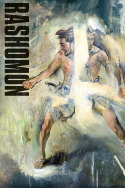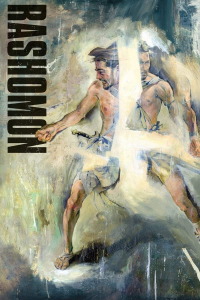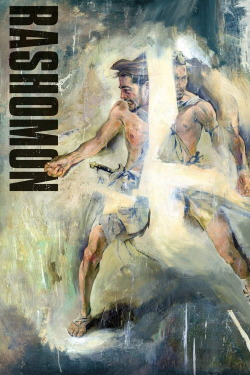
Review of Rashomon (1950) by Jake R — 08 Jul 2009
For a small-scale, neatly timed existentialist tract, 'Rashomon' did more than reclaim its (then) large budget; it proved a turning point in the history of world cinema. Now bored American intellectuals looked to the east for more exciting fare than the fusty European dramas they'd endured for the last quarter of a century, but it also woke the world up to one of the most crucial eras of Asian cinema, with the masters Ozu, Ray and Mizoguchi about to hit their creative peak. Catapulted to the forefront of this cinematic renaissance was the 35 year-old no-name director who suddenly found himself as one of the most reverred and scrutinised film makers in Japan, one Akira Kurosawa.
Half a century on and 'Rashomon' has been stifled by its own reputation, with audiences choosing 'Seven Samurai'as Kurosawa's defining movie of the '50s, or else seeing a plot so simply effective in its original skin after decades of xeroxing in other, cheaper media. Yet when seeing 'Rashomon' what's most enjoyable is the sheer effortlessness of skill that makes it up. This was far from a fluke: Kurosawa, Shimura and Mifune had already proved a firecracker team with police dramas 'Drunken Angel'and 'Stray Dog', but where those films were more conventional fare, 'Rashomon' is only content with completely rearranging the grammatical rules of filmic narrative.
Again, this is something lost to most people today, with the spliced narrative playing parts to more mainstream efforts like 'Run Lola Run' and 'Pulp Fiction'; it's difficult to gauge just how revolutionary this warping of storytelling was back in 1950. But since that novelty has long worn off it's easier to appreciate the film's other key quality: style. This is a perfect showcase for Kurosawa's love of silent cinema: Expressionistic lighting and composition, long periods withut dialogue and a heavy emphasis on bombastic physicality this is a monument to the beauty of the silver screen.
Kazuo Miyagawa's sumptous cinematography isthe breathtaking artistry behind the dream-like visals. It's this evocation of a dream world that is the beating heartbehind the complex whole.
The story itself is a testament to the power of the unreliable narrator, offering four different versions and contexts of the same incontrovertible facts. Of course the bigger point is the more downbeat conclusion that people only tell a story in the way most likely to benefit themselves, but there's also a more profound observation of the compulsive human attribute to lie. In the first few minutes the cynical commoner remarks that people lie so much they can't even be honest with themselves, a mantra proven correct given how each story relocates the roles of murderers and victims based on not-unconcealed agendas.
Toshiro Mifune, in the first of his most defining film archetypes, is often seen as the standout effort here, bouncing insanely with a relentless energy married to astonishing moments of contemplative reflection; people often forget Tajomaru is only manic when he's trapped or under pressure. But his performance is only the most volcanic amongst a cast of professional turns. Shimura waddles around under a bewildered mind; Masayuki Mori strikes a sneering figure as the somewhat disgraced doomed samurai; and Machiko Kyo adds another sweltering element in the form of the voluptuous wife, though she, like everything else, has an unnatural and otherworldly appearance.
Finally, Kurosawa's beloved use of weather as a god-like presence gets vivid grounding. The central stories take place in an unbearable heat, coating everyone with glistening beads of sweat, whilst the frame narrative is itself framed by a wall of rain, creating a claustrophobic atmosphere that allows the nervous mind to poke around within itself. They only add to the film's intense visual beauty.
The original and best, there's not question about it. With a succinct running time it's perfect viewing for people who want a more refined class of entertainment. Loaded with philosophical insight and constructed in a flawlessly stylish manner, 'Rashomon' remains an iconic classic of cinema's power to unleash a universe of vibrant yet familiar fantasy.
This review of Rashomon (1950) was written by Jake R on 08 Jul 2009.
Rashomon has generally received very positive reviews.
Was this review helpful?