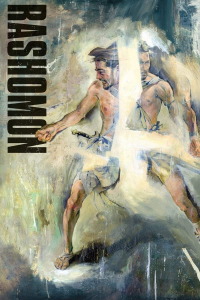
Review of Rashomon (1950) by Damien L — 23 Nov 2009
The first time I saw this I partly understood the structure and aesthetic, but one exposure isn't enough. I have hints of memories of impressions, but the transmission doesn't feel complete.
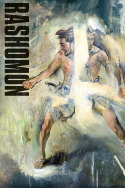
Update: the second time it still feels incomplete. Of course, I missed key lines of dialogue when the projector slipped and cropped subtitles (I paid AFI $10 to do that), but I think the incompleteness is also a puzzle quality of the movie itself. There are any number of questions one needs to answer on one's own, reflecting on the testimonies and their intersections and divergences, which you'll probably do over coffee afterwards, or as I did, over a late night Irish breakfast (the McGinty's by AFI Silver Spring in Maryland does a good one). Rashomon is a bit of an abstract movie; it leaves you fretted about its gaps and inconsistencies. The effect plays neatly to a trial involving multiple witnesses in the death of a samurai.
What the questions are exactly and what their answers are--I think--is somewhat up to you. The movie only *presents* different versions of the same story in a pleasant frame at a crumbling temple in the rain. Your mind has to reconstruct what you think is the one true telling by considering what motives might underlie the points of departure in the different testimonies. This in itself is quite fun. What troubles me, because I haven't figured it out on my own, and I'm determined to, is that I don't know whether the movie is made to have any consistent single interpretation. Is there a buried line of interpretation or maybe a pair of them that are most likely, expected landmarks, as it were, or is Rashomon studiously contradictory and wonderful, an origami chain of rock-paper-scissors? I somehow wish for both, because I want to muse and puzzle, and yet I want something more than a whodunit (or wuthapend). That the movie can straddle these hopes over two watchings without resolving either makes it slightly maddening and probably makes it a classic of cinema.
The movie's main sentence looks like the rag about the tree falling in the forest and what, shy of an observer, actually happens. In the movie it's rape and murder in a forest, and there are several observers, but no matter, they're unreliable. The multifangled scene is not only more complex than any telling, but also more than any reconstruction. We pull meaning into stories that might never have been seen before we looked and thought; we add and we also subtract. And yet that can be said in a sentence, and everyone already knows it. What is a story? Moments and particles disconnected outside a heart imposing? Even a single tree is a story of connections.
The rain and the child and the temple symbolize something about the various tellings of the crime one level down in the narrative, but I still don't understand how, or I've forgotten. I felt it, though. Maybe the child left on the steps in the rain is meaning. Spontaneous, painful, and welcome.
So a few months after seeing this movie for a second time, I'm beginning to feel I need to see it a third time to really crack its fortune, or to guess one from the working of its hinge.
Richard Linklater's Tape is a more modern look at the same thing, a little more down to earth and probably more easily understood.
This review of Rashomon (1950) was written by Damien L on 23 Nov 2009.
Rashomon has generally received very positive reviews.
Was this review helpful?