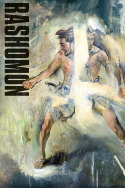
Review of Rashomon (1950) by Nickolas I — 15 Aug 2013
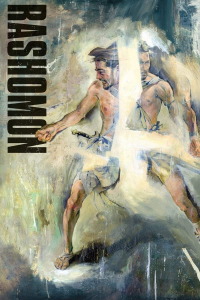
Although Rashomon is definitely a very good film, I take issue when people call it Kurosawa's best. It features performances of varying quality and is definitely a very slow movie experience, but it makes up for most of its flaws in the stylish direction, original visuals, and compelling and thought-provoking story. This is definitely one of the most original films of all time, and explores the depths of people's ability to falsify the truth with absolute precision. All-around, it's a fun and engaging movie to watch... even though my dad fell asleep during it.
Rashomon begins in a dilapidated building, where three people are sitting around waiting for the rain to stop. Two of them won't stop muttering about how "It's the most horrific thing ever," and the third asks what they are talking about. Finally, they tell him the story: A dead man was found in the woods, and all those involved told the story of his death in different ways. The bandit who attacked him said that the two of them fought gallantly over the man's wife, the wife said that the bandit killed him, the dead man (through a psychic) said that the wife encouraged the bandit to kill him, and the guy who found the bodies claimed that he saw nothing. Who says dead men tell no tales?
This movie is about lying and how different people see different things. But it's also about how people can lie to themselves about things that they did or didn't do, in order to make themselves feel better. For instance, the bandit said that he killed the man after a ferocious yet epic battle in which both of them were very skilled with their weapons. The woman, however, said that they scrambled around in the dirt for ten minutes trying to sissy-slap the shit out of each other. Maybe what she said was hyperbole, maybe the bandit was lying through his teeth-- we'll never know.
Rashomon is one of the first films that explored the concept of putting falsehoods to celluloid. Back in the day, when a movie presented a situation to you, you were expected to believe what it told you. Nowadays, of course, we have films like Total Recall or Inception, where anything could be a dream, and it's out to confuse the audience deliberately. Rashomon started that concept. After hearing the four stories all the way through, you realize that none of them must be truly accurate, as each person had their own personal bias in the retelling of the tale.
The performances in this movie are mostly good, but as it is with many Japanese films, they're a little over-the-top. The bandit's Joker-esque laughing gets a little old after a while, and the wife cries nonstop in the most obnoxious way possible. The man, unfortunately, is the one respectable and sane character who, through whatever turn of events, has to end up fucking dead. I will refrain from spoiling the film's final irony for you, suffice it to say that it will make you want to watch it over again. However, I will say this-- the fight scenes go on a little too long, and there is a lot of needless screen time in which people stare off into space and flop around in the dirt. This movie is only an hour and a half long, but I don't doubt that the story could have been told just as well in under an hour. And that's saying something.
The cinematography, although in black and white, is beautiful. The building that the characters start out in is very well-crafted; it's falling to pieces and warping from the rain, and it gives the dialogue some very spooky atmospherics. The scenes in the forest are particularly memorable for the sun-dappled scenery and well-crafted set pieces. Even if it does tend to go on and on, Rashomon is just visually spectacular. If nothing else, the movie redefined what can and can't be done with such simple things as a camera, six actors, and some trees.
Final Score for Rashomon: 8/10 stars. Those of you who get bored during other Kurosawa films should definitely stay away from this one, as it's honestly probably a bit beyond you. However, if you got bored during Man of Steal Your Money's onslaught of incomprehensible action, this is definitely where you should turn to. It is a studious film on people's uncanny ability to deceive both others and themselves. It basically states that people are born liars, and will continue lying compulsively until the day they die. Whether you agree with this statement or not, it's definitely a film worth watching. It's smart, focused, and is somehow able to tell the same story four times, all the while keeping it interesting. And that's a pretty big feat all by itself.
This review of Rashomon (1950) was written by Nickolas I on 15 Aug 2013.
Rashomon has generally received very positive reviews.
Was this review helpful?