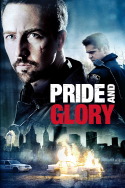
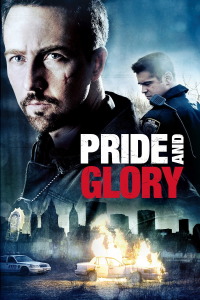
Review of Pride and Glory (2008) by Chads. — 28 Oct 2008
Denzel Washington's historical Best Actor win for his portrayal of a bad cop in Antoine Fuqua's "Training Day" at the 2002 Academy Awards was met with tempered excitement in some quarters.
These well-wishers were disappointed that Washington couldn't have followed in the footsteps of Sidney Poitier with a role more along the lines of Malcolm X.(in which Washington lost the Oscar in 1992 to Al Pacino for his role as a "hoo-ha('ing)" blind man in Martin Brest's "Scent of a Woman"), or Dr.
Virgil Tibbs(Poitier's 1967 Oscar-winning role from Norman Jewison's "In the Heat of the Night"), than the gangbanger with a badge who would leave his unformed partner in the ghetto for dead.
But give Washington credit, when the "St. Elsewhere" alumnist put his screen image at risk, he went all out. Alonzo was one bad mutha*****. Thankfully, the filmmaker let Washington explore all the nuances of this one dimension, the bad mutha***** dimension, instead of fortifying the rogue cop with redeeming characteristics to cajole the audience into complicity, by having them sympathize with the antagonist's flaws.
In other words, bad mutha*****s are human beings, too. But there can be only one Martin Scorsese. And "Pride and Glory" is not "Cape Fear"(Scorsese's reworking of the 1962 J. Lee Thompson original); it's also not "Good Fellas" in blue.
Alonzo was a gangsta. Jimmy Egan(Colin Farrell) is a gangsta, too. But Jimmy has a wife and child; together, hangin' in the family crib, they look like the very model of domestic bliss(conversely, Alonzo's girl looks like a "homegirl" on blow).
The kindness that Jimmy bestows on his family is supposed to absorb whatever illegal shennanigans he orchestrates on the job. But the good-hearted nurse and the child who goes to sleep with racecars dotted all over his blanket, can't absorb, and finally, redeem, a husband/father who'd punch a woman square in the face, hard, then threaten her infant with a piping hot iron, close.
This sort of gratuitous act is ugly, but at least it would be honest, if Jimmy didn't show contrition soon after. Farrell is obviously thinking about his screen image. In the dialogue-less final scene, Ray Tierney(Edward Norton) become a Scorsese-like protagonist, but the expression is incomplete without Jimmy's presence.
Ray never quite gets the chance to be the hero before his code of ethics is compromised by family pressure.
This review of Pride and Glory (2008) was written by Chads. on 28 Oct 2008.
Pride and Glory has generally received mixed reviews.
Was this review helpful?