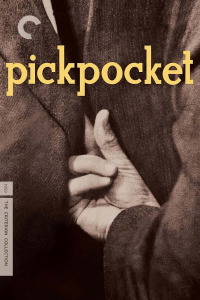
Review of Pickpocket (1959) by Wut S — 30 Jan 2008
When a man holds no faith and fears no sin, only love and surrender could heal his soul.
The knowledge of Bresson's upbringing allows us to trace Pickpocket's Jansenist structure; nevertheless, the essence of the film isn't pious, but rather spiritually conscientious--asceticism is emphasized over divinity.
Michel is a skillful pickpocket living in a rundown Parisian flat. Fixated on crooked craft, he neglects friends and family who are much needed for tending his disdained decency. Faithlessness tempts man to commit moral crime, fraudulent proficiency leads to pride that violates laws. Blinded by criminal obsession, Michel fails to realize the emptiness of his soul. Only when the laws caught up on him, he arrives at a newfound existence through love. And it's this love that would torment him, for it comes too late and too restricted.
Pickpocket can be considered both atheistically spiritual or religiously spiritual. Atheistic because love and responsibility, Michel's causes for change, can be practiced secularly. One does not need divine faith in order to achieve contrition, humane virtues are sufficient. Religious because the bittersweet ending articulates the betterment of having faith in (and fear of) God: if only Michel had faith, he wouldn't dare initiated the crime altogether.
Bresson's films utilize modern society as metaphors for religious teachings--not the teaching that burdens us with religious devoutness, but one that teaches us of spiritual morality integrable contemporarily.
This review of Pickpocket (1959) was written by Wut S on 30 Jan 2008.
Pickpocket has generally received very positive reviews.
Was this review helpful?