Review of Philadelphia (1993) by Fabio D — 27 Jun 2009
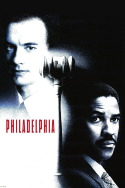
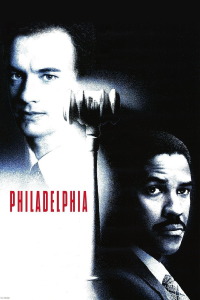
If you initially mistake this, like I did, for it's soft, creamy and thoroughly delicious namesake, you're going to be bitterly disappointed. However, if you look to the film's tagline - "No one would take on his case...until one man was willing to take on the system", you'll realise there are weightier issues at stake: Tom Hanks gets HIV. A man of seemingly flawless hygiene standards, and pioneer in the field of 'wholesome entertainment' (effervescent cultural commentator, Paul Morley, argued for 'Big' as the finest family film of the 20th century - this was before he had seen 'Joe Versus the Volcano'), plays an AIDS victim. Another welcome novelty came in the shape of Morgan Freeman as Hanks's lawyer. Eschewing the wisecracking frivolities of his younger incarnation, Axel Foley, Freeman exposes the spineless bigotries of white-collar America. Go Morgan!
The film is littered with powerful moments. There is a scene in which Hanks, now in the final stages of his illness, rhapsodises along to a Maria Callas aria. I won't lie to you, I swallowed back tear after tear. I hadn't felt like that since Bonnie Greer's electrifying performance as Joan of Arc at the Royal Court in 1991 where I stifled an entire standing ovation. My only qualification is that the film fails to give any explanation for the peculiar intimacy between Hanks's character and Antonio Banderas...or how he caught the disease in the first place. Except for a brief suggestion he was in a cinema at the time sporting a faintly sinister tash, we are left totally in the dark.
The pressure of the role, his first foray into 'pure' drama, proved too much for Hanks. He developed nervous exhaustion and, on the advice of his doctor, Herbert, temporarily withdrew from the acting limelight. His behaviour grew increasingly erratic, coming to a nasty head one intoxicating summer night: Hanks charged into an LA nightclub brandishing a meat cleaver, his white shirt drenched in the blood of an otter, chanting the impenetrable phrase "Hooch...here boy, here boy" over and over. Shocked clubgoers, including a member of Depeche Mode, described him as a "looned beetroot". One visibly shaken reveller said she saw "unmistakable flashes of satan" in his eyes. Clinical psychologists said Hanks's behaviour corresponded with that of an "illicit substance" abuser. It is not clear what he had taken but the National Enquirer reported Oprah Winfrey (or someone matching her description) had been spotted dispensing "mysterious sachets" round the back of the club earlier that day. But it could have been anyone - illicit substances are rife on the streets of LA.
Hanks's marathon of cannibalistic depravity didn't end there: later that evening he subjected his-then-girlfriend Cher to a catalogue of "unspeakably cruel" sexual acts. The song 'Life after Love', with its disorienting, electronically manipulated vocal, is widely perceived to have reflected the trauma of their affair. Cher remains understandably quiet on the matter.
A period of calm was to follow as his career receded into vettriano banality with films like 'That Thing You Do' and 'You've Got Mail'. Whilst they did not present the emotional challenges of 'Philadelphia' and 'Forrest Gump', Hanks grew tormented by self-doubt and palpably diminishing public and critical admiration. Audiences questioned whether he could reclaim the immaculate innocence of his 'Splash' years. Award-winning film critic Roger Ebert is said to have shriveled into a tiny screeching cockroach during a screening of 'The Green Mile' at the Venice Film Festival. The shame took its toll.
By the time he agreed to star in 'Castaway', Hanks had gone so far off the rails director Robert Zemekis disposed of the script altogether and just filmed him behaving naturally. "I turned the camera on and pointed it at him," Zemekis recalls affectionately. "Tom would often show up on set wearing nothing but knee-length riding boots and a santa clause hat and carry on, oblivious to the cameras".
This tragic derangement, however, was punctuated by occasional bursts of sanity. One day I was with him on the set of 'The Terminal' (a quintessentially Spielbergian slice of raw simplicity), by which point he typically only communicated through incontinent streams of gibberish: he looked up from an involved plate of salad nicoise as if a dire realisation had dawned. "Who am I" he asked with arresting clarity. I told him he was 'a man of rare genius who had endeared millions by combining the extraordinary with the everyday'. He got up wordlessly from the table and peered through the glass at a row of jets. His face contorted with a look of intense ontological panic. It transpired sight of the planes had triggered a psychotic episode in which he believed he was a marketing executive for Virgin Atlantic. He was eased out of this terrifying delusion by four months of psychiatric treatment. Hanks soon returned to mainstream success in Ron Howard's 'Philadelphia 2', where he would reprise his beloved role as "Woody the Cowboy". Post-seminal.
This review of Philadelphia (1993) was written by Fabio D on 27 Jun 2009.
Philadelphia has generally received very positive reviews.
Was this review helpful?