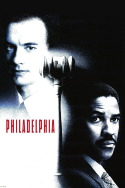
Review of Philadelphia (1993) by Filmclub — 27 Mar 2016
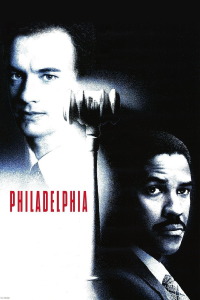
“Philadelphia” is an ideal film for people who have never known anyone with AIDS. In other words, this extremely well-made message picture about tolerance, justice and discrimination is pitched at mainstream audiences, befitting its position as the first major Hollywood film to directly tackle the disease. Intelligent but too neatly worked out in its political and melodramatic details, Jonathan Demme’s follow-up to his Oscar-winning “The Silence of the Lambs” is fronted by a dynamite lead performance from Tom Hanks, but will need top reviews and a superior marketing campaign to make it a must-see for members of the general public whose idea of a night out might not be to see a movie about a man dying of AIDS.
Even if the format and arc of Ron Nyswaner’s script constitute a familiar one of outraged justice resolved by courtroom fireworks, the story is seductive, its concern for humanity unavoidably stirring. The picture feels compelled to signal in a hundred ways that its heart is in the right place, although that doesn’t change the fact that it is. The impulse behind the film seems to be to make people who haven’t had to deal with AIDS face up to the illness, and it dramatizes the issue grippingly enough to probably succeed at that aim.
Hanks stars as Andrew Beckett, a rising young attorney at a powerful Philadelphia law firm. But as soon as he’s made an associate and assigned to an extremely important case, he displays the first visible signs of AIDS. Suddenly and shockingly, he’s fired by the firm over a bit of alleged incompetence that might have cost them the case, but Andrew knows he was dismissed because of his illness.
Determined to spend the rest of his life, if necessary, fighting this gross injustice, Andrew, in desperation, is finally able to recruit Joe Miller (Denzel Washington) as his attorney. A somewhat flashy lawyer who advertises on TV, Joe initially refuses the case and goes in panic to his doctor to see if he’s in danger merely from superficial contact with Andrew. “I admit it. I’m prejudiced, ” Joe confesses. “I don’t like homosexuals.”.
Nevertheless, Joe begins to see that discrimination is discrimination, and signs on, even if he still can’t buy Andrew’s lifestyle.
By the time the trial begins, at the 45-minute point in the film, Andrew has lost weight and gone gray. In court, Joe broadens the issue to talk about the public climate of prejudice, while the defense remains adamant that Andrew didn’t measure up professionally.
On a scene-by-scene basis, in terms of performance and the grave issues under consideration, the film is quite absorbing. Through the character of Joe, Nyswaner and Demme have found a shrewd way of dealing with the audience’s discomfort with the subject of AIDS, and it’s both realistic and dramatically admirable that Joe never comes around entirely to an enlightened perspective.
Filmmakers have also neatly avoided showing the conventional emotional moments that would be the designated high points of a by-the-numbers TV movie — the announcement of the verdict, the big death scene, and so on. The screenplay has been extremely well worked out, but too much so, because every piece fits so perfectly that there are no rough edges, no moments when the raw, devastating reality of the situation registers with total force.
Pic’s rainbow coalition of sympathies is impeccably tidy — Andrew’s lawyer is black, his “partner” is Spanish, one trial witness is a woman who contracted AIDS “innocently” through a transfusion, the defense attorneys are a woman and a black man, Andrew’s family is unfailingly loving and supportive, and the bad guys are big-shot WASP lawyers anyone can root against.
Film’s biggest gap is its non-portrait of Andrew’s private life. The basic outline of his biography is easily surmised, but there are no intimate scenes between him and his mate, Miguel (Antonio Banderas), to illuminate the personal side of his struggle. Rather, in a sequence that’s intended as a tour de force but really doesn’t work, Andrew plays his favorite operatic aria for Joe and wrenchingly attempts to explain what it means to him.
Still, Hanks makes it all hang together in a performance that triumphantly mixes determination, humor, perseverance, grit, energy and remarkable clearheadedness. Whatever else might nag about the film’s treatment of a difficult subject, Hanks constantly connects on the most basic human level.
Washington is also first-rate as the attorney dragged reluctantly to an awareness of others’ sensibilities and problems.
Demme’s direction is constantly inventive, from the opening credit montage backed by a superb Bruce Springsteen song, the first he’s written expressly for a film, to the superior use of colorful locations and the particularly fine subjective evocation. Howard Shore’s lively score, which is abetted by numerous tunes old and new.
This review of Philadelphia (1993) was written by Filmclub on 27 Mar 2016.
Philadelphia has generally received very positive reviews.
Was this review helpful?