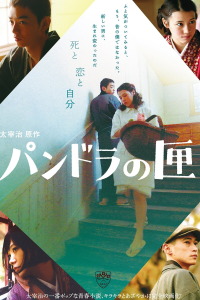
Review of Pandora's Box (2009) by Jake R — 31 Mar 2009
1929 was the final year for the silent film, the change over to sound spread across the Atlantic and into European cinema. Soon the delicate, intricate art of making silent movies, with their astonishing visuals, careful compositions and instantly romantic quality would be abolished in favour of cheap, predictable melodramas made solely for the naive public who were amazed at 'talking pictures'. With the days of the silent movie numbered, and with Murnau's 'Sunrise', arguably the best silent film ever made, now a long-distant memory, there was little direction left for the dying cinema. Only in Europe, where the filmmakers were much more reluctant to give up a fantastic craft, were silent films lovingly detailed to the last.
'Pandora's Box' is no exception. With acres of class, intrigue, style and sexiness it became an instant classic, even in the final hours of the silents. It briefly reminded the world of what they were about to give up, though, naturally, the ignorant American public couldn't care less.
Pandora is a peculiar box. Based on a couple of fusty, obscure German plays, director G W Pabst has great fun twisting those plots into his own fiendish story. There are a lot of melodramatic conventions and devices, inevitably, but thanks to Pabst's remarkable visual sense and demand from his cast something about the story transcends its pulp roots. Instead, what happens is a purely dreamlike narrative splays out over almost 2 and a half hours. Everything in the film has a heightened, unreal feel to it, a conscious artificiality, but only in the surroudings and the locations, and with the more dour characters. It's as easy to categorise as 'Donnie Darko'. There are no set paths for it to take, it just wanders freely, grinningly, through a myriad of genres: thriller, romance, farce, horror, golddigger; one can't have a 'melodrama' genre all to itself. In this sense the viewer is constantly kept off guard, genuinely confused as to what might happen next. And, extraordinarily, it's inescapably engrossing.
A crucial element to its success is Louise Brooks herself, to the silent screen as to what Marilyn Monroe was to sound and colour. Her instantly iconic image is perhaps the first pop-culture recreation: the bob haircut, low-cut dresses and slinky shape were the fashion codes throughout the entire 1920s, but here is a character summing up all of it in one strong, consummate image. Needless to say, it's never looked more ravishing than on Brooks herself, with her chiselled face and her intense eyes a veritable window into her soul. What's more impressive is Brooks' natural ability to act. She fills out her character with particular gestures and physical details, as well as shading out a palette of real emotions; she couldn't be more out of place with the rigid, over-the-top Expressionistic style is she tried, but its her performance that glues the film's various great elements together. Her character is also a more complex creature than normally found in the cinema of shadows. 'Lulu' is not simply a maneating minx, she is also vulnerable, warm, friendly, loyal, and, most radically, guilt-ridden. In the final act, when she miserably trudges about her derelict room, her eyes freeze with the pain of memories of a much happier, simpler life. It's an astonishing performance, years before any acting revolution embraced naturalism, and even foreshadowing James Cagney's energy, wit and innovation by a couple of years. Out of all the great actors of the silent era, Louise Brooks is the most enduring and most accessible today to modern viewers, quite an achievement 80 years on.
The rest of the cast do pretty well, keeping any melodramatic flourishes to a minimum, and, if anything, emulating Brook's understated style to ironically make their characters more memorable. Francis Lederer inhabits his traditionally blunt-headed male with a much more believeable fear and cautiousness and easily doubles Lulu's ruminative nature towards the end. Carl Goetz is a rather tender old man, a little oblivious perhaps, but it makes his old crone more convincing. Gustav Diessl, as a misogynistic serial killer, brilliantly dazzles with his volatile conflict, coming across as a sort of wild-eyed Norman Bates in a trenchcoat. As for the rest, they fall back into the cliched acting styles of Expressionism some what, with Fritz Kortner's Lurch-like 'Dr Schon', being an awkward example.
But, again, its Pabst himself who works tirelessly to make the film a vertiable fantasia. Gunther Krampf's lush cinematography unusually combines moody Expressionism with an almost tacky high-gloss. Dark, artificial shadows and jagged lights go hand in hand with soft, shiny hihglights and outlines. It's an odd style, often appearing in the same scene, but it only furthers the dreamlike nature of the film. There are some very disorienting camera angles too, Pabst completely ignoring the 180 degree rule at times to make several characters face the same direction. But then his camera comes close to Murnau's idea of 'unchained' movement, leering over scenes of high energy or solemnly walking past scenes of melancholy and sombreness. It all makes for a very dynamic style and manages to speed up the film's running time seemingly into thin air.
There are a few glitches. The 8-act structure is a little unnecessary and damages the film's otherwise smooth forward motion; the locations, whilst gorgeous and interesting, do seem a little small-scale especially London, which also conveniently puts up warning posters in German, presumably for the large German population of that particular district; and one can feel a little lost sometimes with the speed of the narrative, as scenes double-take and spiral through each other.
But overall, with such sheer quality, these are only small whines. As a whole, it's a vibrantly fantastical piece with a strangely gripping story, near-flawless execution and with a sultry, erotically-charged performance from a gifted actress. A better swansong for the silent era could not have been made.
This review of Pandora's Box (2009) was written by Jake R on 31 Mar 2009.
Pandora's Box has generally received very positive reviews.
Was this review helpful?