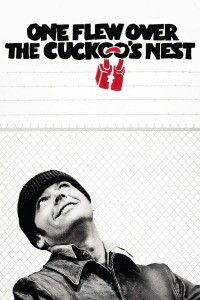
Review of One Flew Over the Cuckoo's Nest (1975) by Lianna M — 27 Nov 2013
In 1934, Frank Capra's "It Happened One Night" made Academy Awards history by becoming the first film to win all top five Oscars: Best Picture, Director, Actor, Actress & Screenplay. 80 years on, this is an accomplishment that has only been achieved twice since that time. Most recently was in 1991 with Jonathan Demme's "The Silence of the Lambs" and the other (that's the most deserving of them all) is this 1975 adaptation of Ken Kesey's radical novel.
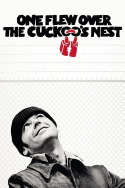
Randall Patrick McMurphy (Jack Nicholson) is a convict who fakes insanity to escape the confines of prison and instead, spend his remaining years of incarceration in a mental hospital. McMurphy gets more than he bargain for though, when he comes across the tyrannical Head Nurse (Louise Fletcher). Rebelling against her control over the vulnerable patients, McMurphy turns the hospital ward upside-down with his wildly infectious and challenging personality, which incurs the wrath of the embittered Nurse.
Now widely considered a classic of American cinema, "One Flew Over the Cuckoo's Nest" was not without it's problems in making it to the screen. The film rights to Kesey's novel were actually owned by Kirk Douglas who starred in the 1963 Broadway production. However, there wasn't a major studio that was interested in financing it. Douglas' intention was to reprise the leading role but the film took so long to get off the ground, that it left him too old to play the part.
Before passing the rights down to his son, Michael Douglas, he recruited Czechoslovakia's Milos Forman as a suitable director and even had a screenplay drafted up by Ken Kesey himself. It was Forman who rejected this version, though, as Kesey wanted to retain the mute, Native American, Chief Bromden as the narrator of the story (as it was in the novel) while Forman's intention was to focus on McMurphy. This proved to be only the beginning of the films problems; Kesey was so incensed with the filmmakers approach to his material that he sued the producers and vowed never to watch the completed film while numerous actresses including; Audrey Hepburn, Jane Fonda, Anne Bancroft and Faye Dunaway turned down the, supposedly coveted, role of Nurse Ratched. Nicholson wasn't even the first choice for McMurphy either; Marlon Brando and (Kesey's proffered choice) Gene Hackman turned down the part while Forman had his heart set on Burt Reynolds.
With a sense of irony, it could be said that these fraught production issues actually reflected the fraught and rebellious themes of the material but despite the hiccups, the film opened to widespread critical acclaim and went from a $3 million budget to gross over $100 million and as well as sweeping the board at the Academy Awards, it received a further four nominations.
Nicholson may not have been the first choice but there's no doubt that he was born to play McMurphy. He's an actor that has always produced high quality performances and has even become synonymous with rebellious characters but this is the absolute definitive, The only difference between actor and character is that Nicholsonâ(TM)s appearance is nothing like the flame-haired Irishman described in the book (where it's easy to see why Kesey might prefer Hackman) but heâ(TM)s McMurphy in every other hazardous and feral way. He's the perfect embodiment of the character's reactionary behaviour against the repressive and authoritarian figurehead of Louise Fletcher's villainous and castrating Nurse Ratched. Although it's these two stupendous performances that anchor the film, the rest of the supporting cast are equally solid - with particular mention going to Brad Dourif and his nominated turn as the stuttering, immature Billy Bibbit. Also not going unnoticed is the haunting score by Jack Nitzsche and the striking cinematography by Haskell Wexler in capturing the stark, enclosed environment that reflects the perceived insanity of the inmates.
Whether observed from the point of view of Chief Bromden or R. P. McMurphy, it doesn't matter, as there's still no denying that it retains the free-spirited theme's of Kesey's novel and the revolutionary and anti-establishment ethos that was rife throughout a generation. A masterful adaptation where Milos Forman and screenwriters Lawrence Hauben and Bo Goldman put their own stamp on the indicting material without losing any of it's emotive or uplifting power. Simply superb!
Mark Walker.
This review of One Flew Over the Cuckoo's Nest (1975) was written by Lianna M on 27 Nov 2013.
One Flew Over the Cuckoo's Nest has generally received very positive reviews.
Was this review helpful?