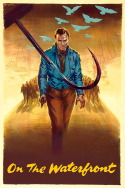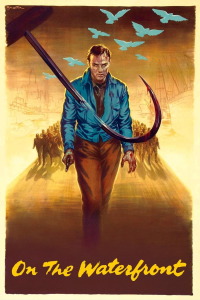
Review of On the Waterfront (1954) by Shane S — 02 Oct 2011
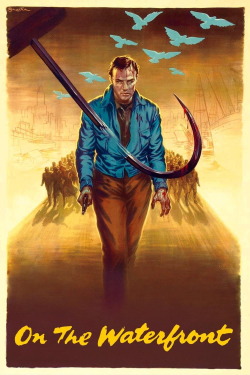
Man, this deserves Best Picture in every sense of the word. Sure, Marlon Brando mostly mumbles his lines throughout the film, but you sense that the character he plays is an extremely disturbed soul who feels betrayed by his own brethren.
With a strong script that takes the simple concept of the underdog story, combines it with a monomyth, and actually lays back so that it can capture the realism of said waterfront without becoming extremely fantastical, Elia Kazan and Budd Schulberg's "On the Watefront" is up there with "A Face in the Crowd" as for being one of my favorite films of theirs.
Yeah, Kazan normally makes a lot of great stuff without Schulberg's help (just ask Tennessee Williams about the tame-yet-disturbing "A Streetcar Named Desire"), but during the '50s, when Hollywood was going through that change in tone and thematic material via heightened artistry that Ray Comfort really hates (it introduced language, violence, and sex to his beloved family-friendly films), Schulberg and Kazan began pushing the envelope in many ways in order to show that Hollywood can be an artistic industry that doesn't entirely sell out its integrity for money.
Yeah, by making these dark films where the hero isn't necessarily the most sympathetic and by actually defending his questionable actions during the "Red Scare," Kazan pretty much revolutionized Hollywood and turned it towards edgier fare. And to me, he did that all for the better. Then again, given that this is a man who learns to be a dignified "pigeon" against the big bad that hovers over him, you could interpret that this film is against the HUAC and not necessarily Kazan's defense as to why he ratted out his friends (but more or less him defying the system on how movies should be made).
This is a film that has a lot of historical significance and it's a film that pretty much set Hollywood on the right course towards handling then-taboo issues in a tasteful/borderline manner. Without this film, you wouldn't have the incredible bravery of the New Hollywood filmmakers and their efforts to make entertaining films that had a lot of substance yet still somehow connected to their audiences without stooping down to what Hollywood thought was their level. You wouldn't have the boldness that future filmmakers had when they began to tackle controversial issues in film. Most importantly, you have a strong argument as to why the Hays Code wouldn't be viable - the idea of the Code was to protect Hollywood's audience from the "big bad world," so as to not stir up any controversy and outlawing of films, they set up this censor board that barred everything from the taboo to the mundane. This film pushes it a lot with its gritty depiction of violence - but that's not the case. After all, violence is inflicted by Johnny Friendly's gang in this movie.
No - I think what makes this film a middle finger to both stale Hollywood and the Breen Office is that Terry Malloy is celebrated as a hero...and somehow, he doesn't get any jail time for being an accomplice to murder. Much like "It's a Wonderful Life," the Office only focuses on the heroic deeds of the character - ignoring anything else. This was, to them, a celebration of the underdog...when in fact it was a tale about how supposed snitches were considered social pariahs in an oligarchical community.
Then again, you'd expect that from Schulberg. Guy writes a lot of scathing looks at the media industry. Not the people, but the family-unfriendly Aesops they try to get across to everybody in America.
OK, sorry for that spiel, but that's why I love "On the Waterfront." It was bold for its time...and it's still very bold today.
This review of On the Waterfront (1954) was written by Shane S on 02 Oct 2011.
On the Waterfront has generally received very positive reviews.
Was this review helpful?