Review of On the Waterfront (1954) by Jayakrishnan R — 08 May 2016
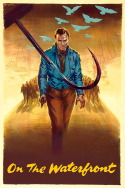
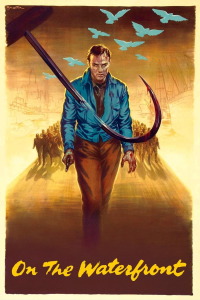
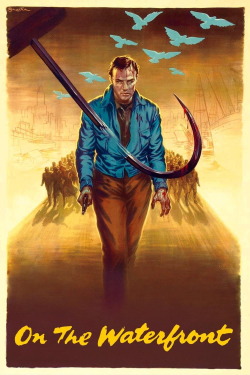
'On the Waterfront' is a tour de force that really has it all - a great script, outstanding acting, and great direction. It tells the story of a group of longshoremen who are being coerced into silence by their corrupt and mob-connected union bosses. These are tough guys who work backbreaking jobs and have a code of not ratting out others. It's this ethic combined with the threat of being denied work or killed that keeps them all in line. We're sucked in immediately when in the opening minutes of the film there is a brutal murder to silence one of them, in which Marlon Brando finds himself unwittingly an accomplice.
Brando is absolutely brilliant in this movie, and it boggles my mind that he considered his performance to be subpar after he saw it. He is a genius in the big moments and in the small ones he creates. Karl Malden is also outstanding as the priest who tries to rally the workers to stand up for themselves, and Lee J. Cobb and Rod Steiger turn in strong performances as the mob boss and one of his lieutenants (and Brando's brother), respectively. It's a shame that these three were all nominated for best supporting actor but split the vote so that none of them would win, though the film won 8 others, including Best Picture.
The scene in the taxicab with the brothers, where Steiger implores and even threatens Brando to remain silent, is one of the best in movie history - not just because of the fantastic script, but also because of Brando's acting. He recalls having to take a dive in a fight for a mob, and when his brother blames his manager for trying to bring him along too fast as a young boxer, running his career, he responds:
"It wasn't him Charlie, it was you. Remember that night in the Garden, you came down into my dressing room and said, 'kid, this ain't your night. We're going for the price on Wilson.' You remember that? This ain't your night! My night ... I could have taken Wilson apart. So what happens, he gets the title shot outdoors in a ballpark and what do I get, a one-way ticket to palookaville. You was my brother, Charlie, you shoulda looked out for me a little bit. You shoulda taken care of me, just a little bit, so I wouldn't have to take them dives for the short-end money.".
Charlie: "I had some bets down for you, you saw some money.".
"You don't understand! I coulda had class, I coulda been a contender! I coulda been somebody! Instead of a bum, which is what I am, let's face it. It was you, Charlie.".
That scene of being let down by a loved one is so poignant that on its own it makes the movie worth watching, but it's rock solid throughout, even if a little on the dramatic side at the ending. Kazan provided great direction with scenery that looked realistic because it was, having been shot in Hoboken with many of the extras real longshoremen, and on rooftops with aerials and dovecotes. I absolutely HATE the idea that Kazan made the film in part to justify his own testimony to congress during the McCarthy years, but it's a sad fact about the backstory of the film.
With that said, I have to put that aside and give it credit for being a great, great film. Aside from the taxicab scene, there are a couple of others that give me goosebumps every time I see them, one of which is Malden calling out the bosses in a speech despite being threatened and having garbage thrown at him ("Every time the mob puts pressure on a good man and stops him from doing his duty as a citizen - it's a crucifixion!"). This is a tough, gritty movie, about the little man overcoming intimidation to stand up for himself against evil. The theme is timeless, and the movie creates timeless, immortal moments.
This review of On the Waterfront (1954) was written by Jayakrishnan R on 08 May 2016.
On the Waterfront has generally received very positive reviews.
Was this review helpful?