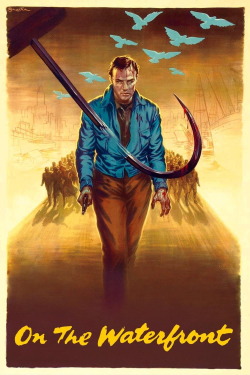
Review of On the Waterfront (1954) by Spangle — 02 May 2017
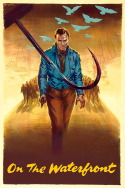
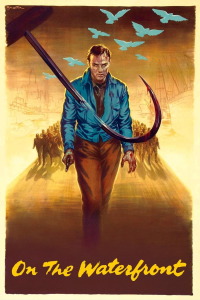
Arguably director Elia Kazan's best known work, On the Waterfront features a career-high for both its director and its star Marlon Brando in this dramatic depiction of corruption, intimidation, and ambition. Set on the docks of New Jersey, the film shows the level of control possessed by mob boss Johnny Friendly (Lee J. Cobb). A terrifying presence, his shadow looms over inch of the waterfront, with him and his henchmen deciding who can actually work that day and who must go home. Corrupt and deeply involved in the criminal underworld, Friendly and his men seek to silence any possible "cheese eaters" by any means necessary. Part of the peripheral of their crew is former boxer Terry Malloy (Marlon Brando). Working as a longshoremen, he is the young brother of Friendly's right hand man, Charley the Gent (Rod Steiger). This gives him ample opportunity at the docks, but also puts him in the crosshairs of the criminal case and, as such, finds himself getting squeezed by the cops. Starting a romance with pure girl Edie (Eva Marie Saint), Terry must decide whether he wants to remain loyal to Johnny or to himself.
Opening with one of the best first acts I have seen, in which Terry visits his friend Joey Doyle (Ben Wagner), On the Waterfront's opening sets the tone. Giving Joey a pigeon that he believes belongs to him, Terry is merely there to setup Joey. Professing later on that he thought that Johnny Friendly's men were just going to rough him up a bit and not kill him, this opening scene not only shows the vicious nature of the Friendly gang, but also sets up the conflict that will consume Terry's being. Feeling great remorse for getting his friend killed and then being unable to face Edie, Joey's sister, with the truth even when the two begin going together, Terry realizes his only way out is to rat. However, in doing so, everybody he loves will be put in danger. But, to not do so would be to become complicit in the continued exploitation of the longshoremen by the ruthless mobsters that run the union.
Through this tale of corruption and intimidation, On the Waterfront paints a frightening picture of blue collar America and how easily it can transform into lawlessness if a ruthless criminal gets their hands on it. Easily crushing all opposing forces due to the desperation in the area, Johnny Friendly is the gatekeeper between being broke and being able to work for a living. In essence, he is the man capable of ruining you or helping you. His brutal killings and beatings of those that step out of line only further establishes him as the head honcho in the area and not a man to be toyed with. Leaning on a local priest, Father Barry (Karl Maiden), for help and strength, Terry must overcome his own issues and fears to be able to stand up to this powerful man and tell the truth to the courts. Through this, the film becomes not just scary portrayal of crime and its influence on the poor, but also on the strength and courage it takes to stand up in the face of absolute adversity.
One of the more apparent themes at play in On the Waterfront is ambition and life goals. Having become hardened over time due to his exposure to the crime underworld, Terry has largely given up on his dreams. Once a promising boxer, he had to throw away his career to allow the mob to win its bet on the fight. Now, he opts to avoid having dreams to avoid future pain. As a result, he never reached his potential in life and is left wallowing as a longshoreman that is considered a bum by everyone around him, even Edie's father and often times, Edie herself. Having passed on every opportunity before him and throwing away his life in the name of supporting his brother and Johnny, Terry must finally work towards his own goals. No longer can he put everybody else ahead of himself. Being selfish is a quality he desperately needs to learn, as without it, he is being trampled on by all the men on the docks. He is a man who feels he has failed in life and by ratting on the crime bosses, he can finally live up to his own expectations for himself and not be such a disappointment. He can be more than a bum and not have to worry about becoming a beggar on the streets. He can live in the comfort of the knowledge that he did what was right and lifted the control of the docks away from criminals.
Featuring a career-best performance from Marlon Brando, On the Waterfront may be a bit too melodramatic at times with a poor-to-mediocre romance given too much screentime, but on the back of excellent direction from Kazan and Brando's bravado, it lives up to its classic billing. Brando's authenticity as an actor and his committed performance as Terry really bring the film to life and make it feel akin to something out of the Italian neo-realism due to its intense focus on the harsh reality of life. Now, a lot of this is due to Kazan to be sure, but Brando brings truth to this representation of life. He is Terry Malloy. Terry Malloy is him.
This review of On the Waterfront (1954) was written by Spangle on 02 May 2017.
On the Waterfront has generally received very positive reviews.
Was this review helpful?