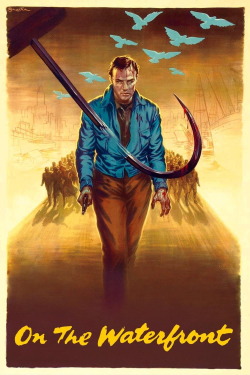
Review of On the Waterfront (1954) by Wesley H — 25 Jan 2010
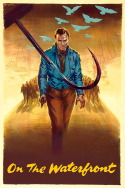
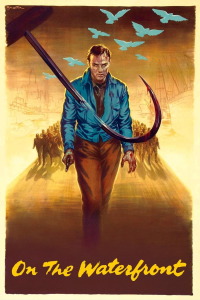
Who can deny the acting of Marlon Brando. His slick eyes that provoke such charm and character as they slant down his face. His heavy set jaw implies a man that should not be messed with, telling the opposing man to step off. His realism is mellifluous in almost every film he performs in. Along side actors he can make a movie work, make the film come to life. As a primary source, Brando's talent can be ultimately and indubitably seen in the 1954 classic: "On the Waterfront".
Elia Kazan's masterpiece by the name stated is imaginary and ineffably powerful. The films messages and inundated emotion makes it a powerhouse of dramatic conflict in movie history.
The film follows a time in which work for Americans was difficult to find, and unions were becoming a forming organization. Terry Malloy (Brando), is a young and tough ex-fighter who lives his life working on the waterfront. His favor is with the corrupt mob boss, Johnny Friendly (Lee J. Cobb), who has an addiction to gambly and keeping things on the down low. The main conflict begins when Joey Doyle, a man who squawked to the law about Johnny's business, is killed for attempting to rat him out. The hit involves Brando's character, who is unware of the extent to which Johnny's gang would take Joey's punishment. Now, with this secret on his chest, and a growing love for Joey's sister, Terry must make life risking decisions that will define him as a man and a honest person.
One strong point in this film is its capability to thrill and stimulate emotion in the audience. One of the most memorable scenes in the film (and one in movie history) is the scene called "The Contender". In the scene, Brando shares the spotlight with Rod Steiger (who plays his brother in the film). Steiger and Brando argue about Brando's impending fate, and the conversation leads to the two actors creating an emotion and heart breaking scene. Steiger is sent to kill Brando, but he finds that he can't once he looks in his brother's eyes. The fate of them both is radiated from their acting in the cab, and it is one of the most remarkable scenes to date.
On top of "The Contender", the story shifting scene where Brando reveals to Edie Doyle (Joey's sister played by Eva Marie Saint) that he was behind the death of her brother. Kazan sets up the emotional break down of Edie with the horns of ships in the background blocking out Brando's dialogue and fast paced editing to imply a panicked emotion. Kazan's and the editor's ability to create such emotion on the screen is what makes the film.
Let's not forget to mention that the film is a precursor to all mob films and crime dramas. Kazan's film additionally presents a message that states one cannot stand alone. The union based work in the film stands up against corruption and what they need. In numerous scenes, Karl Malden's marvelous performances as Father Barry ignites emotion to stand up against the system, and demand justice in the right circumstances.
Now, "On the Waterfront" still is a classic and masterpiece. It will be always, because no one can recreate a premise such as this film's story, or a team of actors such as this film's. "On the Waterfront" is the definition of an American classic.
This review of On the Waterfront (1954) was written by Wesley H on 25 Jan 2010.
On the Waterfront has generally received very positive reviews.
Was this review helpful?