Review of On Golden Pond (1981) by Edith N — 06 Nov 2012
Loons, After All, Are Monogamous.
This is not going to be the best-written review you'll ever see from me. It's late, and I'm tired. I've been tense with waiting for election results all day, and it's perhaps not the best state of mind for watching a touching, personal drama about a family and how it does and doesn't connect, especially since I don't much like Jane Fonda. However, the important stuff both nationally and in my state appears to be determined, so I can concentrate on this a little more. I'm sad about some of it and happy about some of it, and I figure that's about what you get out of life. In that sense, this movie isn't so bad a fit for election day as it might be. We all make our choices, and sometimes, we come to regret them. Sometimes, we are given the opportunity to fix them. However, we can't always fix what we've broken, so maybe we ought to think more about it the first time around.
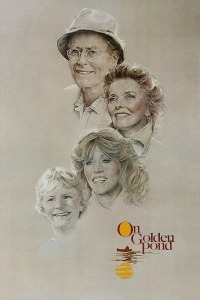
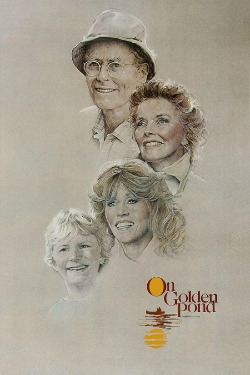
Norman (Henry Fonda) and Ethel (Katharine Hepburn) Thayer have returned once more to their summerhouse on the lake known as Golden Pond. They've been going there for decades; Ethel almost feels as though she knows the individual loons, and Norman is trying to catch the giant old rainbow trout known as Walter. For once, their daughter, Chelsea (Jane Fonda) will be there for Norman's birthday. She has brought her boyfriend, Bill Ray (Dabney Coleman), and his son, Billy, Jr. (Doug McKeon), and after a pleasant evening spent with her parents, she tells them that she and Bill are planning to go to Europe for a month, and can they take Billy, please? At first, Billy is no more happy about it than the elder Thayers, but Ethel is a friendly woman, and Norman and Billy unfreeze to one another. Norman teaches Billy the quiet joys of fishing for Walter. In fact, he opens up to Billy in a way he never did to Chelsea, a fact which does not escape her upon her return from Europe.
Famously, Henry and Jane didn't get along so well, and for many of the same reasons that are shown in the movie. It wasn't just that Jane wasn't a boy; Peter Fonda didn't have the greatest relationship with her father, either. However, for all Henry Fonda projected an air of quiet dignity and respect for all around him, he wasn't the best father out there for his kids. In many ways, his career came first. I also suspect that he never quite knew what to do with them; that can cause more trouble for families than people realize. It isn't all about actually having wanted a boy or a girl instead of the girl or boy you got; sometimes, it's that the person wasn't really sure how to be a parent at all. My mother's father wasn't terribly good at being a grandfather, though he tried. One of the differences here is that I'm not sure Henry Fonda--or, indeed, Norman--really tried. Ethel clearly did, and there is great affection between mother and daughter. But boys were simply easier for Norman.
Also famously, this is Henry Fonda's last movie and the only one where the Fondas worked together or where either of them worked with Katharine Hepburn. (Henry was in [i]War and Peace[/i] with Audrey, though!) In fact, according to the special features, Henry Fonda and Katharine Hepburn had never even met until shortly before filming began. (He had worked for 20th Century Fox; she had worked for RKO and then MGM.) Some actors are so incredibly iconic of their era that it's hard to imagine that they didn't know each other, but neither Henry Fonda nor Katharine Hepburn really fit into the Hollywood social whirl--she never even attended the Oscar ceremonies where she won. By 1981, however, most of their contemporaries were dead or dying, and these two grand old icons of the Golden Age of Hollywood were as much symbols as actors; she only made two more films herself, though she only died quite recently. Their Oscars were, in part, Valentines--though I suspect it gave her pleasure for the rest of her life to have beaten Meryl Streep.
This is a quiet film, the story of a family. It is also the story of a love affair, for all I think that makes some people uncomfortable. After all, Norman is in his seventies and Ethel is in her sixties. We don't like to think of people that old as still being in love--we especially cringe away from Norman's claim at one point that he is just trying to turn Ethel on. Ethel and Norman tease each other, and I think it really hurts her to see his distance from Chelsea, but they also love each other a great deal. Ethel spends the film realizing finally that the pair of them are going to die and likely to do so sooner than later, but I think as much as anything, it makes her sad that she will probably have to go one without him at some point. Katharine Hepburn had let Henry Fonda wear one of Spencer Tracy's hats as Norman, and he painted a picture for her of the three hats he'd worn. After he died, it was just a reminder of two men she would never see again. The worst part of getting old is all those you lose.
This review of On Golden Pond (1981) was written by Edith N on 06 Nov 2012.
On Golden Pond has generally received very positive reviews.
Was this review helpful?