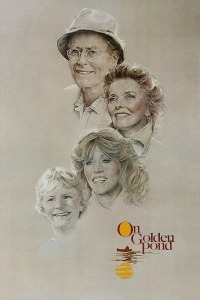
Review of On Golden Pond (1981) by Cameron J — 30 Aug 2014
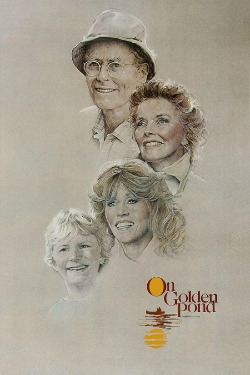
I'm so tempted to make a reference to The Band's "Up On Cripple Creek", but that song is way too fun for a film this slow-I mean, sad. This film is reasonably entertaining, I guess, but it's more family dysfunction, and features Henry Fonda about a year away from dying, and that is some sad stuff, and premium Oscar bait, at least in the early '80s, when family dysfunction dramas were still being popular after "Kramer vs. Kramer". First, it's "Ordinary People", and now we have "Old People", with Jane Fonda being pretty decidedly an exception. Man, she was nearing her mid-40s in this film, and she was still hot, as well she should be if she was going to fulfill certain daddy issues that this film kind of helped her resolve. I guess annoying liberal democrats have to stick together, even if they are part of the family unit that they are trying to destroy, or at least deconstruct. Before this film, with "The Rose", Mark Rydell even made the rock star lifestyle look depressing, so as if family pond trips weren't already a bummer, just wait until you see this. No, really, I would recommend that you see this film, because it's a good note for Henry Fonda to go out on, despite its shortcomings.
This film holds the potential to be pretty refreshing for what it is, and in a couple areas, it is, but on the whole, it's pretty predictable, hitting a number of tropes as it progresses down a familiar path, and at something of a limp clip, as well. Mark Rydell's steady directorial approach to storytelling is thoroughly realized more often than not, with adequate entertainment value and a solid deal of intrigue, but things really start to bland up once Rydell loses material to draw upon, as he does fairly often, or at least just often enough. By that, I mean that there is enough dragging to the storytelling to beget a sense of repetition, if not aimlessness, until the film begins to lose focus, if not consistency to focus. Minimalist though this film's narrative may be, it does have certain distinct segments, and a sense of aimlessness goes exacerbated by jarring shifts between them, established through the film's dedicating too much time to each segment, yet not enough time to fleshing out the layers of this plot. Immediate development is barely there, and gradual exposition does have its lapses, in spite of nuanced storytelling whose depth would be more realized if there weren't certain sentimental extremes to the dramatics which shake a sense of genuineness, and overemphasize an ambition to milk this drama for all its worth that, in turn, overemphasizes the limitations of this drama. There is plenty about this story which is rich with a potential that, upon being hit, is thoroughly fulfilled, but there's also a lot of simplicity to it, and that is stressed by the predictability and questionable pacing and structure of this inspired, but ambitious and sometimes sentimental project. Of course, the final product compels pretty thoroughly throughout its course, delivering on resonance for every challenge to engagement value, to the point of immersing, with the help of a distinguished setting.
As the title might suggest, this film focuses a good bit on its setting, filmed at Squam Lake in Holderness, New Hampshire, a lovely location that the filmmakers explore thoroughly, and polish through cinematography by Billy Williams that only stands out with its lighting, but stands out a good bit in that department. There's something beautifully tender about the visual style of the film, and about Dave Grusin's score, which is underused and conventional, but tasteful and lovely in its complimenting the genuine heart that drives a lot of the storytelling, and the story concept itself. The subject matter followed by the film may be predictable and light in scale, but it is of considerable value, at least in theme, dealing with an aging man coming to terms with his condition and finding a firmer grip on life, partly through his relationship with loved ones. Ernest Thompson's script is not as extensive as it could have been in fleshing out its narrative, no matter how much fat it leaves around the edges of storytelling, but it holds your attention through clever dialogue and humor, as well as a number of thoughtful spots to characterization that draws distinguished roles for the intimate storytelling to thrive on. Even Mark Rydell's direction is intimate, with a thoughtfulness that is a pinch bland at times, but near-consistently realized, enough so to milk the wit of Thompson's writing and sustain plenty of entertainment value, punctuated by sentimental touches that, when subtle, are near-piercing in their genuineness and resonance. This is a very moving character study, but it couldn't be if the characters weren't so well-portrayed, and sure enough, just about everyone delivers, with the lovely Jane Fonda, the endearing Dabney Coleman and the young Doug McKeon being pretty convincing in their respective supporting roles, while Katharine Hepburn, with her classic sparkling charisma at its most realized, would have stolen the show, if it wasn't for Henry Fonda's final performance, which is rich with charm, and with effortless dramatic layers whose more subtle spots capture a sense of fear in a man nearing the end of a long and happy life, and whose more charged spots sell the great deal of life and humanity still left in the Norman Thayer Jr. character. This is among the better performances Fonda gave throughout his career, and is therefore a good note for him to go out on, for it does about as much as the inspired storytelling when it comes to driving the final product as a touching tribute to life.
In closing, the film is a little predictable, draggy and slow, and fairly uneven, with enough undercooked and sentimental touches to emphasize the natural shortcomings that most threaten the final product, whose solid engagement value is consistently and firmly secured by the lovely location, cinematography and scoring, clever writing, tasteful direction, and inspired performances - especially the final one by Henry Fonda - which drive Mark Rydell's "On Golden Pond" as a consistently compelling and sometimes deeply moving drama.
3/5 - Good.
This review of On Golden Pond (1981) was written by Cameron J on 30 Aug 2014.
On Golden Pond has generally received very positive reviews.
Was this review helpful?