Review of Notes on a Scandal (2006) by Rocko P — 24 Jun 2009
Summary: Disappointed hedonists--beware the gap.
Well, thank goodness, a British movie captures the spirit of a decade--again.
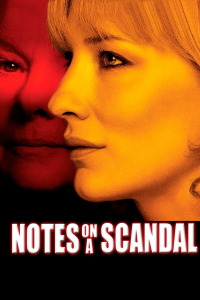
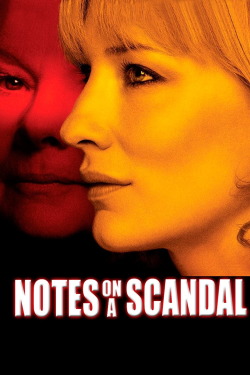
As its poster implies, Notes(2007) is a rich, modern thriller/drama hybrid. Although its inveigling narration and lilting Hitchcockian-homage score (by Philip Glass) hints at the iceberg of devious fury to come, the film quickly settles into a keenly observed commentary on early 21stC Western mores.
It furthermore acts as a logical moral reversal on, and a sequel of sorts to, Sidney Poitier?s To Sir With Love(1967), illustrating the socio-political upsets since. Together with The History Boys, Notes completes a rather surprising 2007 picture of student dalliances with hapless teachers, depicting relationship inequality between adults too. It dawns on us that our morality should extend to a continuum of compassion for child-child, child-adult, and adult-adult dalliances.
Specifically, Notes is commenting on the easy sexual temptations of a reduced authority-gap with students when a teacher is herself not much more than ?a big baby?. The Bathsheba character (Blanchett), while a magnet for many as a delicate and beautiful blonde, is a disappointed hedonist. Having faked it till she made it during the previous 15 yrs of her backstory, Sheba quickly falls off the adulthood wagon for the attentions of a self-serving, callow ?little tower of testosterone?.
On the other hand, Barbara--Covett, as in ?to covet? (Judy Dench)--is a tired ?class warrior? of Western education who withers everyone around her. Robot-like, she long ago detached herself from the social standards of her peers, and now we?re all in for a shock about what this costs.
Surprisingly lacking self-insight for a woman her advanced age, Barbara is conversely so hard up for company that she exalts in any new friends--pre-vetted for her tastes with ruthless prejudice, of course. Scrapbooks which she calls ?Notes? contain her social occasions, all rated for personal pleasure-value. Childish designations like ?Gold Star days? are a clue to Barbara?s naïveté, jarring against her pretentious aspirations to life as ?a companion in an older, better time?.
It?s only gradually that we recognise the irony of Bar?s bizarre depths, as her domineering coverup style of ?friendship? manifests a ferocious need for exclusivity. She is rattling as the OLDER obsessor of the two who is ?not young?, repeatedly losing female friends, predictably, to marriage and kids. Women like Barbara, while somehow still passing for ?normal?, can be driven by psychosexual narcissism to the point of small-claims crime, or worse.
Unobtrusively, Notes opts for an additional gay interpretation of Barbara?s ?intensity?, but this might strike some as unnecessary. The film?s staunch reasons for Bar?s repressed homosexuality are threefold:
1. Barbara?s core underestimability (by Bathsheba and us) relies on her own denial of her sexual orientation;.
2. this exploration addresses how mere blunt sexual repression skews other social equalisers, allowing Notes to indirectly critique pusillanimous panic about gays;.
And finally.
3. Bar?s repressed homosexuality in this case is just the foil for life?s sardonic wriggle-room (whenever one person has a crush on somebody, their beloved will often have a crush on somebody ELSE).
The wriggle-room here sadly involves full-blown (reverse) paedophilia--neither of these women are without issues.
Some viewers choose to dismiss Barbara?s social problem by claiming that she?s simply gay. She might be, but it?s certainly not simple, and it?s not at all what drives her core dysfunction. Her identity denial is part of a deeper unexamined self, because Bar is knife-edge narrow and blind to the limitations of her own cemented ideas, which remain despite being based on little actual experience in life.
Casting a ?dowdied-down? Judy Dench was the key; no appeal to mere sexual orientation would ever do justice to the entire stern person that is Barbara. Nor does she fit any known mould of a lesbian.
More likely, her developing personality was limited by some degree of early autism, psychosis or borderline-spectrum disorder. Barbara?s crime is that in her search for identity she just became venally prejudiced. Rejecting commonality with others, Barbara never learnt to love, only to need, and now serially preys upon singled-out ?special friends?. Always choosing a younger female, her victims then become solely responsible for all of Barbara?s hopes and dreams, tremendously pressurising their friendship. Clearly the battleaxe?s self-induced alienation should have been medicalised during childhood. She now has a massive social disability which no-one has addressed; colleagues just loathe her, unhelpfully.
It?s shocking to discover she?s remained a virgin all her life, and tragic to see her unable to learn and heal herself. Only lifelong clinical aberration explains this. Where were the disabusing social workers and mental healthcare professionals? Why is standing up to her left to her victims?
Gay or straight, why does Barbara pass for ?normal??
Surely society needs to deal much better with autistic/personality-spectrum disorders. There are far too many opportunities for friends and relatives to psychologically devastate each other in private.
Based on the Booker Prize-nominated novel by Zoe Heller (not Joseph?s niece--Zoe?s English), the film too is an instant classic. A rare example of the film adaptation improving the plot?s expression, Notes makes tonal changes more explicit with active combat between its leads.
Consummate direction by Richard Eyre and editing by John Bloom ensure that the whole film is remarkable for its pitch--Notes will of course be always remembered for its pyrrhic confrontations.
Shaheen Baig?s talented casting allows everyone to utterly inhabit their characters, even the children; and Judy Dench?s Barbara constitutes the most pitch-perfect casting of her career.
Bill Nighy is no slouch either. His unflattering ?crumbling patriarch? is even more honest than his similar Love Actually(2005) role. Richard?s cuckolded pleading at the door is a study in the cost of betrayal--and why no-one should try this at home.
There are only a few ?false notes?:
A. Barbara?s shallow derisiveness--prejudice--towards her ?chunky? colleague is gobsmackingly overwrought. Her description of Sue Hodge (Joanna Scanlan) as ?a pig in knickers? is more than just mere venom; offensively, it?s reinforced by the director?s unexplained scene depicting the teacher seeking a pat on the head from her director in public. This is bizarre, hamfisted sheepdipping of the Sue Hodge character by the script.
B. Our sense of the passage of time is missing near the beginning, so we don?t believe a paedophilic affair would be possible in the apparent timeframe. Interstitial (transition) scenes don?t support it, so meaning and audience learning aren?t given a chance. Editors must take greater care to nurture this.
C. Barbara?s many visits with Bathsheba?s family were reduced to a quick montage, robbing the audience of its uniformity of perception with the husband?s exasperated allegation about the ?f?ing spell? that Bar cast on his wife. The screenplay is too knowledgeable for what has been left in the film: this is again an editing issue.
Ultimately, Sheba?s ?Mind the gap? speech sums up the film best. It both explains and fails to prevent her misbehaviour supposedly to offset ?the quotidian awfulness of things?. Her father?s truism sheds equal light on our own similarly unmet expectations beyond our individualism. Seeing Sheba?s humiliated recovery to the reality of things with the aggressive journalists, we finally get her self-indulgence (entitled hedonism) as very much a ?gap? from ?life as it is?. Being ?a big baby? costs too much. (Blanchett borrowed the primal-screaming scene from the real life of ?wild child? rock journalist and widow of Michael Hutchence, Paula Yates, not long before Yates passed away in 2000.).
Sheba is, of course, a spectacular departure from Sidney Poitier?s Mark Thackeray in 1967--the stark difference being Mr.Thackeray?s admirable maturity and depth of character.
Notes? closing bookender bench scene is the ?buttoning? that stamps the success of the film; it?s better shock-value than the book?s mere nasty confusion was. Again, the adaptation improves on the original with this thunderclap ending--to a surprisingly short film. The closing scene reconfirms prevailing Hitchcockian tensions as NOTHING CHANGES. Although Jennifer Dodds? AVO(Apprehended Violence Order) was partially effective, it did nothing to dissuade Barbara from ?covetting? replacement relationships with which to reoffend.
The story, both book and on film, is therefore such a keen observer of today?s mores that it?s hard to know if it intended to target our kneejerk reactions to paedophilia, disappointed hedonists, or our thriller-territory misunderstanding of ?normal?.
Frankness about such private dilemmas makes this film a welcome if explosive reward; filmmakers have wasted too many years in the wildernesses of sometimes desperate-to-be-?alternative? storytelling when the unexamined routine was always more interesting. (However, we should draw the line at the mostly fake, insulting and calculated ?reality tv? so popular with inexperienced young people.).
Historically, it has always been the role of art--as much as philosophy--to point the accusing-finger-of-fate at its beholders. Notes(2007) is a welcome return to that enlightenment.(10/10).
LIzziebeth-1, IMDb,.
Sydney.
This review of Notes on a Scandal (2006) was written by Rocko P on 24 Jun 2009.
Notes on a Scandal has generally received very positive reviews.
Was this review helpful?