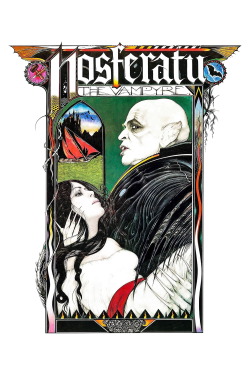
Review of Nosferatu the Vampyre (1979) by Edwin A — 12 Jan 2009
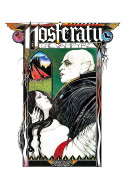
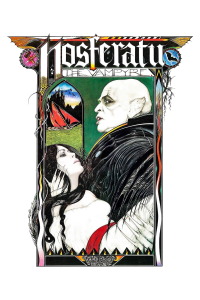
Some movies just stick with you, for better or for worse. I like it more when its for the better. Werner Herzog's 1979 version of the classic vampire tale, Nosferatu, has is one of those films that has stuck with me. Thankfully it's been for the better. In fact, my appreciation has only continued to grow and grow with time. It's one Herzog's more seen films, thanks to Kinski's reputation and the fact that most versions are in in English, but in my opinion, it's one of his more overlooked and under appreciated.
Bram Stoker's story of Dracula has been told countless times on film, but only a few really noteworthy times. Probably the most widely seen is Francis Ford Coppola's 1992 Hollywood version. That version is not without it's merits. Gary Oldman is a fine actor, and does a good job with his version of the vampire, and Coppola flared the film up with an interesting visual style. The most respected and also well known version is the first, FW Murnau's silent film Nosferatu: eine Syphonie des Grauens. That film reserves itself a spot on any film aficionado's must see list for Murnau's expressionist artistry. It was an assuredly constructed film with brilliant imagery and an unforgettable turn by the preternaturally creepy Max Schreck. Many people will tell you that while having the highest respect for Murnau's film and it's stunning achievements, they found it something of a dull affair. And I include myself in that category. Todd Browning and Bela Lugosi's 1931 version, though that version is perhaps more of a cult classic than a full on artistic masterpiece like Murnau's.
And then in the wings is Herzog's version. It too is respected by those who've seen it, and is itself something of a cult classic. It's a product of Herzog's famed collaboration with the volatile Klaus Kinski. Together they made five films, notably including Aguirre:Wrath of God and Fitzcarraldo. Friend, documentarian, and the man who infamously won a bet which resulted in in Herzog literally eating his own shoe, Errol Morris once referred to Kinski as a bonified "crazy person." That opinion, by most psychological standards, was probably correct. So if there was ever anyone to offer up a performance worthy of comparison to Schreck's original, it's Kinski.
The story follows closely to Murnau's version, except notably this time with the Stoker original name's, which were protected by copyright in 1922. Bruno Ganz (who brilliantly portrayed Hitler a few years back in Der Untergang) plays Jonathan Harker, who's called to deliver a real estate proposal to the Carpathian castle of Count Dracula. His wife Lucy is nervous of what may come and has strange dreams. His boss, Renfield is seemingly ever increasingly drifting further and further into excited insanity as Dracula's arrival draws nearer. Jonathan's trip to Count Dracula's castle is filled with tension and foreboding. He lodges for a night where he hears tales of a vampire and warnings, but continues on anyway through the mountains. This act contains one of the films most memorable sequences of imagery, set to Wagner's Prelude to Das Rheingold. It ends as a carriage mysteriously emerges from the fog to pick up Harker and carry him off to the castle.
Count Dracula's castle is the definition of ominous. The colour palette is lifeless, and of course in tribute to Murnau, shadows seem to take on a life of their own. Harker is greeted by Kinski's terrifying Dracula with uncomfortable courtesy. He searches the castle one day to find Dracula sleeping... in a casket.
While Jonathan is incapacitated, Count Dracula makes his way to Wismar on a ship. Mysteriously to the crew, they're all dying off. The ship carries hoards of rats. Is it the plague the captain ponders? When the ship finally arrives, everyone on board is dead. Dracula emerges, with him the rats, who flood the town.
To continue to harp on about the story is at this point an exercise in redundancy. We all essentially all know what follows - Renfield is Dracula's minion, and the vampire is in love with Jonathan Harker's wife, Lucy. Herzog changes things up a bit for the end, but it's Herzog and Kinski's execution that sets the film off. It's executed with terrifying strangeness. The locations are unforgettable - something to be expected from a man who famously declared that he directs landscapes. Delft (in Holland) served as Wismar. It's canals throughout the town are haunting, especially as the death ship squeezes it's way through. The castle scenes are filmed at Castle Pernstejn, which I'm told still looks much like it did during filming.
The film's opening sequence is of real life mummies in Mexico, which can still be visited. It's a surreal and haunting scene. Another strange and surreal moment comes when Harker wakes up to the a young boy playing violin standing above him. It's one of those great Herzog moments that seemingly serves no purpose other than as beautiful oddity. They do have a reason for being there, inexplicable as they seem, but even if they didn't I welcome them. The film's creepiest sequence, and one of the most unforgettable and brilliant scenes I've ever seen, takes place as Lucy Harker walks through the town square. Pigs and grey rats wander freely; the remaining townsfolk dance around the coffins; one group sits down for a nice meal in the wake of a plague. Lucy tries to escape those trying to dance with her, as the soundtrack plays a choral piece as Herzog's camera films from above, trailing behind, from always perfectly chosen distances to set the tone. The result is a purely visceral and delirious sequence that has never left my memory.
There are two versions of the film available, Both basically the same. One's shot in English, the other in German. Herzog has said he prefers the German version, feeling that for some reason those scenes just flowed better. I'm inclined to agree. The English version was the one I first saw, and had a few initial problems with. But as the years passed, and the viewings increased, any problems with the film only seemed to add to Nosferatu's greatness. Some have said that in order for a film to be a true masterpiece, it has to have some flaws. Sounds silly, but there's something to it. Herzog's films are filled with lots of little flaws, many due to working with next to no funding. His films are deeply personal, and were understandably emotional affairs. And working with Kinski was always at least sometimes a volatile affair. But that's what does make these films so endearing. There are lots of technically "perfect" made films. Yet many of them that don't have that endearing quality. It's films like these that seem to stick with you, for better or for worse. For their flaws, or for what they achieve in spite of them.
This review of Nosferatu the Vampyre (1979) was written by Edwin A on 12 Jan 2009.
Nosferatu the Vampyre has generally received very positive reviews.
Was this review helpful?