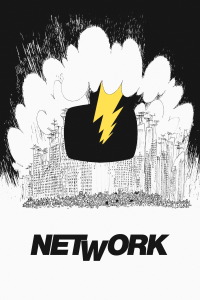
Review of Network (1976) by Harry W — 20 Dec 2014
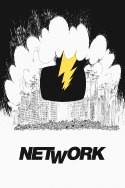
Network caught me as the first film for an Australian Actor to win the Academy Award for Best Actor for British born-Australian Actor Peter Finch, which he won over Sylvester Stallone for Rocky.
Network is a film with a very original concept, because it's one of the earlier films which handles the concept of TV studios doing anything on the quest for ratings. As the 1970's was largely the beginning of this, Network serves as a timely film which explains much of what was going on during that decade. It looks into how the entertainment industry will commercialize literally anything to be the number one channel on TV and so just how desperate the corporate world of entertainment is for popularity. In a satirical manner, the film examines the nature behind TV studios. And Paddy Chayefsky proves through the intelligent dialogue and real truth of his screenplay that he knows just how the entertainment industry functions.
The screenplay in Network is very original and intelligent since it deals with the painstaking nature of commercialism in the 1970's which is as valid today as it was then, and it provides a lot of strong material for the characters to work with, and it gives a strong setup to the film with many characters of interest. Most of the story is interesting, even though the pace of the film detracts in the second half and the story loses its momentum.
The first half of Network is thoroughly interesting and it explores a lot of concepts fresh to the cinematic world, so it's easy to look back at the film as a nostalgia piece, and it's all very well filmed and had a somewhat tense atmosphere thanks to the dedication of the cast.
And it's easy to learn from Network, and many of its dramatic elements are intelligent as well as there being a lot of clever satire in the story which provides a laugh here and there, particularly in the iconic scene where Howard Beale encourages people everywhere to stick their heads out a window and shout "I'm as mad as hell, and I'm not going to take this anymore!".
But the ending didn't make sense in my opinion. I thought that by the end of the film, it was too satirical for its own good and had run out sense, descending into a senseless joke to close everything down. For an extended period of time, Network can be seen as a legitimate satire but in its final act it descends into one last joke. If it was consistently focused moreso on comedic elements like the satirical masterpiece Dr. Strange love or: How I learned to Stop Worrying and Love the Bomb then the ending would have been more appropriate, but it feels instead like screenwriter Paddy Chayefsky had the same sense as the network heads at UBS and decided to take a concept and make it memorable without considering how that could be inappropriate. If he does this for satirical purposes, it is too satirical for the good of the film.
Much of the latter half of Network fails to match up to the quality of its former half, bevy are the first part of Network presents many high-concept story elements while the second part loses its focus on exploring them all evenly, focusing more on the relationship between Diana Christensen and Max Schumacher. While this is interesting, it doesn't have the same interesting qualities as Howard Beale's story which ends up characterising him as more of a supporting character than a main one, when though the Oscar that went to Peter Finch's performance in the role was for Best Actor in a Leading Role. Director Sidney Lumet isn't at his best in Network because he fails to balance things out in the second half of the film, so the momentum decreases and I found that much of the time I was just waiting in a state of boredom while actors came and went on screen but my sense of entertainment simply went. Network decreases in quality in the second half and loses a real sense of direction. Sidney Lumet fails to hold things together in Network, and so at times it's rather scattershot.
But the great talents of Network are undeniable and all the best come from the efforts of the largely talented cast.
Peter Finch's lead performance is unforgettable. His gripping tenacity over the insanity of his character Howard Beale is out of place in Network, but although his character is deemed a rambling lunatic having a mental breakdown, he is the most sane character in the film. Howard Beale is the one character in Network who truly tells it like it is, being honest about the dark nature of the world and the sad life he has been stuck with. He is the most same of all the main characters in Network, and the irony behind that is fairly hilarious. Peter Finch's over-the-top effort is perfect because it never becomes excessive but is fierce and strong enough to mercilessly dominate the attention of viewers, and so of all the characters that Network has lined up, Howard Beale is the most memorable. Peter Finch's finest hour is in Network, and it his sad that he didn't live to claim the Academy Award that he won for Best Actor in a leading role.
Faye Dunaway's performance is clearly one of, if not her absolute best performance in Network. In Network she is put in the challenging role of portraying Diana Christensen, the network head on a merciless quest for ratings. And therefore her character is the root of all the elements that Network attempts to satirize. And thanks to the relentless passion she puts into her performance, it feels truly genuine and immensely powerful. Faye Dunaway breathes so much life into her character and gives Diana Christensen the strength she needs to come off as a convincing female authority figure whose passion for her job matches nothing else in her life, and it is arguably her finest hour.
William Holden's performance practically matches up to Peter Finch's in Network. Although his character is significantly less notable than Howard Beale, anybody who appreciates the acting talents of William Holden can rejoice at the sight of one of the finest performances of his career in Network, and the final performance he gave to be nominated for the Academy Award for Best Actor. In Network he proves that his talents as an actor have grown with him as he has aged, and he makes an amiable lead who shares a fine chemistry with Faye Dunaway.
It's interesting to see William Holden and Faye Dunaway engage onscreen in Network because while William Holden's character Max Schumacher has the wisdom of age and is appealing to Faye Dunaway's Diana Christensen, she is the one with the power at the news station since she has a high level job. So when the two characters share a conversation over dinner there is no way to actually dictate which figure is a stronger one in the relationship, and as they talk there is a really interesting chemistry that emits from what goes on between. It is simple yet it is smart, and it makes Network into an interesting examination of human relationships among other things.
Robert Duvall's performance is a mighty powerful one, but from an actor of his talent you could expect no less from him. Whenever he is on screen he makes the effort to attempt to dominate it, and much of the time he is successful. His fierce combination of a dominant physicality, and tense facial gestures combined with his swift and sharp manner of projecting his words so that as well as reaching the other characters they essentially strike them. Robert Duvallâ(TM)s performance is surely deserving of an Academy Award nomination, and the fact that he didn')t get one is not right. Robert Duvall does an excellent job in Network.
Beatrice Straight makes a powerful impact in her screentime which only equals up to 5 minutes and 40 seconds. Even though her character isn't the most key to the story and her only reason purpose is to characterise Max Schumacher, her fierce power in delivering the drama through her words is just immaculate. She makes a hell of an impact in such a small time on screen, so itâ(TM)s really not surprising that she won the Academy Award for Best Supporting Actress. She shows off what her true talents as an actress are, and she's easy to remember for her performance in Network.
Ned Beatty's supporting performance is a strong one too and Conchata Ferrell also does a good job in her small appearance thanks simply to her dedicated line delivery.
So while Network is rather scattered and lacking a sufficient final act, the acting in it is brilliant and the satire is very clever.
This review of Network (1976) was written by Harry W on 20 Dec 2014.
Network has generally received very positive reviews.
Was this review helpful?