Review of Morning Glory (1933) by Edith N — 10 Aug 2013
Finding Yourself in the Legitimate Theatre.
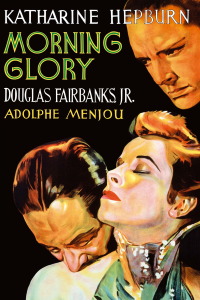
It's easy to forget how very young she was then. This was her third movie, her first Oscar. She was twenty-six then and could still pass for younger. She was ninety-six when she died; for my entire life, she was old. For as long as my mother can remember, she was middle aged. But there was a time, long ago, when Katharine Hepburn was young. In some ways, I think she was very like the character she played here--earnest and determined beyond the average. Wanting very much for everyone to be aware of how talented she was. She mellowed, with time, and I suspect her relationship with the more down-to-earth Spencer Tracy probably contributed to that, deeply messed up though that relationship was. However, part of me still likes young and earnest Katharine Hepburn, even when I find the characters she's playing to be more than a little embarrassing. I sympathize with them more than I really want to admit.
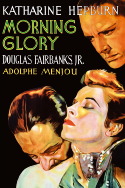
Ada Love (Hepburn) has come to New York to be an actress. She has begun called herself Eva Lovelace, and she wrote George Bernard Shaw to tell him of her admiration for him--and got a letter back. She is waiting in the office of Louis Easton (Adolphe Menjou), a theatrical producer (I think), in the hopes of auditioning for one of the plays he's putting on. He works with up-and-coming playwright Joseph Sheridan (Douglas Fairbanks, Jr.), who is strangely captivated by Eva, even if she is brash and callow. She's lovely, and he can see that she has more talent than the kind of sophisticate so frequently cast in Easton's plays. Eva also befriends Bob Hedges (C. Aubrey Smith), an experienced actor who is also enchanted by her. Her pride will not let her admit just how much help she needs. She will not admit that she is broke and hungry, for example. However, Bob sees through her and goes out of his way to help her, even when she doesn't want to let him.
Of course, Eva is a lot luckier than hundreds, if not thousands, of others. Most young women who come from small towns to act in New York don't befriend producers' mascots. Mostly, they starve. Or go home. Or find a way of making a living that isn't acting. Now, that isn't as popular to watch. We want to see the underdog succeed. All the better when she is played by someone like Katharine Hepburn, who was never truly an underdog in her life. She was never going to have to worry about starving. Most of those women trying to come to the attention of producers and playwrights are not Bryn Mawr graduates. Still, there is something to her in these early performances, when she played a common woman. Eva Lovelace is from a small New England town. She did local theatre, and she tried to improve it. Despite the fact that young Katharine Hepburn instead met Margaret Sanger and fought for suffrage, you can still see her in the different kind of earnest nature of Eva.
That said, the movie itself isn't terribly good. It goes on a bit despite also being quite short. It's really more of a character study than anything else, but instead on focusing on what's genuinely interesting about the character, we hammer in a tiny amount of a romance between her and Sheridan. And only a very tiny one that I'm not sure is two-sided. I think Eva is as much in love with the theatre as any human, and there is at one point the implication that she believes she is about to begin an affair with Easton. And she's perfectly willing to do it, in part because she thinks it will help her career and in part because she thinks it's the sort of thing that that great actresses all have in their pasts. This is the thing that I don't think we bring out enough in Eva--her beliefs in what a great actress should do. We focus rather more on the men than we do on Eva, and I don't think that helps the movie, whether in plot or character. It's an unfortunate trend in movies that has not much changed.
And, yes, it was her first Oscar. I wasn't hugely fond of [i]Lady For a Day[/i]--and just didn't bother writing a review of its later remake, even if that remake did star Bette Davis in the role that didn't win an Oscar in the original. I haven't seen [i]Cavalcade[/i]. But I can't help wondering, given that there were only three nominees in the category that year, what other, possibly better, performances went unrecognized. Don't get me wrong; I love me some Katharine Hepburn. I have a great distaste at the idea that Meryl Streep will someday tie her record and win a fourth acting Oscar, though I take some comfort in knowing that at least one of hers was for supporting, while Katharine Hepburn never got a supporting nomination in her life. Still, I often wonder, in situations like this, what other performances might have been worth noting. It was in the silly first few years of the ceremony, where the eligible period was longer than a calendar year, so I don't know, alas, what was missed.
This review of Morning Glory (1933) was written by Edith N on 10 Aug 2013.
Morning Glory has generally received mixed reviews.
Was this review helpful?