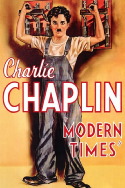
Review of Modern Times (1936) by Lyzette G — 13 Mar 2011
Since Modern Times is my favorite movie of all time, I feel obliged to write a review. But how could I possibly write a review about the greatest film ever made?
.
The year was 1934. The "talkie" revolution in motion pictures has been on the rise for about six years, and silent films were treading in popularity. This was also the same year Charlie Chaplin began production on Modern Times. Despite the sustaining demand to make a sound film, Chaplin previously fought against it with his 1931 film City Lights. He now had intentions on mainly releasing Modern Times as a silent film as well. He brought back his memorable Tramp character, and, in turn, created one of the funniest, most iconic feature films in all of cinematic history.
.
The story is simple. A tramp and a homeless woman (played by Paulette Goddard) experience numerous trials and tribulations in a present-day industrial society. Like always, Chaplin contributes his perfect share of slapstick humor to the bunch. From accidental drug consumption, to becoming trapped in factory machinery, to getting arrested at least five or six times, this is exactly the type of absurd hilarity one could expect from the comedian. However, there are also a variety of societal and political undertones that highlight these moments. In one of the very beginning scenes of the film, the factory worker, who pretty much repeats one motion all day long, experiences a mental breakdown and runs amok, causing him to become admitted to a mental hospital. Soon after, while walking down the street, he sees a red flag fall off of a truck, and attempts to return it to the driver. As a result, he is arrested for supposedly leading a Communist demonstration. Such situations may seem ridiculous, but there is some sort of dark, morbid humor amongst it all. After a while, our main character has decided that he likes it better in jail, where he was able to eat and feel secure, and thus tries to get himself arrested on purpose. One must remember that this film was made during the days of the Great Depression; therefore, people actually went through many of these problems. To make light of this situation through gags and humor was a bit of a risky move in its times; but Chaplin did it, and made it work magnificently.
.
Though this film could not necessarily be classified as a "talkie" film, we do hear human voices. However, in nearly every instance we hear them, it is not the actual individuals who are speaking, but some sort of man-made device that has synched their voices, such as video or audio recordings. This could be seen as a way to really depict how much modern-day technology takes over the lives of societal beings. In this sense, modern times were not greeted with open arms by all. This element is relevant in pretty much the entire beginning scene at the factory. From conveyor belts to giant, Big Brother-esque monitor screens, the advanced industrial age is in full swing in that one factory alone. We are even introduced to a new "eating machine", which basically forces food into the mouth of the individual (as Mr. Chaplin humorously demonstrates).
However, throughout all of this machine-age desensitization, there remains another underlying story; one of tenderness and love. As enjoyable and fun as the film may be, it carries across a generally bittersweet message. Some time into the film, the tramp meets a "gamine", who recently lost her family and is left all alone. She finds comfort in the tramp, as he does in her, and they both can relate to feeling so feeble in such a cruel world. Chaplin and Goddard were married in real life, so the chemistry and magnetism between the two seems genuine and real, which can't be said for much of the romance films of today.
There is one scene in particular that really touches my heart. The gamine and the tramp have just escaped from going to prison, and have settled in the front of a suburban household to take a rest. They see a man and woman come out of this house, the woman waving goodbye as the man leaves for work (we presume), and they both laugh and jokingly mimic their behavior. Mere moments later, they fantasize on how wonderful it could be if they lived in that sort of household. We then are led into a dream sequence, beginning with Chaplin's character returning from work, and Goddard's character cleaning up the house they reside in. The vision is one of a perfect home in a capitalist society. There are fruit and crops growing right by their window, ready to pluck. A cow is easily summoned, and milk is available right then and there. They remove their freshly-made steak from the stove, and begin to eat dinner. It is then that the dream sequence ends, and a cop arrives to move them along, simultaneously returning them to their harsh situation.
This scene forever holds a place in my heart. Not only did it make Modern Times the first movie to make me cry, but the underlying message is just so profound. In such harsh times as these, there is only so much our characters could do to retrieve the adequate amount of resources needed to survive. How wonderful would it be to have food right there when needed, instead of having to scavenge and steal just to get by? Halfway through the scene, the viewer may even forget that they are watching a dream sequence, and not the severe reality of the characters. Wouldn't we much rather like to see our two relatively likable protagonists in a pleasant situation, instead of where they really are? The couple eventually do find themselves a house, which is no more than a shack by the side of a lake. The gamin's remarks: "Well, it's no Buckingham Palace. But it's home." .
There are also a great deal of many other scenes that have become some of Chaplin's most memorable and beloved. We see Charlie Chaplin rollerskating blindfolded in a department store, feeding his factory boss who has become trapped inside machinery, and doing nearly everything in between; every second of which is such a delight. This movie also introduces the first time we hear Charlie's voice in a feature film, through a nonsense song he improvises during a café scene. The language he speaks is some sort of mock dialect, with some combination of French and Italian lingo, but the song is universal. This is all thanks to his brilliant pantomiming technique, in which he tells a story that even a child could understand. This scene is exceedingly hilarious, and also seals the fact that Mr. Chaplin is truly one of the greatest comedians in cinematic history, if not the absolute greatest.
There are a great deal of reasons why this is my favorite movie, many of which I have already mentioned. For the most part, it is the loveliest, most profound film I have ever seen, with a story that, while told very simply, stretches over a great deal of boundaries. The very last title card of the movie - and thus, of the silent era - states, "Buck up - Never say die! We'll get along!". Even today, we still have the ongoing problems of recession, unemployment and corruption. Thus, these touching words finalize the statement that Modern Times is as relevant today as it was 75 years ago. It is a rarity for a film to both make me laugh and make me cry, to be simultaneously hilarious and tragic. Nonetheless, this film is both, and also so much more. It is an essay, in film form, about the current and impending effects of industrialization in modern day. It is a public message regarding the wellness of society, intended to act towards all. It is a timeless work of art, that should be treasured for many more generations to come.
This review of Modern Times (1936) was written by Lyzette G on 13 Mar 2011.
Modern Times has generally received very positive reviews.
Was this review helpful?