Review of Modern Times (1936) by Joey D — 04 Jan 2009
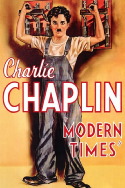
Charlie Chaplin showed once again that he was truly the master of physical comedy in "Modern Times." This film came out in 1936 after silent films had already been out of style for almost a decade, but Chaplin still stuck to his roots and made the movie he wanted to make. While there is sound in the movie, the only intelligible human dialogue comes from secondary sources such as a brooding boss on an overhead screen in a factory, a recording on a record, and on a radio broadcast. The dialogue between the actors in the film was still displayed by intermittent captions in the silent film tradition.
The story follows Chaplin as he is working in a factory where his job of tightening nuts and bolts becomes so monotonous and routine that he involuntarily makes the "screwing" motion even when not at the assembly line. This causes him to have a nervous breakdown and become temporarily institutionalized. After getting out, he, through a comedic stroke of ill fate, finds himself as the ringleader of a communist union worker parade for which he is arrested and thrown in jail. While in jail, he accidentally gets high on cocaine and, in the process, foils a prison break and gains the favor of the guards and gets out. After his release he meets a gamin who is orphaned and also down on her luck. They seek employment together at several places, but trouble continues to find them. Their final job lands them at a cafe where Chaplin is hired to be a singing waiter, and of course hilarity ensues.
"Modern Times" really is a classic piece of American cinema, because it captures many important things at the height of their places in history. Chaplin was at the top of his game here, and this was his last true silent film. It was released during the Depression and focuses on a lot of the societal issues of that era. It also casts a grim view of the future of production and industry, as is apparent in the factory scenes through out the film. Chaplin brilliantly managed to make a strong social message in a silent film which few would be able to boast for themselves. Even the title takes a bit of a sarcastic jab at the era. In fact, the film was banned in Germany and Italy which I'm sure was due to its anti-establishment mantras. Chaplin adds his keen sense of humor to the future during the classic "feeding machine" sequence which is a classic cinematic moment that is still funny today.
With him writing, directing, starring in, and composing the score for "Modern Times," Chaplin showed that he was the quintessential master of his craft. The physical sequences of him tightening bolts, falling down, and so forth are all perfectly choreographed with the orchestra hits in the score and are executed with seemingly effortless precision. This is an outstanding feat for an era when film editing was a much more primitive and tedious process than it is today. I am always impressed to see masterpiece of a film produced by a master filmmaker, and "Modern Times" foots the bill in every sense of the phrase. This is an essential movie experience for everyone who wants to see a legend at work.
This review of Modern Times (1936) was written by Joey D on 04 Jan 2009.
Modern Times has generally received very positive reviews.
Was this review helpful?