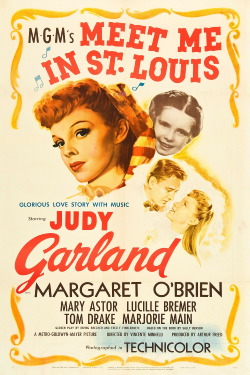
Review of Meet Me in St. Louis (1944) by Max M — 20 Apr 2012
Easily the Weirdest of the Classic Musicals.
I first saw this long ago, though perhaps not quite as long as you might imagine. It was just over ten years, in fact; my senior year in college. A roommate's grandparents has a beach house, and the group of us went out there to spend a night. This may well have been my first experience with the Channel 9 Movie; one way or another, this was playing on TV when we were settling in to the house for the night. I pretty sure not one of us had ever seen it, and we were fascinated. Horrified, even. There was a vague expectation that this would be another one of those sunny movies such as MGM seems to have produced by the dozen in the '50s, albeit a bit earlier than the others. And then this movie ended up being shadowed with all these little dark patches in and among the cheerful numbers about trolleys and such. At that, "Have Yourself a Merry Little Christmas" was supposed to end with a line that perhaps it would be your last!
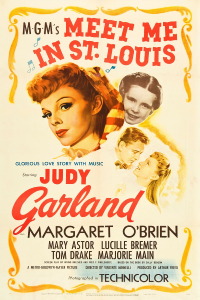
The movie is one year in the life of the Smith family of St. Louis, Missouri. Specifically, the year leading up to the opening of the World's Fair. On that first day, the house is in a to-do because Rose (Lucille Bremer) is to be receiving a long-distance call from New York, in which Warren Sheffield (Robert Sully) might propose. Esther (Judy Garland) is hoping to meet their new neighbour, the handsome John Truett (Tom Drake). Come Halloween, Tootie (Margaret O'Brien) and Agnes (Joan Carroll) must prove their bravery to the rest of the neighbourhood kids. And that night, father Alonzo (Leon Ames, who interacted with Alonzo Hawk on various occasions) comes home with the news that the family will be moving to New York in the new year. Whether they want to or not. Mostly not. After all, they can't leave St. Louis now. They'll miss the fair, the only time St. Louis is ever going to be of interest to anyone who doesn't live there!
The weirdest part is that Tootie buries her dolls in the backyard. She is at one point extremely excited that she has a new cigar box, all covered in shiny silver paper, to use as a coffin. One of the things she's going to have to do before they leave for New York is dig up her dolls so she can bury them there--and one of the reasons she seems distraught at the idea of moving is that they may not have a yard for her to bury them in. Now, I know that the child mortality rate was much higher a hundred-odd years ago, and doubtless Tootie had friends die of diseases we now have vaccinations for, but I'm pretty sure one of those dolls has been beheaded. And even if she played funerals, leaving them buried is distinctly odd. If I were her parents, I wouldn't give her any more dolls after she buried the first one, though I imagine they decided it was a phase and that she'd grow out of it. I mean, how do you make the decision about what's a phase and what's a sign of psychological maladaption?
What's interesting about the behind-the-scenes stuff is that Judy Garland didn't want to be in it and Margaret O'Brien nearly got killed for her increased salary. Judy was tired of playing teenagers--she was twenty-one and Esther is probably about seventeen. She wanted, and I think not unreasonably, the chance to play grown-ups. Though this later was one of her favourite movies of her own, probably because it's where she met Vincente Minnelli. As for Margaret O'Brien, she was hired then dropped, because she'd asked for an increase in salary. They briefly cast the daughter of one of the lighting guys before deciding that they wanted O'Brien after all. He then dropped a light during filming which nearly hit and killed her. He spent time in a mental hospital over it, apparently; IMDb does not say what anyone else went through because of it, including that rejected little girl. In fact, Wikipedia doesn't mention it on either the page for the movie or the page for Margaret O'Brien!
The movie is based on the autobiographical stories of Sally Benson--who never, as it happens, got to the World's Fair. Her family indeed moved to New York and never returned. (Interestingly, she was Tootie; maybe the books shed some light on the thing with the dolls.) Despite the incredible success of the movie--it was the studio's most popular since [i]Gone With the Wind[/i]--no attempt to tell the rest of the family's story has ever gotten off the ground. A sequel didn't get out of the planning stages, and a TV series never made it past the pilot. Much work went into the sets and costumes of this movie; it was made as accurate as possible. (Though the hair kind of bothered me; a girl expecting her first proposal any minute now would have worn her hair up, not down.) And it appears on all three of my thousand-movie lists, though Roger hasn't done it as a Great Movie. (Though it's always possible he just hasn't gotten around to it yet.) I don't think it's all that great, but it's not bad for what it is.
This review of Meet Me in St. Louis (1944) was written by Max M on 20 Apr 2012.
Meet Me in St. Louis has generally received very positive reviews.
Was this review helpful?