Review of Marked Woman (1937) by Caleb M — 20 Aug 2011
Even Holly Golightly Only Got Fifty Bucks for the Powder Room.
It was kind of hard doing a certain kind of crime drama during the era of the Code. It isn't even just the whole thing about how you couldn't have the criminals as good guys and how Crime Does Not Pay. It was also the case, in the days of the Code, that certain crimes were forbidden material for Hollywood films. In the case of this particular story, a fictionalization of the downfall of Lucky Luciano, the problem is that Luciano was convicted of running a major prostitution ring. Thomas Dewey, best known for not defeating Harry Truman for President in 1948, made a fine hero, but the problem was that his witnesses were guilty of crimes you couldn't actually portray onscreen in 1937. This means that there's a lot of talking around, not to mention putting in crimes which you can talk about which are often inevitable consequences of any kind of organized crime. It also, however, means that the reason these "hostesses" are given hundred-dollar bills by random strangers is left a little vague.
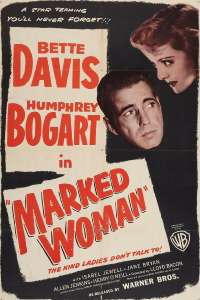
Bette Davis is Mary Dwight Strauber, though she just calls herself Mary Dwight. She works as a "hostess" in the nightclub of the notorious Johnny Vanning (Eduardo Ciannelli). Vanning runs what is called a "clip joint," a place where people are ludicrously overcharged for food and drink, often lured to it by hostesses promising what's not on the menu. One night, Ralph Krawford (Damian O'Flynn) writes a bad check to cover his debts. Mary takes pity on him, but it's too late. Johnny has his men kill Krawford. That gets Crusading Attorney David Graham (Humphrey Bogart) involved. He wants to prosecute Johnny, and he wants it bad. But Mary knows that there's no life out there for a "hostess" who turned in her employer, so she essentially throws her testimony. Only the whole thing means her sister, Betty (Jane Bryan), finds out what Mary does for a living, and what with one thing and another, Betty ends up at a party where she's hopelessly out of her depth, gets into a fight about what, exactly, she should be doing for that hundred-dollar bill, and takes a tumble down a flight of stairs.
Mary is, in fact, the marked woman of the title. After her sister disappears, last seen at one of Johnny's parties, she goes to David Graham for help. Johnny, as you might figure, does not take this well. He doesn't dirty his hands himself; he doesn't ever dirty his hands himself. However, he has his men beat Mary half to death--and then cut an X into her face to show that she double-crossed Johnny Vanning and paid the penalty. It's pretty grim stuff, and Davis handles the part well. Better, indeed, than the studio wanted. This was before the days when the easiest way to an Oscar was to tone down the glamour. (Though the winners that year weren't far gone from that theory.) They wanted the bandages to be small and discreet, nothing which would detract from the beauty of their star. Bette Davis knew they were missing the point, and she insisted her doctor put the bandages on her that he would a woman who had suffered what Mary did--and then insisted that she be filmed wearing them.
This was an unusual role for Bogart, of course--he played the good guy. Well enough; don't get me wrong. Bogart may have excelled at the heavy, but he didn't exactly always play villains. However, if you were to describe the plot of this to someone who knew old movies in general but not this one in particular, they would most likely assume that Bogart played Johnny Vanning. He and Bette Davis actually made several movies together, including of course his breakout role in [i]The Petrified Forest[/i], but they were mostly before he was a major star. It might also be surprising to people to learn that, therefore, he's really playing second fiddle at best. A later Bogart movie would probably involve the Crusading Attorney's being the main character, and he simply isn't here. Arguably, he is just a tool for Mary's use, by the end of things, and that's not what modern audiences expect of Bogart.
One of the reasons the women accept the life they lead is that they know there aren't a whole lot of options out there for them. Mary has hidden her life from her sister. She is sending Betty to school, though she doesn't ever say so, because she wants Betty to be part of a better world than Mary ever will. It isn't even just the prospect of a rich husband--definitely never mentioned but almost certainly considered by Mary, if not Betty. It is also that education is its own power. If Mary finished high school, it's probably more than Emmy Lou (Isabel Jewell) did. If David Graham is Mary's tool, it is no less true that Mary and the others are his. What's more, he is the one who decides when the tool's use is over. He does consider a future for Mary, though he'd have to choose between her and politics, I think, but he does not consider one for the other women. Whatever fate they go to, they go to it alone.
This review of Marked Woman (1937) was written by Caleb M on 20 Aug 2011.
Marked Woman has generally received positive reviews.
Was this review helpful?