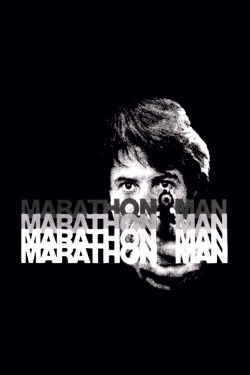
Review of Marathon Man (1976) by Mel V — 08 Mar 2009
In the mid-1970s, with the country reeling from the Watergate scandal and the resignation of President Richard M. Nixon, Hollywood unsurprisingly turned to several, politically themed novels and adapted them for the big screen. Of the four, [i]Three Days of the Condor[/i] (published as [i]Seven Days of the Condor[/i]), [i]The Parallax View[/i], and [i]All the President?s Men[/i], [i]Marathon Man[/i], only one of them, [i]All the President?s Men[/i], which dealt with the investigation of the Watergate scandal by Carl Bernstein and Bob Woodward, was based on actual events. The other novels and subsequent adaptations instead dealt with the underlying malaise and deep-seated pessimism toward the American government (specifically the executive branch). Of the four, [i]Marathon Man[/i], has the less obvious political critique, but nonetheless interweaves the overlapping concerns, fears, and anxieties found in post-Watergate America.
[i]Marathon Man[/i] initially focuses on Thomas 'Babe' Levy (Dustin Hoffman), a Ph.D. student in history at Columbia University and his older brother, Henry 'Doc' Levy (Roy Scheider), an undercover agent for a super-secret intelligence agency known only as the ?Division.? As a cover, Doc pretends to be an oil company executive and Doc hides his double life from Babe. At Columbia, Babe takes a seminar under his father?s old student, Professor Biesenthal (Fritz Weaver). He struggles with the topic of his Ph.D. dissertation, ?tyranny in American political life? and his father?s suicide as a result of the mid-1950s Communist witch hunts directed by Senator Joe McCarthy of Wisconsin. Doc travels to Paris as a courier on a mission for his boss, Peter Janeway (William Devane). There, Doc narrowly avoids a public bombing, meets a soon-murdered contact, LeClerc (Jacques Marin), and confronts a would-be assassin in his hotel room.
Back in the United States, Babe begins to date Elsa Opel (Marthe Keller), a Swiss history student. Dr. Christian Szell (Laurence Olivier), an ex-Nazi war criminal hiding out in Uruguay, travels to Manhattan to recover the diamonds his now-dead brother, Klaus (Ben Dova),.
Kept in a safety deposit box. Only Christian and his brother had keys to the safety deposit box. For Christian Szell, entering the United States comes at great risk. While he?s afraid someone, possibly someone in the U.S. government will steal the diamonds once he?s removed them from the safety deposit box, he also risks the discovery of his true identity. Despite his ignorance of his brother?s double life, Babe is soon drawn into Janeway and Szell?s schemes. Desperate to uncover any plots against him, Szell and his two henchmen, Karl (Richard Bright) and Erhard (Marc Lawrence), kidnap Babe and, in [i]Marathon Man?s[/i] most famous scene, performs unwanted dentistry on Babe while repeatedly asking, ?Is it safe?? Even Erhard flinches away in fear and disgust when Szell begins working on Babe?s teeth.
It?s not until roughly the one-hour mark that Doc and Babe?s storylines collide, violently. Looked at it from one perspective, with Babe as the main character, the ?inciting incident? doesn?t occur until Babe stumbles into his apartment after meeting Szell. For Doc, the ?inciting incident? occurs in Paris, when he narrowly escapes two attempts on his life. For Szell, the ?inciting incident? occurs much earlier, with the death of his brother in a traffic accident. Seen as three, overlapping, inevitably converging storylines (unsurprising, given [i]Marathon Man?s[/i] origin as a novel), then the slow-build first hour makes more sense, at least for viewers or readers willing to see novelist-screenwriter William Goldman?s ([i]The Princess Bride[/i], [i]All the President's Men[/i], [i]Butch Cassidy and the Sunshine Kid[/i]) adaptation of his own novel as non-standard and non-conventional, minus the three-act structure followed by most films made in Hollywood.
With a duplicitous, rogue government agency, Nazi war criminal (inspired by the notorious Josef Mengele, the ?Angel of Death? who performed cruel, sadistic medical experiments on concentration camp inmates), double agents (and double dealing), mistaken identities, and tortured (literally and metaphorically) protagonist, [i]Marathon Man[/i] looks, at least superficially, like a standard suspense thriller, but it?s not. [i]Marathon Man[/i] can be (and has been) described as a political thriller or, better yet, a paranoid conspiracy thriller (just because you think everyone?s out to get you doesn?t mean they aren?t). While does definitions work for [i]Marathon Man[/i], it?s also a slow-build character drama where plot, at least initially, takes second place to character building.
Although [i]Marathon Man[/i] deserves praise for its topicality and willingness to integrate contemporary concerns into the suspense-thriller genre, it also deserves criticism for its casual racism. The director, John Schlesinger ([i]The Falcon and the Snowman[/i], [i]The Day of the Locust[/i], [i]Sunday Bloody Sunday[/i], [i]Midnight Cowboy[/i], [i]Far from the Madding Crowd[/i], [i]Darling [/i], [i]Billy Liar[/i]) and Goldman seem incapable of rising above racial stereotypes. Babe lives in a rundown apartment building in an economically depressed neighborhood. One of Babe's neighbors, Melendez (Tito Goya), nicknames him ?creepy" (Babe runs regularly and he's non-Latino). Late in the film, Babe relies on his neighbors' ?skills? to break into his apartment. While the scene adds some much-needed humor, it also sadly suggests that Latinos, presumably Puerto Ricans are (a) well-armed, and (b) willing to break in and enter an apartment before dawn with only a few minutes notice.
While [i]Marathon Man?s[/i] representation of Latinos isn?t exactly a minor problem, it only takes up a small part of [i]Marathon Man?s[/i] running time. With Dustin Hoffman, Roy Scheider, and Laurence Olivier in the major parts, Marthe Keller and William Devane in the minor parts, William Goldman?s ([i]The Princess Bride[/i], [i]All the President's Men[/i], [i]Butch Cassidy and the Sunshine Kid[/i]) otherwise multi-layered screenplay, and Schlesinger?s cinéma vérité-inspired direction ([i]Marathon Man[/i] was one of the first films to use a Steadicam and the first to be released theatrically), it?s hard to go wrong with [i]Marathon Man[/i]. If [i]Marathon Man[/i] hasn?t satiated your appetite for 70s-era conspiracy thrillers, then definitely give [i]The Parallax View[/i], [i]Three Days of the Condor[/i], and [i]All the President?s Men[/i] a chance (if you haven?t already). While it?s not a political conspiracy per se, Francis Ford Coppola?s [i]The Conversation[/i], also deserves mention (and viewing).
This review of Marathon Man (1976) was written by Mel V on 08 Mar 2009.
Marathon Man has generally received positive reviews.
Was this review helpful?