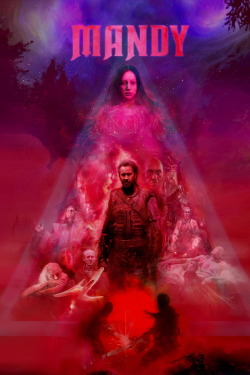
Review of Mandy (2018) by Zc_Lazer — 18 Sep 2018
Chainsaw Shaman: The Mythic Symbolism of Mandy.
Mandy is a beautifully, intensely, ferociously *human* film. Sitting in a darkened theater and diving into this hallucinatory experience, a strange kind of connective magic forms between director Panos Cosmatos, star Nicolas Cage, Cage’s character Red, and the film viewer.
In several interviews Cosmatos describes how creating Mandy and his previous film Beyond the Black Rainbow were ways for him to work through the feelings of rage and helplessness he experienced after losing his parents. Rather than creating a more literal and grounded exploration of loss, Cosmatos instead crafts a bold and shocking mythical world populated by demon bikers, chainsaw wielding cultists, mind-melting drugs, and strange magical artifacts.
Mandy follows a home invasion/revenge plot structure that we have seen many times before in films like Death Wish, Rolling Thunder, and others: a parable for the sacredness of the loved ones in your life and the importance of valuing them above all else. Cosmatos filters this familiar narrative through a psychotronic blend of dark fantasy, 80’s horror, and 70’s surrealism. Mandy’s bloody and bombastic midnight-movie aesthetic might make it appear to be a superficial love letter to cult movies of the past, but I argue that it is a masterclass in symbolism; an exploration of the pain of the subjective human experience in a powerful poetic fashion. Psychologist Dr. Jordan Peterson says of myth and fantasy, “The Mythological landscape is the landscape of human experience. In this world, there is nothing more real than pain”. Cosmatos utilizes this symbolic realm of fantasy to explore his very real grief and fury.
This is a movie about emotional intensity: the value of being intensely passionate and accessing the primal warrior instincts you have locked deep down in the dark, seething abyss of your psyche. Nicolas Cage describes his acting style as ‘nouveau shamanism’, a process in which he journeys inward into the recesses of his own mind, and utilizes what he finds there to embody a character. His goal is not to pretend to be something, but rather to access his most powerful emotions, memories, dreams, and experiences in order to genuinely feel something, and express it via a performance. In interviews Cage shares that he utilized his shamanic practice to access the powerful pain of his most recent divorce in order to bring the character of Red to life. It’s fascinating to see how Cage evolves his character through the remarkable visual communication of his acting. He utilizes his face, voice, and body language to depict the transformation of Red *visually*. In many scenes Cage doesn’t speak a single word: he reveals everything through his face with expressions both subtle and wildly erratic. Red evolves further and further away from the calm, gentle man he was at the beginning of the film. Cosmatos has his character undergo several stages of mutation through ‘rites of passage’ that plunge him deeper and deeper into madness and the realm of the fantastic. A key transformation occurs during Cage’s spell-binding melt-down in the bathroom. This scene functions as a kind of ‘crossing the threshold’ moment for the character where he takes his first voluntary step into the strange unknown. The bathroom set is designed to act as a visual manifestation of Red’s mental state: the shocking orange patterns of the wallpaper and bright lighting make it seem like a perverse prison cell or microcosm of hell in which Red is trapped.
Cage wails in anguish, desperately chugging a bottle of vodka, oscillating wildly through the spectrum of emotional torment. The vodka becomes a symbolic elixir; something that numbs his physical pain and transforms his despair to burning, skull-crushing rage.
At the demon biker’s lair, Red dips his finger into a mysterious jar and mutates even further when his tongue touches the mind-warping “skull juice” LSD concoction. It liquefies his reality and rockets him to another primordial plane. This is followed up by another gleefully psychotic scene of Cage lighting a cigarette from the flaming, decapitated head of a demon biker. He takes a long drag off the cigarette and shows us visually through his wild, nerve-shredding, electric stare that he has somehow journeyed even further into madness. What is amazing about this series of wild scenes is that Cage manages to change his character’s state of mind incrementally after each threshold of violence and depravity is crossed.
Red becomes an avatar of our own rage against the injustices we've experienced in our life. Through him we fight back; eviscerating with savage fulfillment all the dark forces that have harmed us. As always, the viewer brings their pain with them to the theater. Through the alchemy of film we can experience our pain from a unique perspective, reflect on it, and perhaps find answers.
This review of Mandy (2018) was written by Zc_Lazer on 18 Sep 2018.
Mandy has generally received positive reviews.
Was this review helpful?