Review of M (1931) by Tim M — 17 Jan 2010
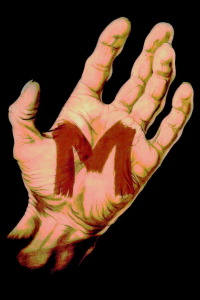
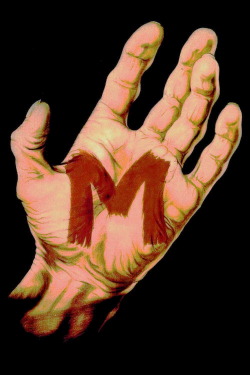
There's an immediacy to this film; there's something that makes Fritz Lang's 1931 film distinctly menacing throughout. Whether it's the distinct intimacy of certain scenes, which take place in enclosed spaces such as underground bars and locked storage rooms; the manipulation of light to create bizarre images and shapes as familiar and somewhat usually unspectacular places are rendered spaces of terror or, indeed, 'uncanny'; the idea that the most powerful 'groups' of characters are additionally the more unlikeable; or just the frank and sheer immediacy of the title, 'M', something in Lang's 1931 picture always seems to just toy with the audience. 'M' is a sublimely taught and somewhat creepy little film that basks in its breaking down of genre convention and thoroughly enjoys its swaying in and out of scenes, elements and subject matter that both thrill and horrify in equal measure.
The film was made by a man on a seemingly insatiable run for making movies; some will argue he never made a better one than this. Lang's 1931 piece is so accomplished that watching it decades later, ticking off the influences and ideas spawned because of it borders on a little game within itself; from John Mackenzie's 1980 effort The Long Good Friday, to the much more contemporary and far more reliant on ambiguity and symbolism, Lady Vengeance; Lang's M knows no bounds in terms of levels of influence.
The world in which M takes place is a frightening and confusing one; a world in which public hysteria and paranoia grips practically everyone. A world in which a police force are experimenting with new techniques in catching criminals and must venture into this investigation blind; a film in which criminals and organised gangs of criminals feel the need to step to the forefront, thus threatening to take on the role of the protagonists as we will them on in their goals, but it is a drive born out of loss of income that takes control within the minds of those that head the operations, thus placing their actions on a fine line between righteous and ignorant. But above all this, a world in which a child killing individual is made the focus of interest and the sole reason all the hate, confusion and anger is born.
M starts in a manner that captures some of what its overall themes will observe. A group of young girls are about to commence a street-set game, and in order to select those first to take part, one member of the group uses a particularly blood thirsty rhyme to 'pick out' a random child. The scene echoes not only what it is the evil within the film indulges in, but highlights a certain juxtaposition that will be prominent later on; in the sense young and innocent girls sing about blood-shed and murder, while supposedly hardened and unlikeable criminals whom run underground bars, are on the hunt to capture a murderer. The notion of evil fighting evil is prominent and Lang plays with this notion when, in what is one of my favourite scenes from the film, the aforementioned killer is trapped in a room and the criminals are closing in – we have to remind ourselves of Lorre's character's past deeds to save wanting him to get out.
The film does indeed revolve around Lorre's character; a certain Hans Beckert. The film has no shame in revealing who he is and precisely what he is very early on; this is less-so a detective story posing the question "who's doing it?" as much as it is a film asking how someone can go about being caught and stopped. A lot of the eeriness of Lorre's Beckert comes from the actor's 'patched up' look and expressive face; that child-like expression, that odd look he carries at the most relaxed of times, that worried and juxtaposed sense of excitement and fear that grips him when a net led by mobsters closes in. This is in great credit to the casting of Lorre, in relation to face and figure, and how he himself delivers a performance that gets across a sense of blood-lust, madness and dread at well spaced intervals.
The sense of technique and progression in M in relation to capturing the killer acts as one of the film's more interesting diversions. Perhaps acting as a representation of modernity, the police force and their methods of apprehension are shot in stark contrast to how the lower-downs of society go about their business. In this sense, the criminals, who are in it purely out of loss of income, use the lowest of the low in street-dwelling beggars and the homeless to keep a look out for who might be the killer. This cross comparison of new methods, which prove unsuccessful, and 'old fashioned'grounded techniques that prove useful, is interesting. As a film that blurs lines between what is frightening and what it thrilling; who is good and who is evil, and how the clear-cut representation of 'good' in the police force is placed in the background for most a film of this ilk, M is a monstrous triumph. In regards to exploring German cinema from whatever era, be sure to include M as a film to see.
Three and a half out of four.
This review of M (1931) was written by Tim M on 17 Jan 2010.
M has generally received very positive reviews.
Was this review helpful?