Review of M (1931) by Mars D — 08 Dec 2009
"M" is an unsettling film, a collection of images that don't seem to quite know how to relate to the accompanying sounds, forming a relationship that is hesitant and tense. An early talkie and German director Fritz Lang's first sound picture, "M" is still silent by about a third, its moments of eerie tranquility seeping through the cracks of Lang's experiments with spoken dialogue and noise.
The film's prologue, in which a young girl is abducted by a whistling lecher, ends with shots of her ball and balloon shown free of her grasp before the screen fades to black. Sound is heard before the picture returns. Newsies are yelling to promote their headlines. The entirety of Berlin is made aware of a man who stalks children. Everyone seems a suspect as mob intolerance begins to grow. The crowds in "M" don't simply talk; they scream angrily in peals of terror, mishear what is said, assume the worst of explanations. When the child murderer writes to the press in a crude cursive script, his taunting words are plastered on the front of newspapers for the entire city to see and fear.
Hans Beckert, played by the manic looking Peter Lorre in the actor's premiere starring role, is first seen testing his expression in a mirror as his personality is described in voiceover. Early in his film, Lang uses sound to describe, to explain and, most importantly, to assume. Thousands claim to know the murderer, each voicing his own preconceptions of how a man like Beckert must look and behave. These days, with its multiple sequences of stratagems and methodologies, "M" is regarded widely as a blueprint for the police procedural. German film scholar Anton Kaes cites no less than "Law and Order" on the Criterion edition's commentary track.
Above all, however, "M" is most fascinating in its portrayal of a haunting transitional state of social being for Germany as it sat positioned between two wars. First World War veterans are reduced to street beggars as children are seen gazing into shop windows at microcosms of thriving infrastructure - wooden cranes that lift and amusement park rides that spin. Proletariat mothers are reduced to grieving messes over the loss of their children while their husbands are nowhere to be seen. In fact, male characters are all but relegated to units of authority removed wholly from the familial, forming their own societies of law and the criminal respectively. They are alike in many ways, chief among them order and morality.
In an early draft of "M", Hans Beckert was a war veteran, a soldier turned serial killer with a developed taste for ending a life. In the final version, he is a mutant, an oddity without relation, consequently regarded as a common enemy. While criminal mastermind Schränker (Gustaf Gründgens) and homicide inspector Karl Lohmann (Otto Wernicke) debate their methods for re-instituting their own brands of order in Berlin via crosscuts, it still comes as a bit of a surprise when Schränker announces his intention to stop Beckert in his tracks. After all, he's a criminal too. Schränker and his ilk are fed up with constant police raids, a ruse to convince the public that an effort is being made to catch Beckert. The killer could be next door. To compete and fill multiple editions, the media are doing all they can to stoke the fires of paranoia.
Lang pays fetishistic attention to inventory and arsenals, repeatedly laying out collections that range from violent weaponry to types of clothing accessories and time pieces. In doing so he makes "M" a bits-and-pieces film in which small collections must be taken together for cohesion. It is reflected further in the use of sound. In Alan Crosland's "The Jazz Singer", music was included as not only a striking feature but as a catalyst to that film's narrative. "M" contains almost no music apart from Beckert's oft-repeated and creepy whistling of a section of Edvard Grieg's "Peer Gynt" suite. Recognized by a blind man, the only character tuned in exclusively to the aural, the act of creating sound leads to Beckert's discovery.
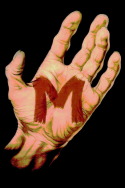
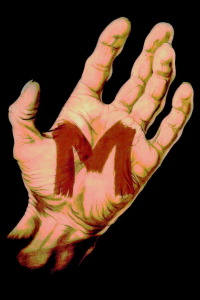
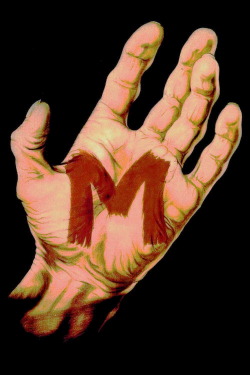
And what of the famous letter? That is Lang's hand shown in close-up, marking himself with the consonant that will soon be branded onto Beckert's jacket. "M" contains a selection of scenes in which off-screen characters make their presence known by reaching their hand into the frame and placing it on a shoulder, thereby constantly drawing attention what is unseen and always lurking. But why an "M"? It stands for Mörder (murderer), and while Lang changed his original title from "Die Mörder sind unter uns" (The Murderers are Among Us), it was done for marketing purposes, not fear of Nazi persecution.
"M" is also a symbol, easily identifiable and unchanging in a reflection. When Beckert sees his jacket in a mirror, his expression differs greatly from the first time he is shown staring at himself with perverse fascination. It has changed to one of fear, seeing himself in the incontestable way he is seen by others. Every truth about his sickness has been identified and pressed upon him for all to see. Once a loner in a crowd, he has been picked out like a child in a game of elimination.
Peter Kürten, the serial killer dubbed the "Vampire of Düsseldorf" by the local media, was put to death in 1931, one of the few killers given the death penalty in the era of the Weimar Republic. Those calling "M" a supportive tract on the death penalty ignore Lang's attempts to portray Lorre as pitiable as the actor thrashes about before a gang of hundreds of criminals, "experts in the rule of law" who believe that death is the only justifiable punishment.
The penultimate scene, in which Lorre delivers one of the cinema's great monologues, is characterized by a rampant and compelling brand of hypocrisy. Beckert exhibits a self-aware sickness that provokes little sympathy from the biased jury, but a certain amount in the viewer, who is suddenly a judge over the proceedings. As the criminals move ever closer toward satiating their collective bloodlust, Lang gives one more indication of sound's power over the image: Beckert covers his ears in desperation, hoping, ironically, that justice will be done.
This review of M (1931) was written by Mars D on 08 Dec 2009.
M has generally received very positive reviews.
Was this review helpful?