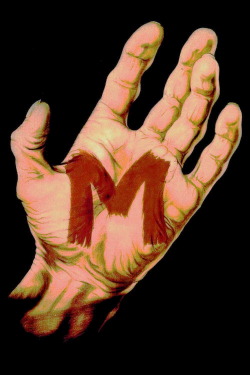
Review of M (1931) by Sherry L — 05 Mar 2013
"Any man on the street could be the guilty one".
It's impressing how little this movie actually has aged. You don't have to be particularly into classics to enjoy this.
The entrance of the murderer in the beginning, is one of the most brilliant and stylish I've ever seen;.
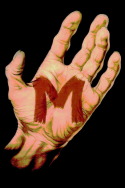
A little girl, "Elsie", playing in the streets, bounces her ball against a poster that is alerting the people that a serial killer might be at large. And suddenly, the shadow profile of a short man with a hat, creeps over the poster. This is the way Fritz Lang strikes to introduce us to the perverted child murderer, Franz Becker (Peter Lorre).
"What a pretty ball you have there...", the he says to Elsie. He later buys her a balloon. After a short while, we see the ball rolling alone on the ground and the balloon tangled in an electric main...
Unlike the dozens and dozens of american crime movies, we don't follow a particular detective who's going to crack the case...We follow a the police force with their attempts to catch the killer before the criminal elements do so.
It's typical for the german expressionism, to take advantage of shadow profiles to increase the suspense, like Lang does in the beginning. Take The Cabinet of Dr. Caligari or Nosferatu for example.
What I noticed, is that Fritz Lang regularly through the movie, make 5-7 seconds long shots of the environment (like the stairwell-shots to take an example) to familiarize the audience with the scene in the movie in a more effective way. I don't recall having seen this technique this early before (but please, feel free to inform me if you know an even earlier example!), which also indicates how innovative this movie actually was on it's release.
Peter Lorre went to history with his portrayal of Becker with his ever so enerving whistling of the tune "In the hall of the mountain king" while approaching his young victims. Fritz Lang uses that sound of the murder's whistling to notify the audience the murderer is soon to be seen. You have to keep in mind that sound in movies was a new device in 1931.
Lorre's defend speech in the end is historical and gives us a clear view of the theories that was in fashion back then; a serial killer kills of compulsion for pathological reasons. Peter Lorre's desperate outcries go stright to ones heart. He claims he cannot help himself. He has no control over his actions. And yes, in a way he is even perhaps better than the common criminals "who are proud of breaking safes or cheating at cards"! Because he is a law-abiding citizen most of the time! The criminals on the streets have chosen to commit their crimes, while he, Franz Becker, is compelled to commit them.
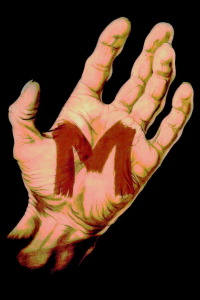
"M" suggests that a killer might be a product of a sick society, which in 1931 was a new way of explaining the psyche of a killer.
This review of M (1931) was written by Sherry L on 05 Mar 2013.
M has generally received very positive reviews.
Was this review helpful?