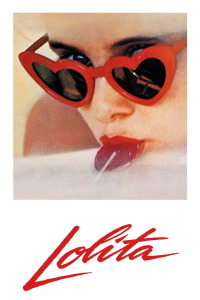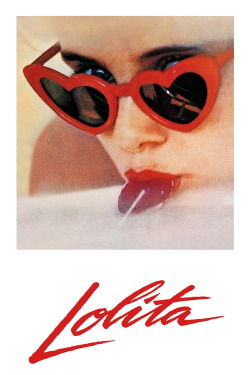
Review of Lolita (1962) by Evan K — 25 Apr 2017
One of Stanley Kubrick's most notoriously controversial films, Lolita sounded like a powerful experience.
Due to the tangible mature of films, screen adaptations never have the ability to capture the same insight and linguistic brilliance of their literary source material. So readers fond of the distinctive style of language used by Vladimir Nobokov can safely bet they won't get the same experience watching the story unfold as they did when reading it. For me, this was a massive relief because the writing style in Lolita was so overbearing and theoretical that I completely lost sight of reality within the story. I put the text down with fragmented notions of what may have happened at some point in the story but no certainty whatsoever and no desire to ever reread the text for any reason whatsoever. The only saving grace for the film adaptation is the fact that Stanley Kubrick is the director, and given that he is my all-time favourite filmmaker I figured that whatever literary significance sat in the novel would be more accessible in visionary form.
Due to both the profusely poetic nature of the source material and the censorship laws governing cinema at the time, Lolita essentially strips its story away to the basic core narrative. The story neglects much of Humbert Humbert's backstory and the deeper elements of his obsession with the titular Dolores "Lolita" Haze. It also means that a lot of the major plot points are either cut out of the story or turned into implications that occur during the transitions of sequences. Perhaps one of the most disappointing aspects of this is the fact that the relationship between Humbert and Lolita is changed from a perverse sexual obsession into dramatic romantic relationship plagued by vague fragments of the same obsession Vladimir Nobokov wrote of. There is a still a strong focus on the controlling nature of Humbert's paedophilic obsession with Lolita, but the controversial edge of the source material is very much lost in the adaptation process. Lolita is essentially Stanley Kubrick's attempts to salvage what he can from an overbearing novel in a time where censorship laws were obsessively strict. He has even been quoted as saying that if he knew how difficult censorship laws would burden the production at the time he would probably not have even made the film.
Nevertheless, Lolita still survives as a strong dramatic piece. Stanley Kubrick is able to effectively implicate his own personal touch into the story, starting from a change in the narrative structure. Having read Lolita I found that the story never took off and so I failed to find myself engaged in the story at any major point. I found myself mildly interested when Charlotte Haze first confessed her love of Humbert Humbert and he began to fantasize about killing her, but outside of that there was not another moment I could coherently absorb what was actually happening on the pages I was reading. To get audiences immediately engaged, Lolita starts where the story ends at a violent confrontation between Humbert Humbert and Clare Quilty. By beginning on such a heavy dramatic note, the story kicks off much sooner and audiences will find intrigue in understanding what led to it. And though it unfolds at a steady pace, Lolita proves to be a steadily developing narrative which captures the complicated relationship between Humbert and Charlotte before shifting the focus to him and Lolita. The story allows room for a lot of powerful character development and relationships to build, and that's where the core strength of the story rests.
While Vladimir Nobokov's source material put far more focus onto the mind of Humbert Humbert, Stanley Kubrick's vision helps us to see the story through his eyes more than analysing his sick and twisted mind. The character Dolores "Lolita" Haze becomes the tantalizing centre of attention in the story as she serves to consistently move the story forward. Lolita is built up as a very strong and independent character which is quite a contrast to the standard female lead from a romantic drama film of the time. While Humbert has a controlling obsession with Lolita, she knows how to manipulate him to enjoy the hedonistic passions that her youthful self-desires. This calls into question just where the power balance lies in the relationship and makes the characters all the more intriguing. Though the drama may be a bit inconsistent in finding its footing at the start of Lolita, once the focus becomes about the relationship between her and Humbert things begin to develop into a passionate and compelling drama which is likely to conflict audiences on how they sympathise with the characters. Stanley Kubrick's adaptation of Lolita makes for a story which is far more understandable and humanized than Vladimir Nobokov originally offered.
The cinematography in Lolita is very nice. In keeping with the traditional cinematic norms of the time, Lolita is supported by a series of long-lasting shots which serve to capture the full extent of talent in the cast through displays of extended interactions between them. This gives a smooth flow to the narrative and really compliments the actors, but there is also the slight touch of some occasional zooms for dramatic effect. For example: When Humbert slips his diary into his desk to hide it from Lolita, the camera momentarily cuts to a close-up of him placing it in his draw and locking it before resuming the earlier style of shot. This way, Lolita is able to maintain its classical film style while also emphasizing the importance of particular items or characters in key scenes. Lolita is shot with precision at a broad series of appealing locations, making it a visionary piece without focusing on style over drama. And with the assistance of a powerful musical score which is heavily mediated in its use, the film proves to be a clearly established stylish affair.
And on the shoulders of an exceptional cast of actors, Lolita finds powerful ground in its character development.
James Mason is such a definitive actor of the Hollywood Golden Age that he proves perfectly cast in the role of Humbert Humbert. The man carries an Orson Welles' type of sophistication; his tone of voice is very stern and sharp and he is very direct in how he speaks. He articulates his words with a poetic intelligence while disguising his true intentions underneath his surface facade. Yet as the story develops, we see him slowly begin to break it down more and more as his insecurities gradually begin to take effect. James Mason begins to lose himself to his character's vulnerable side and lets his emotions take over. James Mason manages to make Humbert Humbert a character who is puzzling, inappropriate and sympathetic all at different times which shows just how versatile and truly engaging he is as a character. Humbert Humbert is far more likable in the film than in the novel, and James Mason plays an essential role in making that a reality. James Mason involves himself deep in the passionate nature of the story and doesn't apply any artificial sugar-coating to the character, making him a rich and well-developed lead who takes audiences on a strong dramatic journey.
Sue Lyon is also an exceptionally powerful talent. Though she is up against Hollywood legends such as James Mason and Shelley Winters, she has no problem holding her own. She does this through maintaining a strong awareness of Lolita's power over the other characters and exploiting them with her juvenile charm and manipulation. Sue Lyon appears to just have fun with the role as Lolita naturally would in her position, proving her to be such a natural talent in the role. Sue Lyon's unprecedented confidence allows her to just ride through the film with he kind of easy charisma that makes her the centre of attention, and her charisma with James Mason is one of the film's core dramatic virtues.
Shelley Winters makes a very powerful presence. In portraying Charlotte Haze-Humbert she projects a very well-meaning and friendly demeanour which quickly reveals itself as a facade for her . Shelley Winters approaches this as if she is in a melodrama and works it extremely well because it presents a portrait of a very unhinged and unpredictable woman. Charlotte Haze-Humbert is an emotional rollercoaster who always hits audiences off guard with the sudden shifts in her behaviour, and in comparison to the far more subtle and restrained James Mason there is a powerful contrast that engages them. Shelley Winters keeps the dramatic edge of Lolita very much powerful while the titular character begins to develop, and her abrasive yet loving nature is very memorable.
Peter Sellers delivers an intriguing supporting performance. Quilty begins lost in a drunken haze as Peter Sellers reminds audiences of his natural comedic talents, but when Humbert fires his gun for the first time you can see him suddenly became shaken and terrified. It's restrained but clear and powerful, and he goes from being a rambling maniac into becoming a very vulnerable person in an instant. He enters the film later on and goes into a seemingly autistic rant in one scene before doing a clear imitation in another, making his entire nature and overall motivations to be a very elusive subject. Peter Sellers manages to bring his comedic talents into dramatic form with Lolita, proving just how strongly he can deliver when collaborating with Stanley Kubrick.
Lolita lacks the same edge as its source material, but Stanley Kubrick's passion for style and character development presents a richly acted and emotionally involving exploration of obsession and relationships.
This review of Lolita (1962) was written by Evan K on 25 Apr 2017.
Lolita has generally received very positive reviews.
Was this review helpful?