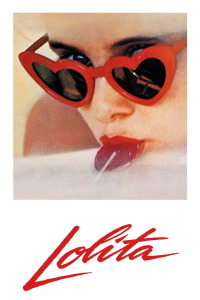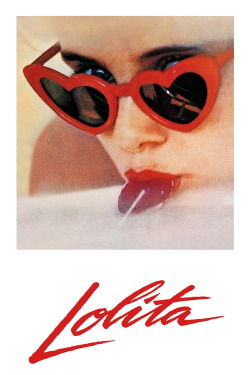
Review of Lolita (1962) by Will H — 04 Jan 2012
Stanley Kubrick, fresh off his big-budget epic crowd-pleaser Spartacus, was given somewhat more creative freedom with his projects. As such, with longtime collaborator producer James B. Harris, he set out to adapt Lolita, the controversial novel by Vladimir Nabokov.
A very sexually scandalous and suggestive story, Lolita would, at least in 1962, have been almost impossible to faithfully adapt due to the strictness of the MPAA, and as such, Kubrick, along with Nabokov as his screenwriter, were forced to make many creative compromises.
Thus, despite its charms and clever humor, Kubrick's Lolita ultimately feels like Stanley Kubrick neutered and dumbed down to meet with the standards of the ratings board. Don't get me wrong, the film is still slick and well-made, as a Kubrick film would be expected to, and Nabokov's script squeezes as much comedic and dramatic juice as could have possibly been done with this adaptation.
The film is also (mostly) well-cast and well-acted, with James Mason being a perfect choice for the role of the eloquent yet sarcastic and unstable Humbert Humbert, who is fully aware that his love for his landlady's daughter is wrong, yet cannot help himself from setting forth a chain of events that will bring them all to ruin.
Peter Sellers is also fantastic as Clare Quilty (as well as in his disguised parts), showcasing all the offbeat comedy and odd magnetism (as well as the talent for multiple personalities that would later serve him in Kubrick's next film) that make him the legend of comedy he is remembered for today.
The leading ladies, on the other hand, leave some to be desired. While I understand that Shelley Winters was playing a needy and overbearing woman in Charlotte Haze, that does not make her character any less irritating when she is onscreen.
The film improves drastically after her exit, though Sue Lyon, despite her childishly charming persona as the title character, fails to truly exhibit Lolita's perils and suffering in her sheltered life with Humbert.
Nelson Riddle's score, while conventional, serves the film well, and Kubrick's choice to shoot in black-and-white works well in the framework of the story. And I also feel that I should mention the fact that the opening scene is the best of the film.
Mason and Sellers are both on top of their game there, and I lament that the rest of the film's scenes failed to live up to the brilliance of the first. So, yeah, Lolita is probably Kubrick's worst film (though I'd probably still rate it higher than Killer's Kiss, based solely on its greater amount of content), but it's still important in his evolution as a director, as it taught him to stick to his vision above all else, and allowed him to help learn some narrative tricks that would serve him well later in his career (EX: By keeping the film in such a frenzied state of movement, Kubrick forces us to hone in on Humbert for viewer identification, a trick he would later use in A Clockwork Orange among others).
Lolita is worth watching, only if to see another step in the growth of one of film's greatest directors.
This review of Lolita (1962) was written by Will H on 04 Jan 2012.
Lolita has generally received very positive reviews.
Was this review helpful?