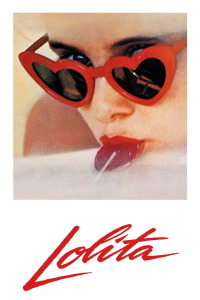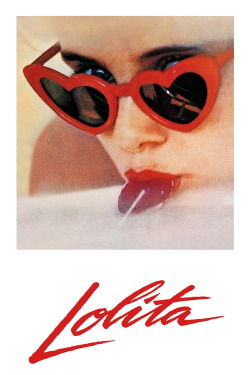
Review of Lolita (1962) by Cameron J — 07 Jun 2013
"Well, I'm not the world's most physical guy, but when she squeezed me tight she nearly broke my spine, oh, my Lolita, Lo-Lo-Lo-Lo-Lolita!" Yeah, that song's theme about a transvestite is indeed pretty "kinky" (Get it?), but this film's themes of lust for an underage stepdaughter aren't exactly the cleanest in the world, or at least not when it comes to the actual source material. Well, marketers of the 1960s, I'll tell you how they made a film of "Lolita": by toning down the novel's notorious provocative aspects... I guess. Yeah, I'm not that much of a reader, and this film takes a long enough time reach it's point, so I think I'm good when it comes to reading the book, even if this story is good enough to make for an awesome film. Say what you will about the film's length, - because I certainly will here in a little bit if you bear with me - but it's two-and-a-half hours well-spent, unless, of course, you're particularly excited about the idea of seeing Brutus from 1953's "Julius Caesar" face off against Inspector Clouseau, because any kind of interaction between James Mason and Peter Sellers is almost as underexplored as the sexual interactions between our leads. Hey, I can't say that I'm too disappointed about the juiciness in this tale being toned down, because if the titular Lolita character has the genes of a character played by Shelley Winters, then that pretty little lady was doomed to get chunky, and plus, this film is juicy enough to get you by. Still, as much as the film compels, even though it tones down the metaphorical kinks, it can't entirely do away with certain other types of kinks, as in flaws.
Considering the final product's length, you'd think that this drama takes more than enough time effectively fleshing out its depths, yet there are still those occasions, limited though they may be, in which storytelling feels kind of hurried, lightening up meditations upon expository depth enough at times for certain areas, some of which are relatively key, to come off as kind of undercooked. These hurried moments are bound to throw you off, but what slows down momentum even more is yet another underseen, but nevertheless present issue: atmospheric dry spells, which are hardly as abundant as they are in certain other Stan Kubrick films, but still rear blandness' ugly head in some places, or at least give you a chance to meditate upon just how overlong the final product is. Again, there are a few areas in the film that could be fleshed out a bit more, but at over two-and-a-half hours, this relatively minimalist drama doesn't necessarily outstay its welcome, - seeing as how it's rewarding through and through - but still drags its feet on a number of occasions that go bloated with excess material, if not a bit of repetition. Pacing issues are some of the final product's biggest problems, and yet, with that said, what pacing problems there are don't really prove to be all that severe, or at least they don't when taken on their own. After a while, the film's jumps between slightly hurried spells and slow spells, or slightly dry spells and limp spells, or whatever craft a formula that feels kind of aimless, not to where you feel that the film meanders a whole lot, but decidedly to where you'd be pressed to ignore natural shortcomings in the film's story concept. This is certainly a juicy story, enough so for it to be made into a film as excellent as this one, but it's not a stellar story, and what storytelling mishaps there are emphasize this fact greatly, to where the final product finds itself at risk of falling short of truly excellent. Of course, with all of its shortcomings, what the film does right it does so well that it ends up fulfilling its potential for excellence, which may often be shaken, but never to where you ignore the areas in which this film accels, such as stylistic ones.
If Stanley Kubrick was known for nothing else, it was a sharp taste in style, particularly visual style, so it's a bit awkward to say that this, one of his best films, is hardly as photographically sharp as other Kubrick efforts, which isn't to say that the film doesn't still look good, as cinematographer Oswald Morris' clever lighting is still handsomely crisp enough to make this black-and-white film look pretty well-defined for its time. As for framing, it's not quite all that elaborate, so you shouldn't go in expecting the scope of "Spartacus", yet you can still expect for there to be enough sharp intimacy within the film's scope for you to get a well-rounded feel for the environment, as surely as you can expect for their to be some impressive artistic taste within the film's musical aspects. As certainly as there's not a whole lot to praise about the film's cinematography, there's not really a whole lot to praise about the film's score, but rest assured that there are indeed things within the decent, if somewhat unevenly used score worth complimenting, with Nelson Riddle's and Bob Harris' compositions being often formulaic, yet consistently enjoyable, with certain pieces that are, in fact, entertaining and unique, being playful in a fashion that cleverly makes a tone out of the theme of maturity and childishness conflicting through mature interactions. Okay, allow me to stop messing around, because I've been trying to pad this paragraph out with meanderings around this film's stylistic punch-up, when really, there's not a whole lot to talk about when it comes to the final product's photographic and musical value, which isn't to say that the film's style isn't still sharp enough to do a fine job of coloring up this film that is, of course, most driven by its substance. Again, the meat to the film's story concept is limited to the point of leaving the final product at risk of being shaken short of excellence, but this story is still strong enough to stand a chance of being made into the excellent film that this effort ultimately is, boasting rich dramatic potential and audacious thematic weight that proves to be thoroughly intriguing on paper, alone. The overall excellence of this interpretation of this tale comes close to falling short of its full potential, because it is hard to deny that what flaws there are in the final product emphasize the intrigue within Vladimir Nabokov's worthy story's not really being all that firmly secured in concept, yet Nakokov's vision is ultimately done considerable justice by what is done very right in storytelling, even the storytelling on paper. Plotting within the script by Kubrick, James Harris and actually credited Kakokov himself gets a bit aimless at times, but on the whole, this is an airtight and strong script, with clever dialogue and subtly dark humor, as well as well-rounded characterization that draws you into the depths of this character piece about as much as the clever plays with thematic depth.
Some would argue that the ambiguities within this film's thematic depth does nothing more than undercut the full amount of juiciness within Vladimir Nabokov's infamously sleazy affair, and Stan Kubrick has, in fact, confessed to keeping thing more subtle for the sake of getting the final product through the then-especially airtight ratings board, but I find that the very subtle interpretations of the source material's themes of maturing through disconcerting happenings and tones of totally immoral sexual tension actually add to intrigue in some places, allowing you to meditate and ponder upon the depths of this tale, not just while you're engaged by the film that often gives you material to analyze, but after the credits roll and leave you to unravel the range within the final product, and gradually grow to appreciate it more. Sure, thematic effectiveness or not, there's plenty to appreciate within this film, but the gracefully subtle studies on barely tasteful, yet worthy subject matter really breathe a lot of life into the final product as an intelligent drama whose approaches to a story of this nature were still pretty grippingly audacious at the time, and remain engrossing to this day, especially when backed up by strengths within Stan Kubrick's directorial telling of this tale. Kubrick's directorial performance isn't great, but it's outstanding enough to end up playing a key role in making this film as excellent as it is, drawing on the juiciness established within the story concept and script in order to produce both thorough entertainment value and gripping intrigue, broken up by dramatic punch that isn't all that piercing, but proves to be gripping as a particular height in a consistently potent degree of compellingness that subtly, but surely wins you over considerable. Like I said, the film almost collapses out of excellence, not just because it's limited amount of flaws leave you to meditate upon natural shortcomings, but because the strengths are generally pretty subtle, though not so much so that excellence cannot be seen by those willing to go with the film, which could be a little bit more, but is already so much there for you to be appreciate if you meditate, or at least for the most part, because if there is no other strength that stands as impossible to disregard, it's the fine performances. There aren't too many secondary bananas to this character piece, but there are still some show-stealing supporting players, with the unevenly used Peter Sellers being exceedingly charismatic as the eccentric other older man with an eye on the titular little lady, and Shelley Winters being effective as an initially charming woman of class who finds her emotions tested by disturbing revelations regarding a new love in her life. Still, at the end of the day, it's the leads who really keep this character drama alive, with the lovely young (Hey, don't judge me, they actively sought out a pretty 14-year-old) Sue Lyon being compelling as an innocent young lady who finds emotional and sudden maturity within the loss of a parent and an unnervingly ambiguous relationship with a stepparent, as surely as leading man James Mason proves to be compelling as a sophisticated fella whose morality goes challenged time and again, initially by lust, and gradually by struggles to keep his questionable "love" interest out of harm that he, of course, could very well bring her, and when our two leads' charismas bond, you end up with sharp chemistry that sells you on the relationship upon which this story is built. Again, the film's strengths are subtle, but they are there, and they're very engrossing, so those able to latch onto the film will find a thoroughly rewarding drama that battles through its shortcomings enough to stand as not simply an underappreciated classic and one of Kubrick's best films, but an excellent effort by its own right.
At the end of the affair, you're left with a final product whose occasionally hurried moments and slow, overdrawn moments create a certain aimlessness that emphasizes the natural shortcomings within a generally strong story concept that all but drive the film short of the excellence that is ultimately miraculously achieved through strengths that are subtle, but potent enough to engross, with cinematography and score work being generally sharp, while a worthy story concept goes brought to life by a strong script that boasts intriguing thematic subtlety, thoroughly entertaining direction that boasts high engagement value, and a myriad of strong performances that are bonded through electric chemistry, thus making Stanley Kubrick's "Lolita" an unexpectedly outstanding and gripping study on a questionable relationship between a morally shaky scholar and his ever-budding young stepdaughter.
3.5/5 - Excellent.
This review of Lolita (1962) was written by Cameron J on 07 Jun 2013.
Lolita has generally received very positive reviews.
Was this review helpful?