Review of Like Father, Like Son (2013) by John B — 14 Jan 2015
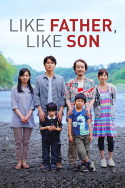
Like Father, Like Son, the winner of this year's Cannes Jury Prize, almost asks us to draw a parallel with the great master Yasujiro Ozu; it is not only Japanese, but also takes as its focus the smallest possible social unit, the family, and seeks to explore its durability in the face of disruption. In Like Father, Like Son, this disruption takes the form of a really rather earth shattering revelation for successful businessman Ryota Nonomiya and his wife Midori: their six year old son Keita is not their own, the result of administrative bungling at a country hospital. The film charts their twelve months flirting with the possibility of exchanging children with the Saiki family, an end both families stumble towards almost unwillingly over the course of the film. Koreeda focuses particularly on Ryota and his struggle to define his own paternity (which he views through the archaic prism of blood ties), in the face of having formed a bond (however rudimentary) with a child not his own, while he is equally shocked to see his kin having turned out so unlike him at the hands of the Saiki family, for example shouting "Oh my God" in English when he loses at a DS game.
It is in the small details which contribute to our perceptions of his characters in which Koreeda excels. His camera lingers on little, quite meaningless details in a diegetic fashion - we know that we are seeing a close up of chewed straws from Ryota's point of view, so we project onto them the implicit judgement passed on the Saiki family. The film is replete with such details, which grant it not only a little subtlety but also a certain lightness; in particular the patriarch of the Saiki family, whose jollity and sloth contrast humorously with the earnest, upright Ryota. It is also this contrast which is the film's greatest weakness, however. Both the Nonomiya and Saiki families are archetypal and simplistic: the former is wealthy but unhappy, the latter modest but happy. This ham-fisted moral dichotomy (think Spielberg) is quickly established in the very first meeting of the two families and Koreeda makes sure not to miss an opportunity to reinforce this. Not only does it drag the script down and make it all feel rather tired, but pervades every little aspect of the film. The sleek saloon of the Nonomiyas is often contrasted with the ramshackle wagon of the Saikis, the house of the former is referred to as a hotel and indeed looks like one - it succeeds in seeming clinical, but looks all the more unlike a home for it. The idea that rich people don't have mess demonstrates the extent to which Koreeda is willing to polarise his characters. The result is that Ryota Nonomiya, though well-acted, is such an out there cliché that it's hard to take his crisis of paternity particularly seriously.
Like Father, Like Son is often an enjoyable watch, and frequently succeeds in being quite amusing, but it comes across more Koreeda's terribly simplistic moral didacticism stunts what could have been a compelling family drama, reducing it to a sort of light comedy, interspersed with infuriating sections of crude melodrama.
This review of Like Father, Like Son (2013) was written by John B on 14 Jan 2015.
Like Father, Like Son has generally received very positive reviews.
Was this review helpful?