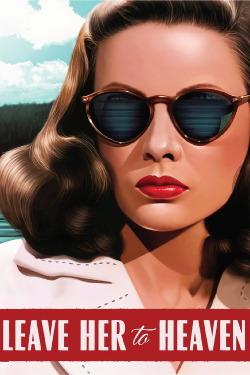
Review of Leave Her to Heaven (1945) by Paul Z — 21 Oct 2008
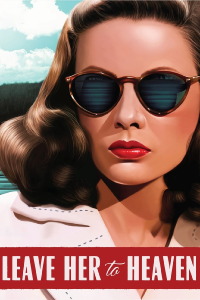
The visual richness of Leave Her To Heaven, all the color, all the emboldened and attention- grabbing scenery and the choice of every location being out in the vast American countryside is a streak of brilliance by the director, John M. Stahl, as the dark nature of Gene Tierney's character is made acutely subtle, practically nonexistent until we see a tangible actualization of it, when the script decides for her to put on sunglasses.
Cornel Wilde perfectly embodies the harmoniously civilized individual, as if the panoramic Technicolor world of the story is representative of his perspective, which exists under the precepts of order, reason and beauty, all of which replace mere function, granting clearance to those moments at which we would normally scoff such as him and Tierney waking up in the morning fully made up complete with carefully styled hair. It's a subliminal surreality in which society is imposed upon the free form in nature. Tierney is the subterranean instigator, that of unseen nature and the inner workings of the emotions and subconscious, stirring the veiled content of the story's environment with her deep, obsessive, yet hardly visible motivations. And none of this ever alters the beautiful appearance of the movie. Stahl is a careful craftsman who knows the ironic clashing of both worlds in his technical vision.
This creates an incredibly potent chemistry between the two characters, and thus the two leads since their performances are both so uncanny. It's as if Tierney is a stranger living in the pure ideological environment of 1940s America who, in her subterranean way, maneuvers her way through her life, not to be frittered away in superficialities. Every person with whom she feels a connection must be seized and squeezed to extract as much benefit as must be afforded her. Lavishing attention on Wilde, she seeks to be everything to him, thus forging an unheard-of insular existence, no matter what the cost, making her a villain in the eyes of the story.
The film begins almost surely as if to be yet another movie from the classic era to begin near the end and be told in flashback, which it is. However, this device serves as an important component to the perfect portrayal of clashing realities in nature, as a defense attorney, played by the subdued libertarian likes of Ray Collins, bookends the story by negotiating an expansion of Wilde and Tierney's energies, suggesting a foray into a collective conscious. Also, Vincent Price initializes himself in my mind as a riveting actor as he gives a tremendously tense performance as a forceful, bull-headed and sharp-tongued district attorney who applies the pressure that means to gush the two repelling principles into the amalgam understood by Collins.
This movie is one of the most tightly constructed masterworks of subtlety and symbolism that I have ever seen, one that is immediately comprehensible, fascinating and seamless. It is also one of the most beautifully filmed movies I have ever seen, regularly using monochromatic color schemes and the subtlest shades and hues to evoke the seeping through of an incongruous intensity.
This review of Leave Her to Heaven (1945) was written by Paul Z on 21 Oct 2008.
Leave Her to Heaven has generally received very positive reviews.
Was this review helpful?