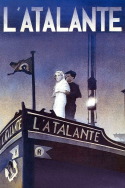
Review of L'Atalante (1934) by Jake R — 19 Jul 2009
This is one of those films you hear whispered every now and then by critics as having influenced this or that. A young director who made his debut and swiftly shuffled off this mortal coil. Some things about 'lyricism' and 'visual poetry' and a love story. But it's obscure, old and French, hardly the most appealing to the casual cinemagoer of the day. Their loss.
'L'Atalante' is a hard film to describe without having to wade through 75 years of thousands of films taking their cues from it. It sets dozens of conventions for the realist documentation of the New Waves, the trippy visuals of surrealist filmmakers both old and new and pioneered the power of the film score in an age where only musicals had a soundtrack that included the middle as well as the beginning and the end. Yet for all this incredible genesis, on it's own 'L'Atalante' is a symphonic masterpiece.
Love stories are as old as time itself, but in the world of movies every tale of romance had to be composed as a skyscraper-high pitched melodrama, with the quieter flourishes of some of the more gifted actors lost in a sea of screamed emotion. 'L'Atalante's love story is like a stone at the bottom of the sea of theatrics: tough, imperfect but enduring. This love story has a definite darkness to it, from the bride's reluctance at the beginning to the damaging separation that takes up most of the final act. While these flaws make the relationship seem more real, in actual fact it's the scenes of affection that display something approaching reality. Here there would be 'romantic' mugging and relentlessly dull embraces; all that is jettisoned in favour of intensely quiet encounters, and that's where the film's legendary eroticism is apparent. Both leads are fairly pretty, especially Dita Parlo, but their gentle cuddles, kisses and snuggles have an extraordinary power, to not only look cute and sexy but to communicate an effortlessness and plausibility to seem as if it could be the couple in the house down the street.
That's not to say this is 'real' in the same sense as Ken Loach or Mike Leigh; Vigo's visual sense owes more to Bunuel, with interludes and camera angles that capture awkward but endearing details. His penchant for looking at innocuous and irrelevant sights along the way - ships, people walking, Jules' army of cats - has an earthy charm that predates Ozu's 'pillow shots' for their tiny brushstrokes of environment and atmosphere.
And that's 'L'Atalante's greatest achievement: atmosphere. Whether by the gorgeous cinematography, the sultry softness of focus either deliberate or accidental, and the deftly romantic score, the film is alive and pulsing with a tender heartbeat.You can almost taste the smoky air, feel the chill of the Autumnal sunlight, smell the oil waters of the canal, sweat in the clammy heat of the Parisian cafe where the peddler tries his luck with Juliette. What Vigo lacks in narrative structure he makes up for in pure instinct.
To top it all, there is a clutch of outstanding performances. Jean Daste is uncomfortable and stubborn as the jealous, over-protective husband Jean, while Parlo is positively luscious as the soft wife Juliette, the focal point of all the film's lightness as well as it's sexual energy. But it's Michel Simon as the loveably toothless bargemate Pere Jules who provides the most astonishment. Deceptive in every way, from the opening scene of seemingly wooden delivery and expression, Simon goes on to showcase a masterclass in unshowy, understated but totally dedicated realism, making the Method ideology seem as subtle as Artaud's 'theatre of cruelty'. It's Simon's performance that has echoed in the 75 years since as the kind of solid supporting turn one sees in dozens of films with over-hyped, useless A-listers. For that grounding of level-headedness alone we an thank 'L'Atalante'.
In the end the film isn't trying to become a momument for the ages; Vigo picked up the original material and worked it out simply because he was in a terrible state, financially and personally. Where the film gets its longevity and enormous appeal from is how it throws everything to do with cinematic revolution and convention away in favour of getting to the core of this gentle love story. Stripped of pretentiousness and higher meaning, it succeeds in the exact opposite way: making the banal unmissable, the ordinary magical, the familiar indistinguishable, and the real life into cinematic immortality.
This review of L'Atalante (1934) was written by Jake R on 19 Jul 2009.
L'Atalante has generally received very positive reviews.
Was this review helpful?