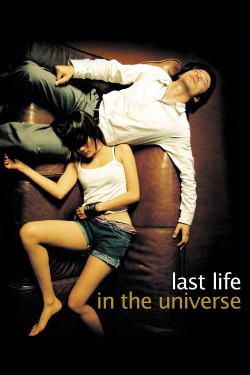
Review of Last Life in the Universe (2003) by Dyna T — 01 May 2015
Last Life In The Universe, is a dream like film that you will unable to stop watching. The lines are smooth and so is the flow of the mellow film. The film starts with the main character, Kenji who keeps trying to commit suicide, but is constantly interrupted. He writes a suicide note of 'this is bliss' (3:38); he believes in the peace of death will bring him bliss as there would be no need to keep up with fast paced life. The film mirrors what Kenji seeks with its calm nature, and succeeds.
Kenji's life is that of work at a library, attempting suicide and his gangster brother - he is not close to any form of bliss. He is alone; the last life in the universe the title speaks of. One of the many books he reads is a children's one on a lonely lizard, who without his family, friends and enemies realizes "it is better being with your enemies than alone" and the lizard motive is repeated throughout the film: the song 'Black Lizard' is played and shot of lizards on walls are repeated. Berkley said that to be is to be perceived ("The objects of sense exist only when they are perceived...no longer than while there is somebody by to perceive them" A Treatise Concerning the Principles of Human Knowledge.) and neither this lizard nor Kenji are able to be perceived, leading to the solution of death as a relaxing alternative.
Yet, Kenji is not truly ready to die. The opportunity presents itself when a man points a gun at him after shooting his brother and Kenji shoots him. Left with no one - not even his brother - he seeks out to be perceived again. No longer trying suicide alone in his apartment, he goes outside to a bridge and meets Noi after the death of her sister. Noi is another last life in the universe, alone after the death of her sister. Noi and Kenji are apparent opposites, visibly acknowledged through the clothes they wear and their apartments. They find comfort in each other and a synthesis is formed between their two opposing lifestyles.
The relationship between Noi and Kenji does not follow the traditional romance metanarrative. Depicted is not lonely people falling in love and finding happiness. The two are together when the question is asked "are you sad?" with the response "everybody is sad" (1:27). However, there is some progress from the beginning of the film shown through the visual elements, although the colour palette remains reserved and without much contrast, more colour is shown towards the end of the film as the haunting blue light of the beginning scene in Kenji's apartment is left.
Kenji's apartment and it's location in the city is left for the more open house and environment of Noi's house. This movement agrees with Kenji who no longer has to deal with the confinement of his small apartment, and the bustling city life he wished to avoid by death. Noi also is removed from another form of confinement when she decides to leave her relationship with her abusive boyfriend Jon and at the end of film moves country. The two characters experience a form of liberation from their previous lives. Kenji does not attempt suicide again (except for after upsetting Noi). Surreal elements are now added to the film with Kenji seeing the house clean itself, and Noi briefly replaced with her schoolgirl uniform dressed sister. He is removed from confinement both physically and mentally and this release is cleverly mirrored with the film's own diversion from the expectations of realism.
One of these surreal scenes is the Noi's messy house magically cleaning itself, helping Kenji on his spring-cleaning project. Kenji puts himself to work cleaning which seems to have a healing effect compared to his previous work as a librarian. His new "job" seems more pleasurable to him, due to the increased use-value, hinting at a Marxist approach to valuing labour for it's use and exchange value. Additionally his work is now provided as a service for another, further elaborating on the importance of Berkley's idea of human existence being reliant on the other.
The film is in opposition to Descartes proposition of "Cogito Ergo Sum" or "I think therefore I am" (Discourse on the Method). Kenji is an intellectual with an apartment filled with knowledge and books, yet he chooses to leave this in order to live with someone else. He becomes content through his friendship/semi-romantic relationship with Noi, with the film ending with him arrested, but smiling due to imagining being reunited with Noi. He may be physically confined, but his mind has been liberated from his internal conflict through a relationship with someone.
Last Life in The Universe is a film that shows the connection between people - and the importance of these connections. Perhaps it is not the most cheerful film - with murder and loneliness and a protagonist that repeatedly attempts suicide. However, the film defies all this and you will be left staring at a black screen, content, thankful for the experience - for the calm bliss.
This review of Last Life in the Universe (2003) was written by Dyna T on 01 May 2015.
Last Life in the Universe has generally received very positive reviews.
Was this review helpful?