Review of La Dolce Vita (1960) by Camilla G — 10 Oct 2009
Movies like La Dolce Vita are playful exuberance; Chicago Sun-Times critic Roger Ebert cites it as one of his favourite movies. The other entries in his top ten list are hard-hitting and passionate baffling masterworks, very emotional and powerful. As much as I try to love movies like Dekalog (the 1989 Polish television drama series that was adapted to the screen as a ten hour epic about the Ten Commandments), I?d still prefer to watch a movie like No Country for Old Men. The latter movie isn?t a dumb movie ? it is complex and very well made, but it is intermediate compared to other, hard-hitting 8 or 9 hour epics. I?ve only been criticizing movies for a little under eight months now, and it took me until yesterday to realise that some things I just can?t love yet. Ebert has been reviewing movies since 1967, totalling about 6800 reviews, each about 650 words, not to mention thousands of huge essays on various movies or subjects in his life. His honesty and writing style is admirable, but I?m not Ebert. I?m Chris. I?m fifteen, and I can?t bring myself to love a movie that goes on for nearly half a day, I like cheerful, well made movies that never lose my attention.
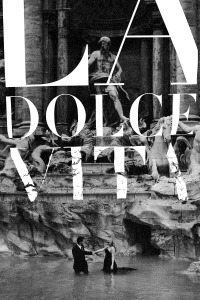
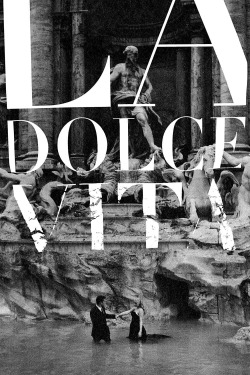
Which brings me back to La dolce vita, here is a movie loved by critics like Ebert, directors like Scorsese and movie lovers around the world. After I saw the movie for the first time, I had no reservations or agendas in saying that I loved it. Even at three hours long it is just as engrossing as a noir movie or gripping like a modern action flick, it bathes us with style and beauty, never before have I fell as deep in love with a movie as I did with La dolce vita. I felt like caressing every shot of the film, cherishing it forever.
Moving from one perfect scene to another, the audience follows seven days and nights in the life of Marcello Rubini (Marcello Mastroianni ?director Federico Fellini?s muse), a playboy newspaper editor in Italy; who uses his job to gain entry to many high profile parties, enjoying himself with the rich and famous. He has a wife at home, who loves him dearly, obsessively even, but Marcello still quakes in his boots at the thought of commitment. I guess that he is trying to find his place in the world. Sure, partying is fun; he is probably living in the best place and time (with the right people) for the constant pleasure of parties, but what happens when he is to old to enjoy himself? He is left with a wife who used to love him, but has gone sour. By the time he is fifty he will have nothing but memories.
That is where the women come into it. He makes love to, or becomes friends with seven women during the three hours we spend with him. Each stays with him long enough to get to know what he is like; I will not describe to you each woman ? I will leave that up to you, but I will describe one femme fatale. Sylvia, played by Anita Ekberg.
Her presence on the screen is nearly a maternal comfort; she is so beautiful, yet delicate. The way she speaks is so sexy and sophisticated, she seems to be above both sex and her attraction to Marcello ? from the look of it all she wants is to have fun. One of my favourite scenes in the movie (choosing one would be like making a choice between two children), is when Sylvia and Marcello attend a party chocked full of respectable guests, among them Hollywood stars and rich investors. When Sylvia?s old friend, Frankie, joins the party they all dance into the night to one of the most memorable soundtracks ever. This scene is so brilliant in its non-stop, wall-to-wall beauty; every scene from this movie is art.
We open to an entrancing yet bizarre, out of place shot of a helicopter transporting a statue of Jesus Christ across a series of high-rise buildings, where Marcello (who is following in another helicopter) stops to chat up a group of bikini clad young women on a nearby rooftop. The seventh chapter is the famous party scene ? originally described as ?an orgy? in 1960, and it finally coming to a close on the iconic beach where Marcello meets back up with a girl he met earlier on in the film. How ironic is it that over the course of the film, Marcello loses his wife but never his attitude to women ? as tools of pleasure, not simply for sex, but for great social company.
This review of La Dolce Vita (1960) was written by Camilla G on 10 Oct 2009.
La Dolce Vita has generally received very positive reviews.
Was this review helpful?