Review of La Dolce Vita (1960) by Luiserghio M — 24 Nov 2009
After World War 2 Italy, along with other countries had to rebuild. You could argue that this was reflected in the style of films being made. Italian neorealism dealt with the ordeals of the lower class, with Vittorio De Sica's "Bicycle Thief" being the most important of these. But as Italy recovered, money was everywhere and the struggles of the lower class didn't seem as interesting before.
"La Dolce Vita" rarely focuses on the lower class, this is a film about one man caught between two worlds: The upper and lower class, gossip columnist and serious writer, bachelorhood and marriage.
It's generally regarded as the Tipping Point in Federico Fellini's career: A bridge between his early neo-realism of "La Strada", "Variety Ligts" and "Nights Of Cabiria", to his later surrealist works (Which I will be more accustomed to at a later time).
"La Dolce Vita" is also the Tipping Point of the lead character, Marcelo Rubini (Played by Marcello Mastroianni). He's a gossip columnist (the word "paparazzi" came from this film) for a tabloid newspaper, drawn to the lifestyle of the decadent upper class of Rome. The film features a number of vignettes all featuring Marcelo, as he interacts with a large number and variety of characters. That's the skeletal outline of the film, but what Fellini does throughout the film is build. He builds images, ideas and messages in every storyline, creating an entire Universe that is thematically ripe with richness. Each and every scene all add up, and it all builds towards not only a wonderful conclusion, but it all builds up to a wonderful realisation within yourself when you've fully digested it all.
Take the opening sequence (a stunning one at that), a statue of Jesus Christ is carried by Helicopter over Rome, over the Vatican with people following it. Marcelo is in a supporting Helicopter covering the story, but he's distracted by a group of women, motioning to them that he wants their phone number (he can't hear them over the Helicopter noise), but they decline. It may seem rather unordinary, but the symmetry in the later sequences, the prevalent ideals and themes are unravelled all add up, each sequence illuminating the other sequences. There is a theory about the film involving the number 7: That it takes place over 7 days and 7 nights, it covers 7 hills in Rome, and the 7 deadly sins are all shown. There's another theory that it deals with a decadent lifestyle that has abandoned its traditional values, with the normal people refusing to believe in God and merely believing in celebrities. It is the strength of the screenplay and direction that either of these theories could be correct, and they could coexist with each other. "La Dolce Vita" contains a varied richness in its source material and characters that I'd love to see more often.
There are a large number of characters in this film, but it's very easy to follow who is who, but I will only mention the major players in Marcelo's life: Maddalena, an upper class woman who Marcelo seduces early on, his possessive and suicidal fiance Emma, an American actress who's also a bit of an airhead Sylvia, his upper class friend Steiner whom he idolises and his father.
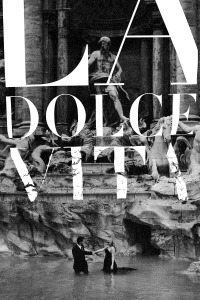
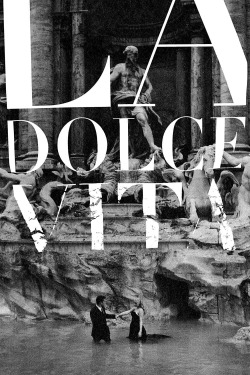
Marcelo is at a crossroads in his life, and he can't seem to see these 5 people for who they are, he merely understands his own image of them into idealised versions that he would like: He convinces himself that he loves Maddalena, but I'm not sure that she loves him. He feels suffocated by Emma, but she's the one woman who loves him the most. He feels utterly enchanted by Sylvia, chasing her all through Rome (And into the Trevi Fountain, the definitive image from this film), but she is not the ideal woman that he imagines, she's just a simpleminded actress with more beauty than brains. He sees Steiner as a future, successful version of himself, but can't see how disenchanted Steiner is with his circle of friends and his lifestyle. He wants to know and understand his father, but his father never had much time for him as a child, and as an adult not much seems to have changed.
I feel like I could write so much about "La Dolce Vita" and still not fully express what a magnificent work of art it really is. The cinematography is stunning, there are images that really will take your breath away. Nino Rota's score is sublime in its variation and simplicity. The screenplay and dialogue is chock-full of meaning, the direction is outstanding, Fellini gives us a meandering storyline that isn't too hard to follow. It is a 3 hour film, and not everyone can handle long films, but if you're in the right frame of mind when you watch it, you will fall in love with it. I didn't fully "get it" the first time I watched it, but now it has grown into one of my all-time favourites. But I have to mention the top-notch acting, Marcello Mastroianni holds the film together superbly well for 3 hours, and the rest of the supporting cast is wonderful.
I absolutely love "La Dolce Vita", it is just outstanding in every single department. "The Sweet Life" may always be out of reach for our main protagonist, but like all the best things in life, it's out there waiting to be discovered.
This review of La Dolce Vita (1960) was written by Luiserghio M on 24 Nov 2009.
La Dolce Vita has generally received very positive reviews.
Was this review helpful?