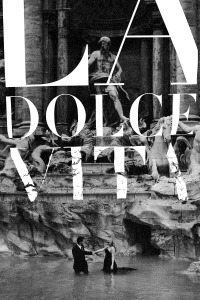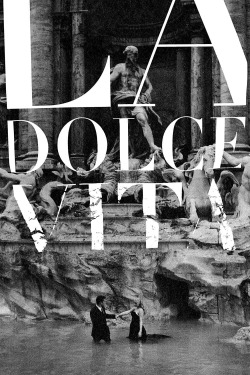
Review of La Dolce Vita (1960) by Mohamed O — 11 Jul 2011
Every brain has a beauty musing somewhere. That goes tenfold for the cock meat in a Federico Fellini film. Don't worry, the dudes are gentle -- just don't try pinning their eyes from wandering, all "Clockwork Orange"-like. Fellini doesn't make this a recipe for easy disaster. In criterion works the vein of "8 1/2", he manages to co-op glamour and gook, latter the one weirdly succumbing. Vulnerability has its stakes, though not without lasting horror. The end of "8 1/2" leaves universal romance an air moving toward the great beyond, where maybe it could find someone who understands.
That'd be every character in "La Dolce Vita" -- Italian for "the sweet love -- if humanity didn't strike first. Marcello Rubini (another knockout performance by Marcello Mastroianni, a dark comic's comic actor with feeling to spare) takes appreciation in his European sensibilities of screwing without perpetual playback. However, he takes names. As a tabloid writer he must. First to cross on that list is the visit of American dream actress Sylvia (Anita Ekberg). The job's escort to a press conference. Oh, and if Marcello doesn't brood once there. Juggling nightclub mistress Maddalena (Anouk Amee) and bored girlfrend Emma (Yvonne Furneaux), Marcello starts questioning his love for either-or. Common ground obviously being, charming that very skeptical phrase.
There's also his friend Steiner (a haunted Alain Cuny), facing the existential cons Marcello's currently run into. Only contrast is Steiner has the potential to take his depression a step further. So does Fellini. Sharp and melancholic? Check and check, though is there any other sort? "La Dolce Vita" seems to make the argument there's sadness in making culture your business, and then to bring work home with you in shape of a sideline.
Doesn't stop this gem from getting drunk in the lost. The Hollywood standard as done by Fellini sets itself up for lies. The first is blind ambition in reaching the bar; the other staged as noise to avoid crashing in true grasp of a fake fairy tale. Marcello sits someplace in the crowded empty of the crevice between, fibbing upward a pretend folklore with the wistful knowing of a scientist. Fellini's mediation "La Dolce Vita" scores the wreckage of emotion searching across the universe for an ultimate translation. It's the hopeless magic that touches deeper than skin, and gives a creative vision the penetration of refined discovery recycling itself and tripping head-over-heels.
This review of La Dolce Vita (1960) was written by Mohamed O on 11 Jul 2011.
La Dolce Vita has generally received very positive reviews.
Was this review helpful?