Review of La Cage aux Folles (1978) by Lydia F — 26 Jul 2010
Crueler Than I Think It Realizes.
There is a difference between "laughing at" and "laughing with," as your parents doubtless told you when you were young. (I had a friend whose mother told her they were laughing with her, and she just hadn't started laughing yet. Yes, she was a deeply scarred individual. Also not very bright.) Better comedies laugh with. At least usually. It isn't mockery. It isn't at anyone's expense. The people don't necessarily know that they're funny; indeed, most comedies work better when the characters aren't aware they're in one. However, the story still realizes that a good comedy is (usually) more than just a bunch of jokes strung together. It is important to care about the characters and what's happening to them. Certainly if you're going to be putting together an intelligent comedy. Even the ZAZ team knows that, and the reason modern parody movies fail, aside from the fact that they aren't funny, is that they don't. Alas, this movie fails on that point as well.
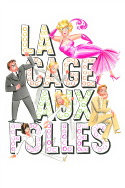
Renato Baldi (Ugo Tognazzi) owns the eponymous nightclub, one of those drag cabaret shows where the straights come to gawk at the freaks, though of course the film never thinks about it that way. Its star attraction and Renato's lover is Albin Mougeotte (Michel Serrault), or Zaza Napoli, as he is known on stage. Twenty years earlier, Renato had a son, Laurent (Rémi Laurent), with Simone Deblon (Claire Maurier), an actual woman. And now, Laurent has come home to announce that he's getting married. To a girl. Andrea Charrier (Luisa Maneri). Well, that's fine--Renato had always hoped Laurent would marry a girl, though he wishes it had taken a few more years. Only Andrea has a father, Simon (Michel Galabru), who is a member of a morality group whose leader has just died in the arms of an underage black prostitute. So Simon and Louise (Carmen Scarpitta) go to St. Tropez to meet their daughter's fiancé and his family.
In [i]The Birdcage[/i], the remake, Nathan Lane's Albert Goldman is a tiresome drama queen a lot of the time, but he is also gentle, loving, and giving. When he feels rejected by Robin Williams as Armand Goldman, his feelings are hurt, not his sense of pride or his dignity. He understands why everyone is so worried about him, but he wishes they had the strength to overcome it and stand by him. It is the fact that they don't which drives his actions. Whereas Albin is acting out of jealousy and, it seems, selfishness. He comes across as thinking of Laurent as a toy, not a son. When he calls himself pathetic, it does not come across as Albert's aura of genuine despair. He wants everyone to come and assure him that he isn't. A discussion of [i]Mame[/i] which I read once said that the difference between Lucille Ball's performance in it and Rosalind Russell's performance in [i]Auntie Mame[/i] was that Russell loved everyone while Ball wanted everyone to love her. This may be the problem here.
In both movies, however, there is the implicit agreement that the gay people are freaks who must hide their shame from the straight people. Laurent is only acceptable if he can present a normal home life--in this version, he isn't even allowed to be an only child, though that may have been as much a lie born of a string of them. In order to be rehabilitated, Renato must become a minor diplomat, a cultural attaché, because a nightclub owner is unseemly. (Oh, it can be argued that it's the gay part, but it seems likely that many nightclubs are owned by people just in it for the money!) Further, there is never any real implication that Renato might be interested in the family of the girl to marry his son. It is he who must pass inspection, with the humour coming from the fact that the father is in the morality business. While it's true that people who make a big fuss about morality generally have a pretty narrow-minded view of it, the implications are still there.
It's probably unfair to compare these two movies so directly. After all, they were separated by nearly twenty years, and a lot changed in that time. However, originals and remakes always invite comparison, and in comparison, I think the original fails. Perhaps the difference can be summed up by the crucifix. In the remake, one of the gay people brought in to help redecorate before the in-laws-to-be get there brings it in and is told not to add. In this version, Albin himself brings it in and leaves it there, hanging over the proceedings. In the remake, someone uses the old "somebody needs the wood" line on it, which is camp gay enough. In this version, though, it feels as though the person who needs the wood is Albin--so he can nail himself up there instead. No, these people have no right to force their moral values onto Renato and Albin, who after all have raised a fine boy. However, Albin isn't making things any easier on Laurent with his attitude. Maybe that's why Laurent vanishes for the second half.
This review of La Cage aux Folles (1978) was written by Lydia F on 26 Jul 2010.
La Cage aux Folles has generally received positive reviews.
Was this review helpful?